
Panel: “Height of Irony” for Complainant to Accuse Respondent of Typosquatting When Respondent Owned Properly Spelled Domain, Prescriptive[.com]
Congratulations to the Panel for its solid and clear-eyed rejection of a baseless claim. Also, congratulations to the Respondent’s counsel (an ICA Member) for his successful defense. It is a shame however, that this case even needed to be defended. As the Panel pointed out, “the Complainant knew or should have known that it could not possibly succeed”. Yet any case that meets the administrative requirements of the UDRP can be brought, regardless of its lack of merit. That can also be said of court, where meritless cases are brought with regularity. A difference perhaps though, is that courts generally do not let corporations go without qualified legal representation while the UDRP has no such prohibition, which in theory should serve as a partial gatekeeper to bad Complaints… Continue reading commentary here.
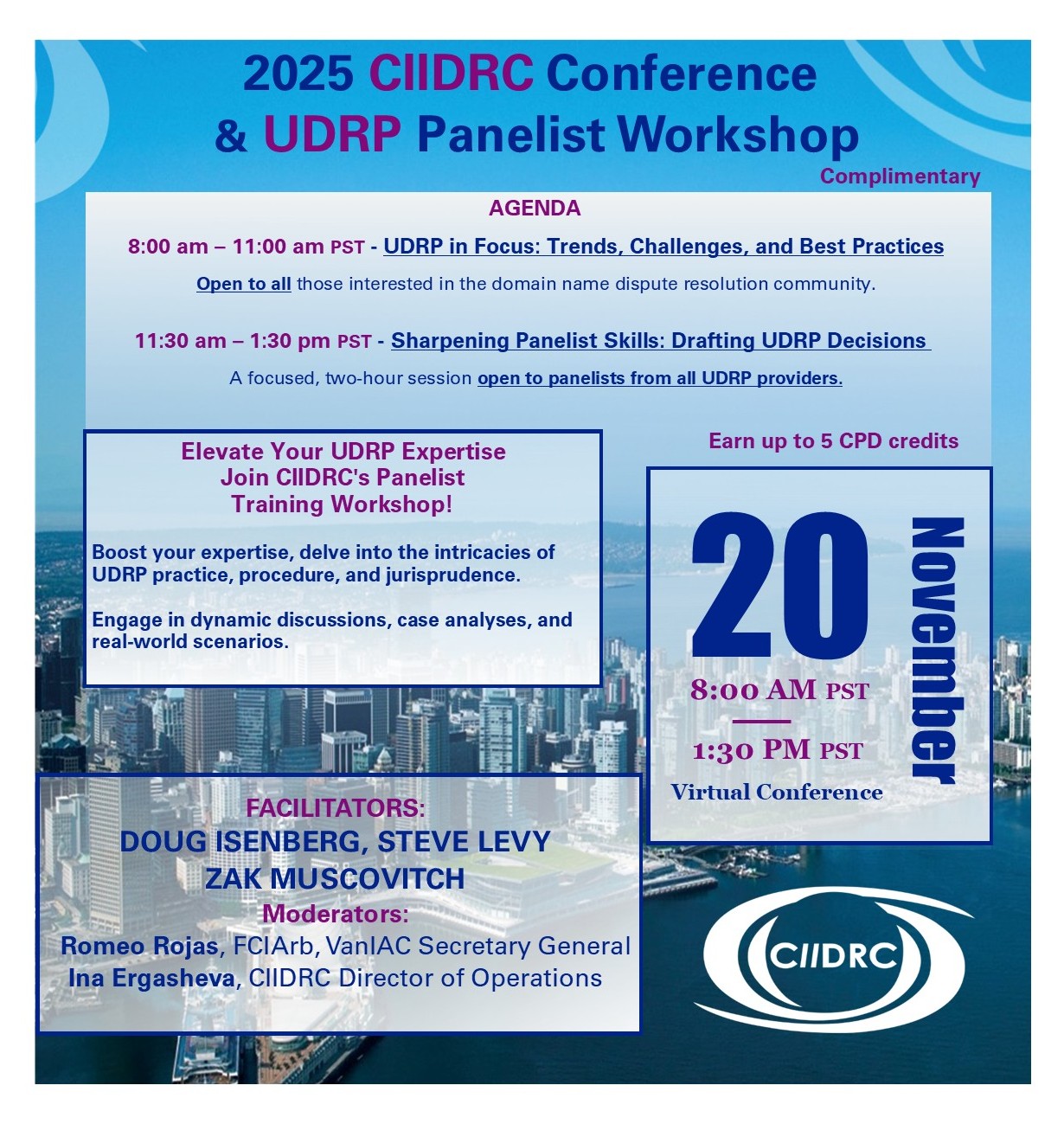 Register here
We hope you will enjoy this edition of the Digest (vol. 5.42) as we review these noteworthy recent decisions with expert commentary. (We invite guest commenters to contact us):
‣ Panel: “Height of Irony” for Complainant to Accuse Respondent of Typosquatting (prescriptive .com *with commentary)
‣ RDNH Against Complainant for the Second Time (magicmenlive .com *with commentary)
‣ Complainant Goes After Profit.[com] Domain Name (profit .com *with commentary)
‣ Panel: Self-Representation is Not an Excuse for Abusing the UDRP Process (skylinemiamicruises .com *with commentary)
‣ Are Represented Complainants Held to a Higher Standard? (münchen .tv *with commentary)
Panel: “Height of Irony” for Complainant to Accuse Respondent of Typosquatting
Prescryptive Health, Inc. v. brent oxley, NAF Claim Number: FA2508002174336
<prescriptive .com>
Panelist: Mr. Nick J. Gardner, Mr. Paul M. DeCicco and Mr. David H. Bernstein (Chair)
Brief Facts: The Complainant owns the trademark “PRESCRYPTIVE” and in addition claims common law rights in the PRESCRYPTIVE mark through continuous and exclusive use in commerce since at least 2017. The Complainant alleges that the Respondent has engaged in typo-squatting by registering a domain name that differs by only a single character from a distinctive mark and offering for sale at a premium price. Because the Respondent registered the disputed domain years after the Complainant’s PRESCRYPTIVE mark and prescryptive.com were established, it likely knew of those rights and registered the name to profit from a sale; the Respondent shows a pattern of abusive conduct. Namely in two prior domain name disputes under the Policy, the Respondent was found to have engaged in bad faith registrations and transfer of the domain name was ordered.
The Respondent contends that he lawfully purchased the disputed Domain Name as part of a portfolio of domain names based on dictionary words. The Respondent had never heard of the Complainant at the time of purchase, has never been active in the healthcare industry, and had no intent to target the Complainant in any way. Further, the term “prescriptive” is a common English word used by numerous businesses and registrants. At best, the Complainant’s PRESCRYPTIVE mark is highly suggestive of its services related to prescription medications and cannot be used to bar others from using the common word “prescriptive”. The Respondent has never used the disputed Domain Name to advertise, generate revenue, or trade on Complainant’s mark. The Respondent is not engaged in typosquatting, and is not otherwise using a typo, parody, or misspelling of Complainant’s PRESCRYPTIVE mark.
Held: The Respondent explains that he is a domain name investor and that he purchased the disputed Domain Name to include in his portfolio of domain names based on dictionary words. Such investment in descriptive and dictionary word domain names can be an acceptable business practice for purposes of the second element of the Policy. See WIPO Overview 3.0 § 2.1. Here, there is no evidence that Respondent’s registration of this disputed Domain Name was done for any illegitimate purpose, or that the claim that he registered the disputed Domain Name to be part of his portfolio of descriptive domain names is a pretext to shield illegitimate conduct. Accordingly, the Panel finds that the Complainant has failed to establish that the Respondent lacks rights or legitimate interests in the disputed Domain Name.
The Complainant further advances a series of arguments attempting to establish bad faith, but again ignores the important fact that “prescriptive” is a common dictionary word. Given this fact, Complainant’s argument that the Respondent has engaged in typosquatting is utterly without merit. Indeed, the Complainant appears to fail to see the irony in its argument, that the Respondent is typo-squatting Complainant’s misspelled version of the dictionary word “prescriptive” by having registered a domain name that spells the dictionary word accurately. The two prior disputes involving the Respondent that the Complainant relies on also do not establish registration and use in bad faith here.
The Complainant has not come forward with any evidence to show that the Respondent was aware of the Complainant and its trademark when registering the domain name, nor has it alleged any facts that would support a finding that the Respondent registered and used the domain name to target the Complainant and its mark. To the contrary, the Respondent persuasively asserts that he purchased the domain name as part of a portfolio of descriptive dictionary word domain names with no knowledge of the Complainant.
RDNH: Although the Complainant has trademark rights in the PRESCRYPTIVE mark, Complainant’s allegations as to elements two and three of the Policy are entirely without merit. The Complainant knew or should have known that it could not possibly succeed as to the second and a third element of the Policy given the fact that “prescriptive” is a common dictionary word. See WIPO Overview 3.0 § 4.16. Instead, the Complainant ignored the obvious, common meaning of “prescriptive” and the well-accepted legitimate business model of registering domain names comprised of dictionary words for resale, see WIPO Overview 3.0 § 2.1.
Further, it is the height of irony that the Complainant, who chose as its trademark a misspelling of the descriptive, dictionary word “prescriptive,” then cited that misspelling to argue that “PRESCRYPTIVE is a coined, inherently distinctive mark with no dictionary meaning” and that “the disputed Domain Name has no independent descriptive value.”
Complaint Denied (RDNH)
Complainant’s Counsel: James Markwith of Prescryptive Health, Inc., USA
Respondent’s Counsel: Stevan H. Lieberman of Greenberg & Lieberman, LLC, USA
Case Comment by ICA General Counsel: Congratulations to the Panel for its solid and clear-eyed rejection of a baseless claim. Also, congratulations to the Respondent’s counsel (an ICA Member) for his successful defense.
It is a shame however, that this case even needed to be defended. As the Panel pointed out, “the Complainant knew or should have known that it could not possibly succeed”. Yet any case that meets the administrative requirements of the UDRP can be brought, regardless of its lack of merit. That can also be said of court, where meritless cases are brought with regularity. A difference perhaps though, is that courts generally do not let corporations go without qualified legal representation while the UDRP has no such prohibition, which in theory should serve as a partial gatekeeper to bad Complaints.
Nevertheless, having a qualified lawyer represent a Complainant in a UDRP is not always an effective gatekeeper in preventing bad Complaints. As IP lawyer and Panelist, Igor Motsnyi recently wrote in a recent post about his UDRP defense of the dictionary word domain name, Profit[.com], reported below in the Digest, “In some cases it is [the] lawyer’s job to tell their clients not to file a UDRP complaint”. Yet in that case, having a lawyer represent the Complainant Corporation did not prevent the Complaint from being brought and it had to be defended against despite it being completely meritless.
RDNH Against Complainant for the Second Time
Magic Men Holdings Pty Ltd v. Myles Hass, WIPO Case No. D2025-3340
<magicmenlive .com>
Panelist: Mr. Nick J. Gardner
Brief Facts: The Complainant, incorporated on May 5, 2014, is an Australian company operating live entertainment shows under the trademark MAGIC MEN (registered on January 7, 2014). The shows appear to be adult revues (or colloquially, male strippers). It appears this trademark was originally applied for prior to the Complainant being incorporated and was subsequently assigned to the Complainant. The Respondent is an individual who owns a US-based entertainment company that has in the past operated in the US similar live performance events to those provided by the Complainant in Australia. The Respondent holds or holds trademark registrations for MAGIC MEN and MAGIC MEN LIVE in the US (registered on December 2, 2014), Canada (registered on February 2, 2017), and the United Kingdom (registered on September 13, 2016). The US trademark registration has expired and was not renewed. The disputed Domain Name was registered on February 7, 2015. It does not currently resolve to an active website.
The Complainant alleges that the Respondent has no rights or legitimate interests in the disputed Domain Name, as evidenced by the fact that the disputed Domain Name has been inactive for over 6 years and the Respondent’s U.S. trademark was cancelled for non-use. The Respondent contends that the Complainant has reached out to the Respondent directly to inquire about the sale of the domain and other digital assets. He provides various communications in this regard and adds this proves that the Complainant is well aware of the strong reputation and value that the Respondent has created with the MAGIC MEN LIVE branding, social media accounts and domain name. The Respondent further contends that this proves that the Complainant has been deliberately dishonest in this complaint in an attempt to hijack the Respondent’s domain name and all things associated with the domain’s email addresses including; email lists, business contacts and social media accounts.
Held: The key point here is that on the evidence before the Panel the Respondent was the first to use the name Magic Men in relation to male revue shows. He did so with effect from at least July 2012. The Complainant was not formed until May 2014, and its evidence is “The Complainant has continuously used the “Magic Men” brand in commerce since its incorporation”. The Respondent says the Complainant’s first public performance was not until February 6, 2016. The Panel has not seen any evidence supporting an earlier date than this, but it does not matter – even if the Complainant did start performances in May 2014 these still post-date the Respondent’s activities. On the above facts, the Respondent has established it has a legitimate interest in the disputed Domain Name.
Further the facts do not establish any bad faith registration or use. It is not bad faith to register and use a domain name in support of a business interest which predates the registration of the trademark relied upon. Further the parties operate in entirely separate geographic markets (Australia and US) with no overlap and the Complainant’s trademark rights are confined to Australia. There is no reason in those circumstances why the Respondent should not have registered the disputed Domain Name for use in connection with his pre-existing business. The Panel finds that the Respondent has a legitimate interest in the disputed Domain Name, and the Complainant has failed to establish that the disputed Domain Name was registered and is being used in bad faith.
RDNH: The Panel has clearly not been provided with the entire picture as to the relationship between the Complainant and the Respondent. They manifestly know each other, appear to be on cordial terms and have for a number of years coexisted running effectively identical businesses under virtually the same name but in geographically separate areas – Australia and the US. Use of virtually identical names may well lead to some confusion online but given the businesses are a form of live entertainment it is not likely that there will be any diversion of one business’ customers to the other business. It appears the Respondent in recent years has let his business lapse but still retains the assets of that business including the disputed Domain Name.
It appears that the Respondent was the first to start this business and clearly at some stage between 2012 and March 2023 the Complainant and the Respondent have become aware of each other and struck up some sort of contact, the details of which are not known to the Panel. The Panel does not see how the Complainant could have certified “that the information contained in this Complaint is to the best of the Complainant’s knowledge complete and accurate” without disclosing fully this background including the communications the Respondent has produced. The Panel considers that for these reasons the Complaint has been brought in bad faith and constitutes an attempt at Reverse Domain Name Hijacking.
Complaint Denied (RDNH)
Complainant’s Counsel: Internally Represented
Respondent’s Counsel: Self-represented
Case Comment by ICA General Counsel, Zak Muscovitch: The mandatory certification which is required under the UDRP Rules is something that often doesn’t get the attention that it deserves. For Complainant’s, the mandatory certification exists under Rule 3(b)(xiii) and reads in part, as follows:
“Complainant certifies that the information contained in this Complaint is to the best of Complainant’s knowledge complete and accurate, that this Complaint is not being presented for any improper purpose, such as to harass, and that the assertions in this Complaint are warranted under these Rules and under applicable law, as it now exists or as it may be extended by a good-faith and reasonable argument.”
For Respondents, the certification requirement is at Rule 5(c)(viii) and reads as follows:
“Respondent certifies that the information contained in this Response is to the best of Respondent’s knowledge complete and accurate, that this Response is not being presented for any improper purpose, such as to harass, and that the assertions in this Response are warranted under these Rules and under applicable law, as it now exists or as it may be extended by a good-faith and reasonable argument.”
As you can see, they are nearly identical, and indeed should be viewed quite seriously. Certifications carry with them in effect, a solemn attestation of the signatory. In the case of a lawyer signing a pleading, this is all the more serious an act.
Now, zealous advocacy – another important legal principle mitigates to some degree the nature of the information included in a pleading despite the certification. The certification does does not require that a party include every last damning piece of evidence that is contrary to their own interest for the sake of the certification of “completeness and accuracy”. Nor does the certification prevent a party from presenting its case in the most favourable light. Nevertheless, intentionally withholding material facts especially when exculpatory of the other party, outright lies, and the like are clearly contrary to the certification of truthfulness and completeness.
A Panel, like the one in this case, are quite right, and indeed obliged, to treat the certification requirements with the seriousness that they deserve. Where as here, a certification could not have been made in the circumstances of failing to disclose material “background including the communications the Respondent has produced” as the Panel noted, a Panel generally can and should censure a party.
For more on this interesting case, please also see, “Australian male strippers fail to strip domain from U.S. company” in DNW.com, where it is noted that this was the second case of Reverse Domain Name Hijacking by the same Complainant.
Complainant Goes After Profit.[com] Domain Name
NELOGICA SISTEMAS DE SOFTWARE LTDA. v. Rostislav Haliplii, WIPO Case No. D2025-3081
<profit .com>
Panelist: Mr. Edoardo Fano (Presiding), Mr. Rodrigo Azevedo and Mr. David E. Sorkin
Brief Facts: The Brazilian Complainant, created in 2003, provides tech solutions for the financial market, focusing mainly on the development and licensing of computer programs, and owning the following trademark registrations for PROFIT in Brazil, both registered on March 3, 2009. The Complainant also operates on the Internet, its official websites being <nelogica .com .br> and <blackarrowtrading .com>. The Respondent is Rostislav Haliplii, a UK tech entrepreneur with background in finance and one of the shareholders and director of Darqube Ltd, a company incorporated in the UK on September 9, 2019. The disputed Domain Name was acquired by the Respondent on December 27, 2022, and resolves to a website on which trading tools and market opportunities are offered. On April 29, 2025, and on May 12, 2025, the Complainant’s legal representatives sent a cease-and-desist letter and email to the Respondent, without receiving any reply.
The Complainant alleges that the disputed domain leads to a Portuguese website where the Respondent offers the same services, trading tools and market opportunities, using symbols, ads, and publications that copy the Complainant’s intellectual creations and misuse its trademarks, infringing its copyright and industrial property rights. The Complainant further alleges that the disputed Domain Name has been used by the Respondent as a financial trading scam, which cannot be considered a noncommercial or fair use. The Respondent, on the other hand, claims to have rights in respect of the disputed Domain Name, since it was registered because of its attractiveness as a common dictionary word and its relevance to the Respondent’s business for a genuine project in the field of financial analytics and trading. The Respondent further declares that he has never heard of the Complainant and only learned about the existence of the Complainant when the Complainant’s lawyers sent a cease-and-desist letter to the Respondent.
Held: The evidence in the case file as presented does not indicate that the Respondent’s aim in registering the disputed Domain Name was to profit from or exploit the Complainant’s trademark. In fact, the Panel finds that the Respondent did not register the disputed Domain Name in bad faith targeting of the Complainant or its trademark rights because the Complainant has not been able to prove that its trademark, which is not inherently distinctive for the services provided, and which also corresponds to a dictionary term and is therefore attractive as a domain name, enjoys such a reputation and in particular outside of Brazil that the Respondent would have been aware of it, and therefore targeted its reputation and goodwill in acquiring the disputed Domain Name. WIPO Overview 3.0 section 3.2.2. As regards the visual comparison between the Respondent’s website at the disputed Domain Name and the Complainant’s websites, the Panel finds that these visual similarities are rather superficial and more likely to be the result of a coincidence rather than targeting.
Complaint Denied
Complainant’s Counsel: Zavagna Gralha Advogados, Brazil
Respondent’s Counsel: Motsnyi IP Group, Serbia
Case Comment by ICA General Counsel, Zak Muscovitch: I could not help but feel frustration for the Respondent and his counsel in this case. The Complaint had no merit yet still needed to be defended against. The thing is, defending against even an obviously meritless case, still requires considerable effort and expense, especially when an extremely valuable Domain Name is at stake, like in this case.
Consider that all a Complaint need set out, are the boilerplate allegations of the UDRP and then the Respondent needs to respond to every allegation, including ones that were not actually made in the Complaint, just in case a Panel decides to go there. When a Domain Name like this one, that is likely worth millions of dollars, is challenged by a UDRP Complainant, the Respondent must marshal a comprehensive defense, pulling out all of the stops because a chance cannot be taken when so much is at stake.
Congratulations to the Respondent’s counsel who is my co-editor at UDRPPerspectives.com.
Panel: Self-Representation is Not an Excuse for Abusing the UDRP Process
Miami Skyline Cruises v. savy grant WIPO Case No. D2025-3163
<skylinemiamicruises .com>
Panelist: Mr. David H. Bernstein
Brief Facts: The Complainant, established on August 11, 2023, is engaged in the provision of sightseeing and boat tour services in Miami, Florida and uses the domain name <miamiskylinecruises .com>. The Complainant is the owner of the service mark MIAMI SKYLINE CRUISES, registered on the Supplemental Register in the USPTO (registration: December 24, 2024; claimed first use: January 1, 2023), with a disclaimer to the exclusive right to use of “cruises” apart from the mark as shown. The Complainant is also the owner of few Florida state trademark registrations for MIAMI SKYLINE CRUISES (October 1, 2024), and MIAMI SKYLINE CRUISES (October 10, 2024), with a disclaimer to the exclusive right to use of “miami” and “cruises” apart from the mark as shown.
The Respondent registered the disputed Domain Name on February 17, 2024 and it promotes sightseeing and boat tour services, including those that compete with the Complainant’s cruises. The Complainant alleges that the Respondent is offering identical sightseeing cruise services in the same geographic market and that the Respondent’s intent appears to be to mislead the public into believing the site is affiliated with the Complainant, thereby exploiting the Complainant’s goodwill and reputation. The Respondent contends that it has been using the SKYLINE trademark since 2020 and was the first to use the MIAMI SKYLINE trademark in commerce.
The Respondent also contends that Junior Dominiguez, a principal of the Complainant, is a former employee of the Respondent. While Mr. Dominiguez was employed by the Respondent, he misappropriated the SKYLINE trademark and improperly registered the mark in his name in violation of his employment agreement. The SKYLINE MIAMI domain and trademark belong to the Respondent. Through its further Reply, the Complainant addressed the arguments raised by the Respondent. In addition, the Complainant reargued the earlier contentions and introduced new evidence including evidence regarding alleged improper one star Google reviews of the Complainant’s services posted by individuals associated with the Respondent.
Held: The Complainant has not proven that it owns trademark rights in the mark MIAMI SKYLINE CRUISES. The Complainant’s service mark is registered on the USPTO Supplemental Register. Such a registration reflects a finding by the USPTO that, as of the time of the application, the mark was merely descriptive and lacked secondary meaning. The Complainant holds two Florida registrations; however, state registrations lack the deference of federal marks and typically, by themselves, do not satisfy the Policy’s “rights in a mark” standing requirement. The Complainant also claims “robust common law” trademark rights, but submits virtually no evidence to support that assertion.
The record supports a finding that the Respondent has been offering sightseeing and boat tour services through the disputed Domain Name. The Respondent is using the disputed Domain Name to advertise services that compete with those offered by the Complainant does not, on its own, show that the Respondent has no rights or legitimate interests in the disputed Domain Name.
The Respondent appears to have targeted the Complainant by registering a domain name that uses the same three words as the Complainant’s domain name, but in a different order. To the extent this has caused confusion, that is unfortunate; however, any such confusion likely arises because both Parties use merely descriptive names for their competing businesses, which do not appear to have trademark significance. While this may constitute unfair competition in a broader sense, it falls outside the scope of the Policy. Accordingly, given the descriptive nature of the names, using the disputed Domain Name is not bad faith under the Policy to target the Complainant’s trademark rights.
RDNH: The Complaint in this case was extraordinarily weak. It is true that the mere lack of success of a complaint is not, on its own, sufficient to constitute Reverse Domain Name Hijacking. WIPO Overview 3.0, section 4.16. But this Complaint was so devoid of factual support that it crosses the line from zealous advocacy to reverse domain name hijacking. The Complainant had to know, or at least should have known, that it had no prospect of success given its failure to establish relevant trademark rights under the Policy. The Panel notes the Complainant was self-represented, but that however, cannot excuse an effort to abuse the UDRP process. The UDRP is more than a quarter century old, and there are substantial educational materials available to educate participants about the requirements of a successful UDRP complaint. Even a cursory review of these materials would have educated the Complainant about the weakness of its claims.
The Respondent may well have engaged in questionable conduct outside of the UDRP proceeding, but the Complainant failed to adequately allege that conduct in its Complaint under the Policy and only raised those issues for the first time in its Reply. As noted above, because the Complainant should have raised those issues in its Complaint, the Panel has declined to consider that evidence. The Panel, therefore, finds that the Complainant’s attempt to mislead the Panel and its knowledge (or willful blindness) that it could not succeed as to the three elements support a finding of RDNH.
Complaint Denied (RDNH)
Complainant’s Counsel: Internally Represented
Respondent’s Counsel: AbrahamsenGrant L.L.C., United States
Case Comment by ICA General Counsel, Zak Muscovitch: As clearly set out by the Panelist in this case, being self-represented in a UDRP proceeding is no excuse for abusing the procedure and should not be a basis for declining to find RDNH.
If a party decides not to retain professional legal representation, as is its right under the UDRP, then it must face the consequences. Commencing a proceeding like the UDRP is a serious business. The procedure enables a Complainant to take away a Domain Name owned by someone else, by legal force. Once filed, a Respondent though not required to respond, must nonetheless respond if it wants to put its defense forward and protect its Domain Name, often at great effort and expense. Thus, Complainants who do not satisfactorily apprise themselves of the UDRP Policy and its substantial case law developed over 25 years, along with the considerable secondary educational sources, do so at their own peril. Such Complainants must not be permitted to put a Respondent to such risk, effort, and expense, willy nilly without at least the modicum of censure that comes with a finding of RDNH.
Some will point out however, that an unrepresented party “may not know better” about the intricacies of trademark rights and as such do not bear the requisite bad faith intent for a finding of RDNH. Negligence in filing an abusive Complaint is however, a basis for RDNH, and the negligence exists in the decision to proceed headlong without legal representation while failing to understand the Policy and its requirements. This is arguably akin to drunk driving. At the time of arrest, the perpetrator may not have appreciated that he had broken the law because he was drunk. But he nevertheless made the decision to drink in the first place and must bear the consequences.
There was another interesting aspect to this case involving trademark rights. The Panel noted that the Complainant “owns two Florida state registrations for the mark MIAMI SKYLINE CRUISES…however, United States state registrations are not accorded the same deference as national trademark registrations and most often do not, on their own, satisfy the “rights in a mark” standing test of the Policy”. Contrast this with Tampa Water Taxi Company LLC v. Dara Hindman / Yacht StarShip, NAF Claim Number: FA2206001999291 <tampawatertaxi .com> where a different Panel held that “the Florida trademark registry does not operate a “deposit” system with automatic granting of rights on application” and therefore “while the rights granted by a state registration may be weaker or smaller in scope than a Federal trademark registration, they remain rights….that are subject to examination and scrutiny prior to registration”. You can read my previous commentary about the TampaWaterTaxi case here.
My view on American state trademarks is that state trademarks don’t count absent demonstrating common law trademark rights. This is even more so when as here, the subject state registrations are also on the U.S. Supplemental Registry which clearly doesn’t count and is in effect, an admission of descriptiveness. As the Panel stated in the present case; “Under United States law, marks that are merely descriptive, and that have not been shown to have acquired distinctiveness, may be registered on the Supplemental Register, but that registration does not evidence trademark rights and does not confer any of the usual presumptions that accompany a mark registered on the Principal Register (such as prima facie evidence of validity, ownership, and distinctiveness). Thus, the fact of a Supplemental Registration is no evidence whatsoever that the Complainant owns trademark rights in the name MIAMI SKYLINE CRUISES”.
Are Represented Complainants Held to a Higher Standard?
München Live TV Fernsehen GmbH & Co. KG v. Christian Reise, WIPO Case No. DTV2025-0004
<münchen .tv>
Panelist: Mr. Kaya Köklü
Brief Facts: The Complainant, established on July 1, 2005, is a regional television broadcaster located in Munich, Germany, having online presence at <muenchen .tv>. The Complainant is the owner of the German Trademark for MÜNCHEN .TV (registered on August 18, 2005) as a word and figurative trademark. The Complainant’s trademark is currently subject to cancellation proceedings initiated by the Respondent due to alleged non-use. On its website, the Complainant uses the MÜNCHEN .TV, which, however, differs from its registered trademark in terms of its stylization. The disputed Domain Name was registered on December 15, 2004 and redirects Internet users to the imprint of a meanwhile claimed terminated consulting and investment company.
The Complainant alleges that the Respondent registered and is using the disputed Domain Name in bad faith, which in view of the Complainant shall be indicated by an alleged offer of the Respondent in 2023/2024 to sell the disputed Domain Name to the Complainant to a price of EUR 30,000 to 40,000. The German Respondent contends that he registered the Domain Name in 2004 intending to build an online platform about Munich companies, including videos. He still plans to use it for business models showcasing Munich businesses and events online. The Respondent further contends that there has been a telephone conversation with the Complainant in 2023/2024, but asserts that it was the Complainant who offered to acquire the disputed Domain Name for EUR 500.
Held: The evidence in the case file as presented does not indicate that the Respondent’s aim in registering the disputed Domain Name was to profit from or exploit the Complainant’s trademark. The Panel finds that the Respondent did not register the disputed Domain Name in bad faith targeting of the Complainant or its trademark rights since the Complainant had no trademark rights, let alone had even been established at the time when the Respondent registered the disputed Domain Name. WIPO Overview 3.0, section 3.8.1. Furthermore, the case file does not contain any evidence or even substantiated assertion provided by the Complainant that the disputed Domain Name could have been registered by the Respondent in anticipation of the Complainant’s intended trademark right registration for MÜNCHEN .TV.
Even if the Complainant’s assertion that the Respondent offered to transfer the disputed Domain Name for more than EUR 30,000 in 2023/2024 were true, this would not indicate that the disputed Domain Name was registered in bad faith back in 2004. Consequently, taking into account all the facts of the case, the Panel does not see any evidence of bad faith by the Respondent in the registration of the disputed Domain Name.
RDNH: In this case, the disputed Domain Name was registered before the Complainant’s trademark was registered and before the Complainant was even established. Also, the Complainant appeared to approach the Respondent already in 2015 with a cease-and-desist letter, and that the Parties discussed transferring the disputed Domain Name again in 2023/2024. This indicates that the Complainant has already tried to acquire the disputed Domain Name in the past. In the view of the Panel, this suggests that the Complainant must have been informed about the overall legal situation and the lack of requirements for claiming a transfer of the disputed Domain Name according to the Policy, yet still proceeded with the current Complaint. In this regard, the Panel also notes that the Complainant is represented by an external representative in this proceeding and agrees with other panels that have held that a represented complainant should be held to a higher standard. (WIPO Overview 3.0, section 4.16.)
As a result, the Panel finds that the Complainant should have known that it could not establish at least one of the essential elements under the Policy. Under these circumstances, the Panel shall accept the Respondent’s request and find that the Complaint constitutes an attempt at RDNH.
Complaint Denied (RDNH)
Complainant’s Counsel: y LS-IP Loth & Spuhler Intellectual Property Law Partnerschaft von Rechtsanwälte mbB, Germany
Respondent’s Counsel: RAUE PartmbB, Germany
Case Comment by ICA General Counsel, Zak Muscovitch: As the Panel rightly pointed out, “panels have held that a represented complainant should be held to a higher standard”. What does this mean in relation to unrepresented complainants? If a complainant does not retain counsel, can they expect to held to a lower standard when it comes to RDNH? As we saw above in the skylinemiamicruises case, being unrepresented does not excuse a complainant from RDNH. Perhaps the best way of looking at this apparent contradiction, is that regardless of whether a party is represented or not, they will not be excused from RDNH where warranted, and in particular, an unrepresented party has an obligation to apprise themselves of the UDRP if they choose to engage the procedure and not to retain counsel. Where a party is represented by counsel however, that standard is “even higher”. i.e. the standard is not lowered for unrepresented parties, but rather for represented parties, is increased from the already stringent standard for unrepresented parties, to an even higher one.
About the Editor:
 Ankur Raheja is the Editor-in-Chief of the ICA’s new weekly UDRP Case Summary service. Ankur has practiced law in India since 2005 and has been practicing domain name law for over ten years, representing clients from all over the world in UDRP proceedings. He is the founder of Cylaw Solutions.
He is an accredited panelist with ADNDRC (Hong Kong) and MFSD (Italy). Previously, Ankur worked as an Arbitrator/Panelist with .IN Registry for six years. In a advisory capacity, he has worked with NIXI/.IN Registry and Net4 India’s resolution professional.