
Business Divorce Dressed Up as Cybersquatting Ends in RDNH Finding
The Panel denied the Complaint concerning <chainbridgeestates.com> and issued a strong finding of Reverse Domain Name Hijacking (“RDNH”), emphasizing that the UDRP is designed to address clear cases of cybersquatting – not internal business disputes over control of a domain name associated with a jointly developed project. The Panel was unpersuaded on multiple levels, and its decision reflects a careful adherence to established UDRP principles in the face of what was fundamentally a business control dispute rather than a genuine cybersquatting case. Continue reading commentary here.

Join us for this year’s Levine Lecture featuring Nick Gardner, who will present: “26 Years of Deciding UDRP Cases—What Does a Panelist Actually Do, and Why? How Will AI Change This?“ A veteran of UDRP practice, Nick’s experience ranges from early landmark English court cases to presiding over hundreds of disputes as a leading WIPO and Nominet panelist. The session will include an introduction by Zak Muscovitch, opening remarks by Tony Willoughby, and closing remarks from Gerald Levine.
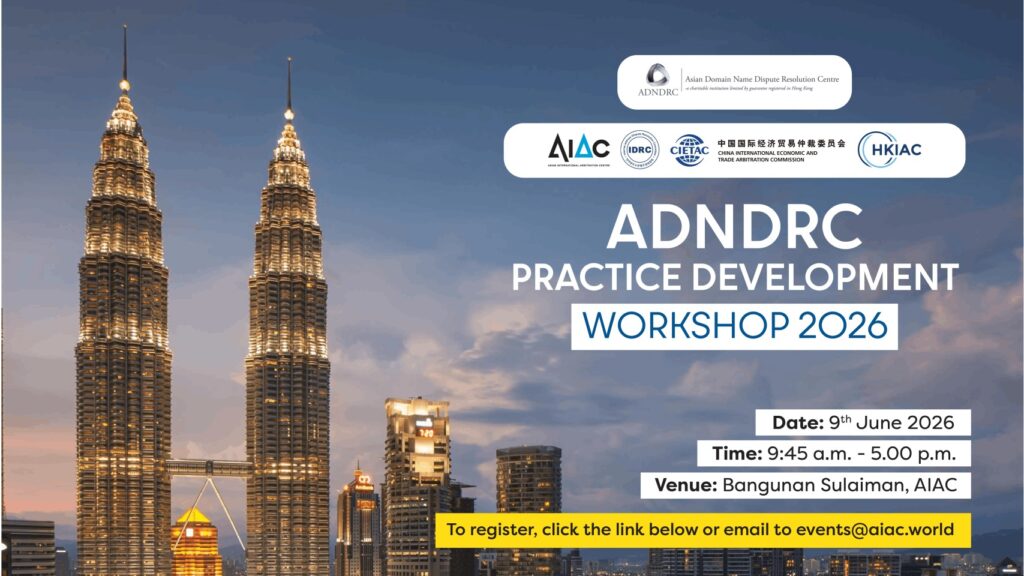
The AIAC is pleased to host the ADNDRC Practice Development Workshop 2026, bringing together ADNDRC panellists, providers, practitioners and members of the legal community in Kuala Lumpur on 9 June 2026.
Now in its 5th edition, the Workshop will feature discussions on domain strategies for brand protection, UDRP proceedings and developments in domain name dispute resolution practice, including practitioner and case administration perspectives.
Designed both as a refresher for panellists and an introduction for new participants, the programme aims to support continued engagement and capacity-building within the domain name dispute resolution community.
More information – bit.ly/ADNDRC_PDW_2026
We hope you will enjoy this edition of the Digest (vol. 6.20) as we review these noteworthy recent decisions with expert commentary. (We invite guest commenters to contact us):
‣ Business Divorce Dressed Up as Cybersquatting Ends in RDNH Finding (chainbridgeestates.com *with commentary)
‣ Independent Coinage and Crowded Namespace Defeat Complaint (creart.ai *with commentary)
‣ Panel Rejects Expansive “Nominative Fair Use” Theory for Attorney Advertising Domains (injureduber.com and more *with commentary)
‣ Panel Rejects Attempt to Revive Discredited “Octogen” Theory in Failed UDRP Claim (accs-market.com *with commentary)
‣ Panel Suggests AI-Generated UDRP Defense Helped Sink Respondent’s Case (temu.ai *with commentary)
Business Divorce Dressed Up as Cybersquatting Ends in RDNH Finding
REINSCH, INC., E. G. and TRI-STATE COMMUNITIES LLC v. Tony Rivera, Forum Claim No. FA2604002214022
<chainbridgeestates.com>
Panelists: Mr. Alan L. Limbury, Mr. Ho-Hyun Nahm and Mr. Nicholas J.T. Smith (Chair)
Brief Facts: The Complainant asserts common law rights in the CHAIN BRIDGE ESTATES mark based on longstanding and continuous use in commerce in connection with a luxury retirement community in Northern Virginia. In 2018, through an LLC, the Respondent, a land developer, purchased land to develop as a luxury retirement community, now known as Chain Bridge Estates. He received approval for development from the local government in May 2021. To assist with the financing of this development, the Respondent formed Tri-State Communities LLC, which was co-owned on a 16.7%–83% split with REINSCH, INC., E. G. The Respondent was the manager of Tri-State Communities LLC from its inception until November 2025. On October 26, 2021, the Respondent registered the disputed domain name. At all times, the Domain Name has been used in connection with the Chain Bridge Estates development and the Complainant has administrative access to the website.
The Complainant alleges that the Respondent does not have rights or legitimate interests in the disputed Domain Name. Prior to March 11, 2026, third party Bloomsbury Living, an entity managed by the Respondent, held a minority interest in Complainant – Tri-State Communities LLC; however, from that date, the Complainant, REINSCH, INC., E. G., acquired 100% of Bloomsbury’s equity, thus becoming the sole owner of all rights in the Chain Bridge Estates project and the sole owner of all rights to the Domain Name. The Respondent registered and used the disputed Domain Name in bad faith. While the Complainant currently holds limited administrative access to the website content associated with the Domain Name, the Respondent, without authorization, retains exclusive control over the Domain Name, in circumstances where it has no legitimate basis to control this registration.
The Respondent contends that the Complainant does not hold a registration for the CHAIN BRIDGE ESTATES mark and has not satisfied its burden to show common law rights in the mark… the Complainant provided no evidence of use duration or extent, sales or customer data, advertising or marketing reach, media coverage or industry recognition, or consumer perception standard proof of common-law rights. The Respondent further contends that the Complainant has failed to show that the Respondent lacks rights or legitimate interests in the Domain Name or that the Domain Name was registered in bad faith; rather, it was registered by the Respondent in his role as Manager of Tri‑State Communities LLC in connection with the development and operation of the Chain Bridges Estate project. The Respondent also notes that the date of registration (October 26, 2021) was well before any trademark rights accrued in the CHAIN BRIDGE ESTATES mark.
Held: The Complainant does not provide sufficient evidence to support its contention that it has common law rights in the CHAIN BRIDGE ESTATES mark. It states that it has used the mark since 2021 but its evidence consists of an Instagram page with 708 followers, a Facebook page with 51 followers, and the website at the Domain Name. The Response contains evidence that Complainant’s social media accounts were only established in 2024. Based on the material provided, the Panel is not satisfied that the CHAIN BRIDGE ESTATES mark has achieved significance as a source identifier; the mere fact that an entity has a modest social media following, without more, does not establish common law rights in a mark. Therefore, the Panel finds that the Complainant has failed to establish common law rights in the mark per Policy ¶ 4(a)(i).
The Respondent gives uncontested evidence that he registered the Domain Name on October 26, 2021, in his capacity as manager of the Tri-State Communities LLC in order to promote the Chain Bridge Estates development that he was involved in on a day-to-day basis, which the Complainant does not dispute. Rather, the Complainant argues Respondent’s renewal or other administrative changes to the Domain Name, amount to a bad-faith re-registration. This position is unsupported by case law under the Policy, and the Complainant, who is legally represented, should well be aware of this fact. The Panel notes that even if it accepted the Complainant’s claim that the Respondent is hijacking or holding the Domain Name hostage, that concerns only use of the Domain Name, not registration, hence the Complainant has not proven bad-faith registration and use under Policy ¶ 4(a)(iii).
The Policy is designed to deal with clear cases of cybersquatting. The Panel acknowledges that the Respondent may no longer have any connection to the Chain Bridge Estates project, and the Panel wishes to make it clear that other remedies may be available to the Complainant in a different forum, and that nothing in this decision should be understood as providing a definitive finding on the respective rights of the parties, beyond the narrow question determined under this proceeding.
RDNH: The Panel considers that, at a minimum, items (i), (iii), and (v) of WIPO Overview 3.1 at ¶ 4.16 are present in this proceeding. The Complaint is brought in circumstances where the only evidence in support of trademark rights in the CHAIN BRIDGE ESTATES mark appears to be a minor social media presence. Moreover, the Complainant is legally represented by sophisticated counsel that have cited 15 UDRP cases in support of its various contentions. Notwithstanding this, its submissions rely on the theory that renewal of a domain name amounts to re-registration for the purposes of finding bad faith registration.
While the Panel accepts that the Complaint does refer to a connection between the Respondent and Tri-State Communities LLC the Complaint omits significant material relevant to this dispute. The evidence was only addressed by the Complainant in its supplemental filing, following the Response which outlined the historical relationship between the parties. The Complainant certified that the information contained in its Complaint was to the best of Complainant’s knowledge complete and accurate. The Panel finds that this was not the case.
Complaint Denied (RDNH)
Complainant’s Counsel: Kandis M. Koustenis, Bean Kinney & Korman, PC, USA Respondent’s Counsel: Jeffrey J. Neumann, JJN Solutions, LLC, USA
Commentary Edited and Approved by ICA General Counsel, Zak Muscovitch:
The Panel denied the Complaint concerning <chainbridgeestates.com> and issued a strong finding of Reverse Domain Name Hijacking (“RDNH”), emphasizing that the UDRP is designed to address clear cases of cybersquatting – not internal business disputes over control of a domain name associated with a jointly developed project.
The Panel was unpersuaded on multiple levels, and its decision reflects a careful adherence to established UDRP principles in the face of what was fundamentally a business control dispute rather than a genuine cybersquatting case.
First, the Panel found that the Complainant had failed to establish common law trademark rights in CHAIN BRIDGE ESTATES. The evidentiary record consisted primarily of modest social media activity and the project website itself. The Panel noted that the social media accounts had only been established in 2024 and held that “the mere fact that an entity has a modest social media following, without more, does not establish common law rights in a mark.”
The decision serves as a useful reminder that conclusory assertions of common law rights – particularly in connection with real estate developments, project names, or internal venture branding – require meaningful supporting evidence demonstrating acquired distinctiveness and consumer recognition.
More significantly, however, the case turned on the nature of the dispute itself.
The Panel accepted the Respondent’s uncontested evidence that the domain name had originally been registered in connection with the development project while the Respondent was acting in his managerial role within the venture. Respondent’s counsel effectively framed the dispute for what it was: a falling out between former business associates concerning control over a business asset, rather than cybersquatting within the meaning of the Policy.
As noted in Section 0.1 of UDRPPerspectives.org, the UDRP is designed to address cybersquatting rather than broader business or contractual disputes. The present case illustrates precisely that distinction.
The Complaint attempted to recast the dispute as bad faith registration by advancing the theory that subsequent renewals or continued control of the domain name constituted bad faith “re-registration”. The Panel properly rejected that argument, observing that sophisticated counsel “should well be aware” that renewal of a domain name does not ordinarily constitute a new registration for purposes of the UDRP.
The decision also reflects an important practical limitation on nominative fair use arguments in the domain name context. A domain name incorporating a famous mark as its dominant element may more readily suggest affiliation or sponsorship than an ordinary textual reference to the mark appearing within website content.
The Panel also drew an important distinction between alleged wrongful retention of a domain name and bad faith registration under Policy ¶ 4(a)(iii). Even assuming the Respondent were improperly withholding control of the domain name, the Panel correctly observed that such allegations concern post-registration conduct rather than the required showing of bad faith registration.
The Panel’s decision to enter a finding of RDNH was well-supported on the record and reflected both the Panel’s careful application of established UDRP principles and the Respondent’s effective presentation of the factual and procedural deficiencies underlying the Complaint. The Panel found that the Complaint omitted significant material facts concerning the historical relationship between the parties and criticized the legally unsupported reliance on the “renewal equals re-registration” theory despite the Complainant being represented by experienced counsel familiar with UDRP jurisprudence.
Independent Coinage and Crowded Namespace Defeat Complaint
Waitos AI, S.L. v. Jie Chen, Newmotors LLC, WIPO Case No. DAI2026-0025
<creart.ai>
Panelist: Mr. Jeremy Speres
Brief Facts: The Complaint gives little business information beyond that the Complainant offers an AI image-generation app for end users under the CREART mark. The Complainant filed several CREART (device) trademark applications, including the earliest EU trademark (applied on Aug. 5, 2025), registered on Dec. 21, 2025, and a U.S. application filed on Sept. 8, 2025, which is pending. The Complainant also owns International registration, designated to China among others; it registered Oct 15, 2025, but designated protections, including China’s, remain ungranted. The disputed Domain Name was registered on November 21, 2025, and resolves to a website offering AI design services to e-commerce merchants. The website is entitled “Creart – The AI Agent Built for E-commerce” and features various descriptions of the service.
The Complainant alleges that the disputed Domain Name was registered and is being used in bad faith in order to take advantage of confusion with the Complainant’s mark by adopting an identical name and using it for closely related services for the Respondent’s commercial gain. The Respondent contends that it registered the disputed Domain Name independently, as a combination of “create” and “art,” a descriptive term well suited to its AI-powered design platform, and not to target the Complainant. The Respondent also provides GitHub evidence showing that it had begun development of its application as early as November 2025, which was prior to receiving the Complainant’s cease-and-desist correspondence in February 2026 and prior to the filing of the Complaint.
Held: None of the Complainant’s trademarks were registered when the disputed Domain Name was registered. Panels generally do not find bad faith where a domain name predates the complainant’s trademark rights (WIPO Overview 3.1, section 3.8.1). While exceptions exist for cases of intent to exploit nascent trademark rights (section 3.8.2), the record here does not support such a finding. The Complainant claims to have launched its CREART application in 2023 and claims that it has acquired “recognition” in the market with a “strong presence” in the AI sector. However, no evidence is provided in support of these contentions, and no evidence showing any use of the mark by the Complainant is provided at all. The Respondent’s offering is related to the Complainant’s in the sense that it also offers AI image generation capabilities to some degree, but it does not appear to be directly competitive with the Complainant, and it is offered via different channels.
The Respondent’s contention that it devised “CREART” independently, as a portmanteau of “create” and “art”, is plausible. The two dictionary words comprising the portmanteau are easily recognizable, and the portmanteau’s descriptive nature in relation to the Respondent’s offering is clear. In the absence of any clear evidence of targeting, the Complainant’s case is essentially based on the Respondent using the same name in a related (but not directly competitive) field. If the Complainant were to have shown that its mark enjoyed a reputation and/or unregistered trademark rights prior to the domain registration, then it might have been appropriate to infer targeting or at least that the Respondent should have known that the disputed Domain Name is identical to the Complainant’s mark. However, there is no evidence of reputation or that the Respondent knew or should have known about the Complainant when registering the Domain Name.
In the circumstances, especially in the crowded AI application naming space, is plausible, and there is insufficient evidence in the record, on balance of probabilities, indicating that this explanation was not in fact what the Respondent had in mind when registering and using the disputed Domain Name.
Complaint Denied
Complainant’s Counsel: Falcón Abogados, Spain
Respondent’s Counsel: Self-represented
Commentary Edited and Approved by ICA General Counsel, Zak Muscovitch:
This is a careful and disciplined decision that should serve as a useful reference point as similar disputes proliferate in the rapidly expanding AI applications space. The temporal mismatch alone disposed of the bad faith analysis: none of the Complainant’s trademarks were registered when the disputed Domain Name was registered, and as the Panelist correctly noted with reference to WIPO Overview 3.1, section 3.8.1, panels generally do not find bad faith in such circumstances (see also UDRPPerspectives.org §3.2 (Trademark Must Predate Domain Name Registration)). This principle is foundational and self-evidently logical: a respondent cannot have registered a domain name with intent to target trademark rights that did not yet exist.
The narrow exception at section 3.8.2 for demonstrable targeting of nascent rights requires actual evidence, and here there was none. The Complainant offered no evidence of reputation, no evidence of use of the mark, and no evidence that the Respondent had or should have had any awareness of the Complainant at the time of registration. As discussed in UDRPPerspectives.org §3.3 (Targeting) and §3.10 (Reputation), bare assertions of “recognition” or a “strong presence” cannot ground an inference of targeting; the Policy demands proof, not adjectives. The Panelist was right to confine the analysis to the record actually before it, rather than supplying the evidentiary case the Complainant failed to make.
Equally welcome is the Panelist’s treatment of the Respondent’s plausible explanation that “CREART” is a transparent portmanteau of “create” and “art,” well-suited to a descriptive use in connection with an AI-powered design platform, corroborated by contemporaneous GitHub evidence of development beginning in November 2025. Where a respondent comes forward with a coherent explanation supported by contemporaneous third-party records, that evidence is entitled to meaningful weight rather than reflexive dismissal as self-serving. In the crowded AI naming space, where branding around terms like “create,” “art,” and “gen” has exploded, the mere fact that two parties have independently arrived at similar descriptive names cannot, without more, support an inference of targeting.
The Panelist’s measured handling of the parties’ adjacent-but-not-directly-competitive offerings is also instructive. While both parties offer AI image generation capabilities to some degree, they reach different markets through different channels, and mere thematic overlap is not a proxy for targeting in the absence of evidence connecting the Respondent’s conduct to the Complainant specifically. The Policy was never intended to grant exclusivity over plausibly descriptive terms in crowded markets, particularly to entrants whose own trademark rights post-date the disputed registration.
Ultimately, this is a clear application of the principle that bad faith registration cannot be conjured out of a record that is silent on whether the Respondent knew, or had any reason to know, of the Complainant when it registered the disputed Domain Name. As reflected in UDRPPerspectives.org §0.1 (Scope of the Policy), the UDRP is a narrow remedy that depends upon the Complainant meeting its evidentiary burden. This decision shows how the analysis should be approached as similar disputes continue to arrive.
Panel Rejects Expansive “Nominative Fair Use” Theory for Attorney Advertising Domains
Uber Technologies, Inc. v. Justin Drazin, WIPO Case No. D2026-0744
<injureduber.com> and six more related domain names
Panelist: Mr. William F. Hamilton
Brief Facts: The Complainant, founded in 2009, operates a global technology platform connecting consumers with independent drivers for ridesharing services, as well as meal delivery and other services. The Complainant is the owner of more than 1,700 trademark registrations for the widely recognized UBER mark in at least 91 jurisdictions, the earliest of which was registered on August 31, 2010. The Respondent is a licensed attorney and principal of Drazin & Warshaw P.C., a personal injury law firm based in New Jersey with more than 75 years of practice. The Respondent registered the seven disputed Domain Names at various times between March 7, 2017, and February 6, 2025, and they mainly fall into two functional categories. The first category comprises three disputed Domain Names used in connection with the Respondent’s law firm, while the second category comprises four domain names each of which resolves to a website consisting primarily of blog-style posts and monetized pay-per-click (“PPC”) links.
In early February 2026, the Respondent emailed the Complainant’s Senior Director of IP at Uber, stating that he had received an offer from a third-party national personal injury law firm to buy the disputed Domain Names and asking whether Uber was interested. The Senior Director declined. On February 9, 2026, the Respondent sent a term sheet offering to sell the domains to Uber for USD $4.8 million, calling them “valuable operating assets” and stating that he wanted to avoid the risk of the competing offer. The Complainant alleges that, because the disputed Domain Names are either redirected to or used in connection with the Respondent’s law firm website, or resolve to PPC or splog pages, such use cannot constitute a bona fide offering of goods or services. The Complainant further alleges that the Respondent’s registration of seven domain names incorporating the UBER mark constitutes a pattern of bad faith conduct under paragraph 4(b)(ii) of the Policy.
The Respondent contends that the disputed Domain Names are used in connection with a bona fide offering of legal services under paragraph 4(c)(i) of the Policy and further its use of the disputed Domain Names is protected by the doctrine of nominative fair use. The Respondent further contends that the disputed Domain Names were registered to develop informational websites and to attract clients injured while using Complainant’s services, which it asserts constitutes legitimate business activity and not bad faith registration or use. Finally, regarding the offer to sell the disputed Domain Names in millions, the Respondent argues the Complainant materially mischaracterized those communications. The Respondent adds that the Complainant’s representative solicited a formal offer, that the price proposed reflected the Respondent’s substantial investment in developing the digital platforms associated with the disputed Domain Names.
Held: As regards the first category of Domain Names, the principal framework for evaluating this issue is the Oki Data test, which the Respondent fails on multiple grounds. The domains <injureduber .com> and <njuberlawsuit .com> redirect to the Drazin & Warshaw P.C. homepage and thus do not reflect the specific subjects their names suggest. The domain <uberhurtme.com> hosts a site branded “UberHurtMe” focused on injury claims related to Complainant’s services and does not impersonate the Complainant. However, it fails the Oki Data test: it does not clearly disclose the Respondent’s lack of relationship with the Complainant, and it prominently and repeatedly uses the UBER mark in a way that risks confusing the site’s source or sponsorship. The Panel further notes that the Respondent’s use of the law firm’s disputed Domain Names is commercial in nature, directed at acquiring paying clients for legal representation. This forecloses any argument that the use qualifies as legitimate noncommercial or fair use under paragraph 4(c)(iii) of the Policy. WIPO Overview 3.1, section 2.5.3.
The Respondent also argues that its use of the disputed Domain Names is protected by the doctrine of nominative fair use; however, the nominative fair use doctrine, as developed in United States law and as recognized in UDRP jurisprudence, has significant limiting principles that are fatal to the Respondent’s argument in this case. The first limiting principle is necessity: the doctrine covers only uses genuinely needed to identify the subject, not those merely convenient or commercially useful. The second principle is context: nominative fair use arose mainly for inline text references to a mark within sentences or articles. Third, allowing nominative fair use for domain names that incorporate famous marks whenever a registrant claims related or oppositional services would significantly weaken the Policy’s protection of famous marks. The remaining four disputed Domain Names resolve to websites consisting primarily of blog-style posts and monetized PPC links. Such PPC pages cannot establish rights or legitimate interests in a Domain Name, incorporating a third party’s trademark.
The UBER mark is extremely famous, creating a presumption that the registrant knew of the mark; the Respondent’s own statements confirm that the domain names were registered because of their association with UBER. The seven similar registrations over eight years show a pattern aimed at exploiting the mark; three law‑firm domains used the mark to attract clients and caused likely confusion or free‑riding; four domains hosted monetized PPC pages directing personal‑injury leads to the Respondent’s business. Pre‑litigation emails show the Respondent initiated contact and later proposed selling the seven domains for USD $4.8 million. That was an unsolicited offer; the Respondent’s attempt to recast it as solicited is rejected. The proposed price vastly exceeded typical registration costs and the Respondent produced no invoices or evidence of substantive investments to justify that price. The price, therefore, reflects the trademark value of UBER, supporting bad faith under paragraph 4(b)(i).
Transfer
Complainant’s Counsel: The GigaLaw Firm, Douglas M. Isenberg, Attorney at Law, LLC, United States
Respondent’s Counsel: Cowan, DeBaets, Abrahams & Sheppard, LLP, United States
Commentary Edited and Approved by ICA General Counsel, Zak Muscovitch:
The Panel ordered transfer of <injureduber.com> and six related domain names, finding that the Respondent law firm’s use of the famous UBER mark in attorney advertising crossed the line from referential use into impermissible trademark exploitation.
The decision is notable, but not entirely free from difficulty, because it applies the Oki Data framework in a manner that may strike some observers as unusually strict in a context that is not a conventional reseller, distributor, or service-provider relationship. The Respondent’s core position was that the domains were nominative: they identified the subject of the legal services being offered, namely claims by persons injured in connection with Uber-related services. That argument was not frivolous. Lawyers commonly need to refer to adverse parties, products, or platforms in describing the subject matter of their practices, and a domain such as <injureduber.com> arguably communicates “injured in connection with Uber” rather than “an official Uber website.”
The Panel’s response – that nominative fair use is limited by a principle of necessity – was analytically sound, though the principle cannot reasonably be applied so strictly that virtually no trademark-referencing domain name could qualify. The better question is whether the Respondent chose the mark-incorporating domain because of its trademark value rather than its descriptive value. A lawyer advertising for clients injured in connection with a particular platform may well have legitimate reasons to use a campaign-style domain name identifying the subject matter of the representation. The more significant issue here was not the mere existence of such domains, but the Respondent’s broader surrounding conduct and implementation choices.
As noted in UDRPPerspectives.org, section 2.3, the Oki Data framework is “best used as a guide and adapted as necessary by Panels” rather than applied as a rigid checklist. More recent panels have adopted a holistic approach examining the overall composition of the domain name, website content, surrounding circumstances, and whether the use genuinely suggests affiliation with the complainant. That broader approach is particularly relevant in attorney advertising and referential-use disputes.
Complainant’s counsel ultimately prevailed in what was, from a UDRP perspective, a challenging and relatively nuanced case. The Complaint required persuading the Panel that the Respondent’s conduct crossed the line from potentially legitimate referential use into impermissible trademark targeting notwithstanding the existence of a facially plausible nominative fair use argument. The record assembled by Complainant’s counsel permitted the Panel to analyze the dispute across multiple domain names, usage patterns, and surrounding circumstances rather than viewing any single domain name in isolation.
The Respondent’s position nevertheless became substantially more difficult when viewed across the portfolio as a whole and in light of the manner in which several of the domains were implemented. Some aspects of the Panel’s reasoning in this regard may reasonably be open to debate. Redirecting a campaign-style domain name to a law firm’s primary website is not inherently inconsistent with attorney advertising practices, nor is the absence of a disclaimer necessarily dispositive under a holistic Oki Data analysis. Nevertheless, the Panel appears to have viewed the cumulative combination of seven UBER-formative domain names, the UBER-branded vanity telephone number, and the overall commercial presentation as substantially undermining the Respondent’s claim that the domains were being used solely for good-faith referential purposes.
The case also raises a broader question concerning the proper scope of the UDRP. Determining the boundaries of nominative fair use in the context of attorney advertising may require a nuanced factual and legal analysis not always ideally suited to the streamlined structure of UDRP proceedings. Here, the Panel ultimately concluded that the Respondent had crossed the line into impermissible trademark targeting. Nevertheless, one could reasonably argue that the existence of a credible nominative fair use argument might, in some cases, warrant deferral to the courts rather than resolution under the Policy itself.
Panel Rejects Attempt to Revive Discredited “Octogen” Theory in Failed UDRP Claim
Carfax Commerce lnc. v. Matvey Furash, WIPO Case No. D2026-0627
<accs-market.com>
Panelists: Mr. Matthew Kennedy (Presiding), Ms. Olga Zalomiy and Mr. Jeffrey Neuman
Brief Facts: The Complainant, incorporated on June 1, 2023 in the Seychelles, holds the trademark registrations for ACCSMARKET, that includes International registration (February 11, 2025) and Russian registration (September 1, 2025). At the time the Complaint was filed, the Complainant’s application for a United States trademark for ACCSMARKET was still pending. The Complainant operates at <accsmarket .com>, an online marketplace for social media accounts. The Respondent is the owner of a company named Metaswap LP (UK) and has operated a website in Russian in connection with the domain name <trade-groups .ru> for trading social media groups, pages, and channels under the name “Trade Groups” since 2014. The Respondent registered the disputed Domain Name on March 1, 2019. It formerly resolved to an English-language website titled with the disputed Domain Name and the subtitle “Quick & Secure Social Media Marketplace,” and, at the time of this Decision, the disputed Domain Name redirects to the domain name <dealbaron .com>.
The Complainant alleges that it discovered that traffic to its website had dropped due to the presence of the disputed Domain Name (registered two years later than the Complainant’s domain name), as consumers were confusing the two Internet services. This use indicates the Respondent’s intent to redirect Internet traffic to its own website, misleadingly misrepresenting the relationship between its website and the Complainant, which cannot be considered a bona fide offering of goods or services or legitimate non-commercial or fair use. Further, several prior UDRP panels have interpreted the statement in paragraph 2(d) of the Policy, made on registration and renewal of a domain name, as an ongoing warranty that the domain name will not be used in bad faith.
The Respondent contends that the Complainant sells bulk social media accounts, operating under the highly descriptive or generic name “Accs Market”, which is understood in the industry to mean accounts market. The Respondent also uses the abbreviation “accs” and the word “market” in a purely descriptive or generic sense to showcase his own legitimate business, which is an actual marketplace where creators and owners list individual accounts for sale. These are different business models. The registration of generic or highly descriptive domain names ipso facto establishes the Respondent’s legitimate interest, provided the disputed Domain Name was not registered with a trademark in mind.
Held: The Complainant did not obtain its earliest ACCSMARKET trademark registration until 2025, six years after the registration of the disputed Domain Name. Where a respondent registers a domain name before the complainant’s trademark rights accrue, panels will not normally find bad faith on the part of the respondent, see WIPO Overview 3.1, sections 3.8.1 and 3.8.2. The Complainant has not provided sufficient evidence that any alleged common law mark had acquired distinctiveness or market recognition by the time when the Respondent registered the disputed Domain Name in 2019. Instead, the Complainant relies on more recent materials, such as website analytics and customer reviews, which do not establish reputation at the relevant time.
The Panel does not exclude the possibility that the Respondent was aware of the website associated with the domain name when he registered the disputed Domain Name. The Parties may have already been operating similar businesses in the Russian market. However, the Respondent provides a plausible alternative explanation for his choice of the disputed Domain Name, based on its nature as a description of his new English-language website, which is a marketplace for social media accounts and YouTube channels. Accordingly, even if the Respondent was aware of the term “AccsMarket” without a hyphen, the record does not demonstrate that he would have understood it as identifying a source with protectable trademark significance in 2019.
The Complainant argues that statements made on the renewal of a domain name registration can operate as an ongoing warranty that the domain name will not be used in bad faith, citing Octogen Pharmacal Company, Inc. v. Domains By Proxy, Inc. / Rich Sanders and Octogen e-Solutions, supra. However, while that line of reasoning appeared in a number of cases in 2009 and 2010, it has not been followed in subsequent cases and is not a consensus view, as noted expressly in the WIPO Overview, to which the Complainant made reference in other contexts. See WIPO Overview 3.1, section 3.2.1. Based on the record, the Panel finds that the Respondent did not register the disputed Domain Name in bad faith targeting of the Complainant or its then non-existent trademark rights.
RDNH: The Panel notes that the Complainant alleges that its business has been operating in association with the same domain name since prior to the registration of the disputed Domain Name, and that the disputed Domain Name is almost identical to the Complainant’s trademark, adding only a hyphen and a gTLD extension. It cannot be excluded that the Respondent was aware of the Complainant’s website at the time when he registered the disputed Domain Name. In the Panel’s view, the Complainant may well have believed that it had a legitimate complaint within the terms of the Policy even though, on the evidence presented, it has failed. Therefore, the Panel does not find that the Complaint has been brought in bad faith and constitutes an attempt at Reverse Domain Name Hijacking.
Complaint Denied
Complainant’s Counsel: IPAKS GROUP, LLC, Russian Federation
Respondent’s Counsel: ESQwire.com PC, United States
Commentary Edited and Approved by ICA General Counsel, Zak Muscovitch:
The Panel denied the Complaint concerning the disputed domain name, concluding that the Complainant had failed to establish bad faith registration targeting of the Complainant or any then-existing trademark rights. The decision is a careful application of the UDRP’s temporal bad-faith requirement and a useful reaffirmation of the limits of the increasingly disfavored “Octogen” line of cases.
The central difficulty for the Complainant was chronological. The disputed domain name had been registered in 2019, whereas the Complainant’s earliest trademark registrations did not arise until 2025. As reflected in sections 3.8.1 and 3.8.2 of the WIPO Overview 3.1, panels will not normally find bad faith where a domain name predates the complainant’s trademark rights.
The Complainant attempted to overcome this problem by asserting earlier common law rights, but the Panel correctly found the evidentiary record insufficient. More recent website analytics, customer reviews, and business activity did not establish that ACCSMARKET had acquired source-identifying significance by 2019. The Respondent, meanwhile, advanced a plausible explanation that the disputed term functioned descriptively within the industry as shorthand for an “accounts market” associated with social media accounts and channels.
Importantly, the Panel recognized the distinction between awareness and targeting. Even if the Respondent may have been aware of the Complainant’s website, the evidence did not establish that the term possessed protectable trademark significance at the relevant time such that registration of the disputed domain name constituted bad faith targeting. That distinction is frequently overlooked in UDRP disputes involving descriptive or semi-descriptive terms operating within the same commercial sector.
The decision is particularly notable for its treatment of the Complainant’s reliance upon the so-called “Octogen” theory – namely, the argument that renewal of a domain name registration can independently support a finding of bad faith registration. The Panel correctly observed that this theory never achieved consensus status and has since been largely rejected by mainstream UDRP jurisprudence (See: Cohen and Muscovitch, “The Rise and Fall of the UDRP Theory of ‘Retroactive Bad Faith’”, CircleID, May 8, 2017)
The refusal to enter a finding of Reverse Domain Name Hijacking was also measured and restrained. Although the Complaint failed, the Panel accepted that the Complainant may genuinely have believed it possessed a viable claim given the similarity between the domain name and the later-acquired trademark and the parties’ overlapping commercial fields.
Overall, the decision reflects both a careful application of core UDRP principles by the Panel and an effective presentation by Respondent’s counsel of the chronological and doctrinal deficiencies underlying the Complaint.
Panel Suggests AI-Generated UDRP Defense Helped Sink Respondent’s Case
Whaleco Inc. v. YANG HUITING, WIPO Case No. DAI2026-0021
<temu.ai>
Panelist: Mr. John Swinson
Brief Facts: The US Complainant is part of the group of companies that operate the TEMU online marketplace platform at <temu .com>. A UK company named Five Bells Limited owns a US trademark registration for TEMU (filed: August 10, 2022; registered: September 12, 2023; first use: September 1, 2022) and a few more trademark registrations in other jurisdictions and has licensed the TEMU marks to the Complainant. The disputed Domain Name was registered on September 2, 2022, by a Chinese resident, resolves to a registrar-generated parking page, and has additionally been listed for sale on the Sedo platform. The Respondent claims that on February 12, 2026, the Complainant made an offer of USD $10,000, which the Respondent rejected and countered with USD $165,000, and that the UDRP Complaint was filed within minutes of the failed price negotiation.
The Complainant alleges that ‘TEMU’ is a fanciful trademark; a coined word that had no prior meaning in the English language before the company was established. The disputed Domain Name was registered just one day after the Complainant’s online shopping platform was launched. The timing of the Respondent’s registration of the disputed Domain Name on September 2, 2022, provides overwhelming evidence of bad faith targeting. The Respondent contends that the Respondent registered the disputed Domain Name for an AI-powered aerial remote sensing image analysis project. The temporal impossibility of the Respondent targeting a launch that was either already 8 days old (if August 25, 2022) or occurring simultaneously during nighttime hours in a different time zone with no publicity, confirms the coincidental nature of the timing of the registration of the disputed Domain Name.
Held: The Respondent claims to have registered the disputed Domain Name for an AI-powered aerial remote sensing image analysis project because the term TEMU means “special eye”. The Respondent provides no details or evidence of any preparation to use the disputed Domain Name for this purpose, asserting that doing so is unnecessary because the meaning of “temu” being “special eye” is sufficient evidence to demonstrate preparations to use the disputed Domain Name for an AI-powered project. However, the Respondent also claims that the disputed Domain Name was registered as part of a domain name investment and portfolio management business “specifically for its independent brand value in the AI technology sector, not for targeting the Complainant”. The Respondent’s position is contradictory, claiming two different reasons for registering the disputed Domain Name. Without any evidence of preparation to use the disputed domain for the AI-powered aerial remote sensing image analysis project, the Respondent cannot succeed under paragraph 4(c)(i) of the Policy.
The evidence in both the Response and the Complainant’s Supplemental Submission demonstrate that the TEMU brand was publicized prior to the Respondent’s registration of the disputed Domain Name. Therefore, the Respondent’s assertions of being unaware of the Complainant’s TEMU brand when registering the disputed Domain Name at about the time of the TEMU launch are not believable. The Respondent also argues whether the Complainant possessed enforceable trademark rights in China in 2022. This argument is contrary to years of UDRP jurisprudence and may be the result of the Response being generated by AI without assessing if the arguments are inaccurate or even relevant. The Panel concludes that the Respondent likely registered the disputed Domain Name because of the launch of the Complainant’s TEMU marketplace platform, with the intention to sell the disputed Domain Name.
Transfer
Complainant’s Counsel: Thomsen Trampedach GmbH, Denmark
Respondent’s Counsel: Self-represented
Commentary Edited and Approved by ICA General Counsel, Zak Muscovitch:
The Panel ordered transfer of <temu.ai>, concluding that the Respondent likely registered the disputed domain name in response to the launch of the Complainant’s TEMU marketplace platform with the intention of selling the domain name at a profit. The decision is notable both for its treatment of launch-period targeting and for the Panel’s unusually direct criticism of portions of the Response as potentially AI-generated without meaningful legal assessment.
The timing issue was central. The disputed domain name was registered on September 2, 2022, essentially contemporaneous with the launch of the TEMU platform and shortly after publicity concerning the brand had begun circulating. The Respondent argued that the registration was coincidental and claimed the domain name had been intended for an AI-powered aerial remote sensing project based on the asserted meaning of “temu” as “special eye”. However, the Panel found the explanation unsupported by evidence and further weakened by contradictory assertions that the domain name also formed part of a broader domain investment strategy focused on AI-sector brand value.
The Panel also rejected the Respondent’s argument that the Complainant lacked enforceable trademark rights in China at the relevant time, remarking that the submission “may be the result of the Response being generated by AI without assessing if the arguments are inaccurate or even relevant.” That observation is unusually blunt by UDRP standards and reflects growing concern regarding indiscriminate AI-assisted submissions that recycle doctrinally irrelevant arguments without proper legal analysis.
Although the disputed domain name was registered at a very early stage in the development of the TEMU brand, the Panel concluded that the surrounding publicity and timing evidence supported an inference of opportunistic targeting. As noted in section 3.2 of UDRPPerspectives.org, section 3.2, bad faith may still be found where a respondent registers a domain name in anticipation of nascent trademark rights already becoming publicly associated with a complainant.
The subsequent sale negotiations also became part of the broader factual record. According to the record, the Complainant offered USD $10,000 for the disputed domain name, which the Respondent rejected before countering at USD $165,000. Standing alone, a respondent’s willingness to sell a domain name – even at a substantial price – does not establish bad faith under the UDRP, particularly where a respondent is engaged in legitimate domain investment activity. Here, however, the Panel appears to have viewed the negotiations in conjunction with the surrounding timing and targeting evidence rather than as an independent basis for liability.
Overall, the decision reflects a careful application of UDRP targeting principles to an unusually early-stage trademark dispute and serves as a cautionary example of the risks associated with poorly curated AI-generated legal submissions.
Disclaimer: The facts are taken from the decisions themselves and have not been independently verified. The editors and publishers accept no responsibility for their accuracy.
 Ankur Raheja is the Editor-in-Chief of the ICA’s new weekly UDRP Case Summary service. Ankur has practiced law in India since 2005 and has been practicing domain name law for over ten years, representing clients from all over the world in UDRP proceedings. He is the founder of Cylaw Solutions.
He is an accredited panelist with ADNDRC (Hong Kong) and MFSD (Italy). Previously, Ankur worked as an Arbitrator/Panelist with .IN Registry for six years. In a advisory capacity, he has worked with NIXI/.IN Registry and Net4 India’s resolution professional.