
Panel: Complainant Made a Farce of the Proceeding
The Panel to its credit, expressly noted that the Policy enables a Respondent to establish its rights or legitimate interest in a Domain Name under Paragraph 4(c):
“The Panel concludes that Respondent has a legitimate interest in respect of the Domain Name. It is clear from the record that Respondent registered the Domain Name back in 1996 and has used the Domain Name since then to promote its computer-related services.” [emphasis added]
This is precisely the correct application of the Policy as noted in my below comment on the <voices .ai> case. Panelists are required to find a Respondent’s rights and legitimate interest where the evidence demonstrates that the Respondent has a right and legitimate interest. Bravo! … continue reading commentary.
We hope you will enjoy this edition of the Digest (vol. 5.29) as we review these noteworthy recent decisions with expert commentary. (We invite guest commenters to contact us):
‣ Panel: Complainant Made a “Farce” of the Proceeding (advanced2000 .com *with commentary)
‣ Panel: Policy Requires “Confusing Similarity”, Not Mere “Similarity” (voices .ai *with commentary)
‣ Complainant Purported to Withdraw, But Case Proceeded on the Merits (sequent .com *with commentary)
‣ Panel: Respondent’s Social Media Post “Breached” Communication Rules (ksuite .com *with commentary)
‣ Dispute Exceeds the “Cybersquatting” Scope of the UDRP (elfbar600 .bayern *with commentary)
‣ Complainant Asserts Common Law Trademark in “Empire Industrial Park” Despite Only Recent Use (empireindustrialpark .com *with commentary)
Panel: Complainant Made a “Farce” of the Proceeding
Brian M Maouad, Advance 2000, Inc v. Reza Sanjideh, Advanced 2000, WIPO Case No. D2025-2137
<advanced2000 .com>
Panelist: Mr. Robert A. Badgley
Brief Facts: The Complainant, founded in 1990, is an Information Technology (IT) products and services company. It owns a USPTO registration for the word mark ADVANCE 2000, registered on January 4, 2011 (first use in commerce: December 14, 1994). The record lacks evidence of the extent to which the Complainant’s ADVANCE 2000 trademark enjoyed renown in December 1996, when the disputed Domain Name was registered. The Domain Name was registered on December 2, 1996 and resolves to a commercial website featuring the header: “Managed Security Services Cyber Security Compliance.” The Respondent contends that the “Respondent has operated continuously under the name ‘Advanced 2000’ since 1995 in the Washington DC metropolitan area, offering and providing a range of products and services.”
The Respondent further contends that the Domain Name is and has always been used for legitimate commercial purposes, and the Respondent’s rights in the name “Advanced 2000” predate the Complainant’s trademark rights (registered in 2011) by over a decade.” In its unsolicited supplemental filing dated June 24, 2025, the Complainant cites three additional and earlier USPTO trademark registrations it allegedly holds for the mark ADVANCE 2000, which registrations are dated October 30, 1990, and two on February 16, 1999. Two days later, in an unsolicited “Closing Statement,” the Complainant added arguments that the Respondent’s conduct violated the Lanham Act, a second federal statute, provisions of the New York Civil Rights Law, and the federal Copyright Act.
Held: The Panel concludes that the Respondent has a legitimate interest in respect of the Domain Name. It is clear from the record that the Respondent registered the Domain Name back in 1996 and has used the Domain Name since then to promote its computer-related services. As of 1998, the Respondent was regarded, at least by a Washington Post writer, as a “reputable dealer.” There is nothing in the record to indicate that the Respondent was more likely than not aware of the Complainant’s trademark when registering the Domain Name. Even if one takes into account the Complainant’s October 30, 1990 registered trademark (now cancelled, and whose existence was not mentioned until the Complainant’s unsolicited supplemental filing), the Complainant provided no evidence of the extent to which its mark enjoyed renown back in 1996.
Accordingly, the Panel finds that, before any notice of this dispute (and there is no record of any dispute prior to the May 21, 2025, cease-and-desist letter), the Respondent had been offering in good faith goods and services for more than 28 years. This vests the Respondent with a legitimate interest vis-à-vis the Domain Name under the Policy paragraph 4(c)(i).
RDNH: The Complainant should have known that it needed to do more to make out its case when it learned that the Respondent had owned the Domain Name for more than 28 years. In the face of a Response articulating a good-faith use of the disputed Domain Name for 28 years, rather than withdrawing the Complaint or seeking to settle the case, the Complainant dragged federal trademark statutes, the federal copyright statute, and a New York civil rights statute.
At this point, in the Panel’s view, the Complainant has made a farce of this proceeding. It is granted that the UDRP is not universally known and understood in the legal and business world, but if one decides to launch a UDRP complaint, one should take a modicum of trouble to understand its basic tenets and its elements and limitations, or else hire someone familiar with the UDRP to get it done.
Complaint Denied (RDNH)
Complainant’s Counsel: Internally represented
Respondent’s Counsel: Internally represented
Case Comment by ICA General Counsel, Zak Muscovitch: The Panel to its credit, expressly noted that the Policy enables a Respondent to establish its rights or legitimate interest in a Domain Name under Paragraph 4(c):
“The Panel concludes that Respondent has a legitimate interest in respect of the Domain Name. It is clear from the record that Respondent registered the Domain Name back in 1996 and has used the Domain Name since then to promote its computer-related services.” [emphasis added]
This is precisely the correct application of the Policy as noted in my below comment on the <voices .ai> case. Panelists are required to find a Respondent’s rights and legitimate interest where the evidence demonstrates that the Respondent has a right and legitimate interest. Bravo!
I also just love the Panel’s frank and to-the-point admonition of the Complainant in this case, that the Complainant “has made a farce of this proceeding”. As noted by the Panel, “in general, a UDRP panel is more likely to make an RDNH finding where a complainant is represented by counsel, but such representation is not required for an RDNH finding when circumstances warrant”. If a party wants to forego counsel in a UDRP proceeding, as is its right, it should, as the Panel emphatically stated, “take a modicum of trouble to understand its basic tenets and its elements and limitations, or else hire someone familiar with the UDRP to get it done”. Well said!
Panel: Policy Requires “Confusing Similarity”, Not Mere “Similarity”
Voices .com Inc. v. Igor Gabrielan / PRAI, NAF Claim Number: FA2505002157805
<voices .ai>
Panelist(s): Mr. Alan L. Limbury (Chair), Mr. David P. Miranda, and Mr. Steven M. Levy
Brief Facts: The Complainant, founded in 2005, is an online voice marketplace, enabling businesses to find, hire, and pay professional voice talent without needing a traditional talent agent. The Complainant claims to have, since at least 2006, been continuously using the marks VOICES and VOICES .COM in U.S. commerce to identify itself and its products and services. In addition to its longstanding common law rights in the VOICES Marks, the Complainant owns an incontestable registration for VOICES .COM before USPTO, issued on April 5, 2016. The disputed Domain Name was registered by the Complainant on March 31, 2023 and inadvertently allowed to lapse for reasons that are not explained. The Respondent acquired the disputed Domain Name by auction and registered it on March 3, 2025. The Complainant alleges that the Respondent registered the Domain Name solely to sell it at an exorbitant price, as evidenced by the website offering domain names for sale.
The Respondent contends that the Complainant’s claim of acquired distinctiveness, and the 2(f) in whole registration which Complainant obtained after years of use of VOICES .COM as a mark, was not in the term VOICES apart from VOICES .COM as a whole. It is readily apparent that the domain name <voices .ai> is a valuable dictionary word domain name susceptible to a wide range of uses, and that when it came up for auction, the Respondent recognized it as such a dictionary word consistent with the Respondent’s existing portfolio of .ai names, including a number of “voice” formative domain names which the Respondent had been accumulating for years in the .ai TLD. On March 19 and 20, 2025, a representative of the Complainant approached the Respondent seeking to “acquire the voices.ai domain back”. The Respondent replied: “I sold a domain fin.ai for USD $1M this year. voices.ai is USD $1M also.”
Held: In making the comparison between the <voices .ai> domain name and the Complainant’s registered VOICES .COM mark, the “.COM” portion of the Complainant’s mark cannot be ignored, because the “VOICES” portion is not distinctive. Here “.ai”, in the present case, whether the comparison is made between the mark and the “voices” second level domain or between the mark and the entirety of the <voices .ai> domain name, the Panel finds the Respondent’s <voices .ai> domain name to be similar but not confusingly similar to the Complainant’s VOICES .COM mark as required by Paragraph 4(a)(i). Further, there is no evidence that the Respondent has used the <voices .ai> domain name to target or otherwise encroach on the Complainant’s rights in its VOICES .COM mark. Accordingly, the Panel finds that, as a longstanding domain name investor, the Respondent has a legitimate interest in the disputed Domain Name based on its acquisition at auction and the Respondent’s business model of selling domain names through his website.
Furthermore, although USD $1M clearly exceeds the Respondent’s out-of-pocket costs directly related to the domain name, the Panel is not persuaded that the Ukrainian Respondent, a domain name reseller, knew of the Complainant at the time he acquired the domain name, nor that he acquired the domain name primarily for the purpose of selling, renting or otherwise transferring the domain name registration to the Complainant or to a competitor of the Complainant. The Complaint claims the Complainant serves users in “160 countries,” but provides little evidence, especially regarding activities outside North America or in the Respondent’s country, Ukraine. Even if, prior to the auction, the Respondent had done some research and discovered that the domain name was formerly owned by the Complainant, the Respondent had no reason to believe that the Complainant had not intentionally abandoned its .ai domain name rather than having inadvertently allowed it to lapse, which is quite rare in substantial and successful businesses. In all the circumstances, there is no basis on which the Panel could find that the Respondent has acted in bad faith.
Complaint Denied
Complainant’s Counsel: Robert M. O’Connell, Jr. of Orrick, Herrington & Sutcliffe LLP, USA
Respondent’s Counsel: John Berryhill, USA
Case Comment by ICA General Counsel, Zak Muscovitch: I have long said that where appropriate and supported by the evidence, a Panel should make an affirmative finding of a Respondent’s legitimate interest. The reason is that the Paragraph 4(c) expressly enables a Respondent to demonstrate its rights and legitimate interests:
As noted in UDRP Perspectives at 2.1, some Panels may be tempted to skip over determining whether a Respondent has rights and a legitimate interest. This is often done for reasons of judicial economy, as strictly speaking a case can be dismissed on one prong of the three-part test and therefore the decision need not address any additional, extraneous grounds. Nevertheless, Panelists should generally make an affirmative finding of rights and legitimate interest if the facts so warrant, due to the implicit obligations of Rule 4(c).
I am therefore pleased to see that the Panel didn’t chicken out in this case and made an affirmative finding on the basis of the evidence, as required by the Policy:
“The Panel finds that, as a longstanding domain name investor, the Respondent has a legitimate interest in the disputed Domain Name based on its acquisition at auction and the Respondent’s business model of selling domain names through his website.”
I am also pleased to see that the Panel seriously considered Confusing Similarity in a meaningful way. The Panel duly noted that “it is well accepted that the first element functions primarily as a standing requirement. The standing (or threshold) test for confusing similarity involves a reasoned but relatively straightforward comparison between the Complainant’s trademark and the disputed Domain Name”, but made the important observation that;
In making the comparison between the <voices.ai> domain name and Complainant’s registered VOICES.COM mark, the “.COM” portion of Complainant’s mark cannot be ignored, because the “VOICES” portion is not distinctive.
Although it is customary to ignore the usually inconsequential top-level domain in the domain name, here “.ai”, in the present case, whether the comparison is made between the mark and the “voices” second level domain or between the mark and the entirety of the <voices.ai> domain name, the Panel finds Respondent’s <voices.ai> domain name to be similar but not confusingly similar to Complainant’s VOICES.COM mark as required by Paragraph 4(a)(i).
The Panel is quite right to draw a distinction between mere similarity and confusing similarity. If the Policy had only required similarity, it would have said so. But the Policy crucially qualifies the term, “similarity” and requires that the similarity be “confusing”, not just similar.
As noted in UDRP Perspectives at 1.8, “confusing similarity” is a higher threshold than mere “similarity” but in most cases it is not a difficult test to meet. Although the first part of the test can be considered preliminary in the sense that only an identical or confusingly similar trademark qualifies for a UDRP and thereby confers “standing” so that the Complainant can proceed onto the second and third parts of the test, it is no more nor less important than the other parts of the test. Panelists should apply an appropriate amount of focus on this part of the test as they do the other parts of the test.

Complainant Purported to Withdraw, But Case Proceeded on the Merits
Sequent (Schweiz) AG v. james booth, WIPO Case No. D2025-156
<sequent .com>
Panelist(s): Mr. Piotr Nowaczyk (Presiding), Mr. Warwick A. Rothnie and Mr. John Swinson
Brief Facts: The Swiss Complainant provides wealth planning, fiduciary, and administration services. It claims common law rights in the SEQUENT trademark for its services since 2019, citing press, marketing, invoices, and a 2019 co-existence agreement as evidence of distinctiveness and recognition. On or about January 23, 2025, DomainBooth, FZE LLC, a domain name investment and brokerage firm, registered the disputed Domain Name. The Domain Name resolved to a domain marketplace where it was offered for sale for USD $1,995,000. The Complainant states that it tried to buy the Domain Name from the Respondent during these proceedings, but no agreement was reached due to widely differing price expectations.
The core of the Complainant’s case, as formulated in the Complainant, is that the Respondent acquired the Domain Name with the primary intent to capitalize on the Complainant’s SEQUENT trademark. The Complainant contends that the surrounding circumstances, including the timing of the acquisition following the establishment of its rights, the use of a privacy service to obscure ownership, the lack of any bona fide use, and the excessive sale price, collectively point to bad faith registration and use under the Policy.
In turn, the essence of the Respondent’s case is that the Domain Name is a common English dictionary word with widespread third-party use, acquired in good faith as part of a legitimate domain investment business. The Respondent maintains it had no knowledge of the Complainant, who operates in a niche market without a registered trademark, and that the Domain Name’s value arises from its generic character, not any association with the Complainant. The listed price is consistent with standard market rates for premium dictionary-word domains.
Preliminary Issue: The Complainant’s first supplemental filing addressed its May 26, 2025 request to withdraw the Complaint. The Respondent, on the same day, declined to consent and invited the Complainant to provide written reasons. On May 30, 2025, the Complainant submitted its explanation, and on June 6, 2025, the Respondent replied that these reasons were insufficient to justify terminating the proceedings. The subject matter of the Complainant’s filing concerns developments that occurred after the filing of the Complaint – namely, the disclosure of the Respondent’s identity by the Registrar, the filing of the Response, the Complainant’s subsequent withdrawal request, and the Respondent’s request for substantiation of that withdrawal.
As such, the Complainant’s supplemental filing pertains to matters not known at the time the Complaint was filed and is relevant to the procedural and substantive issues in the case. Similarly, the Respondent’s supplemental filing of June 6, 2025 responds directly to the Complainant’s May 30, 2025 submission regarding the withdrawal request. It likewise pertains to developments that occurred after the filing of the Response and is relevant to the Panel’s assessment of this case. Accordingly, the Panel accepts and has taken into consideration the supplemental filings submitted by both Parties in rendering this Decision.
Held: The Panel is inclined to favor the Respondent’s case. The Domain Name consists solely of a dictionary word, and the Respondent is engaged in the acquisition, investment, and brokerage of generic and descriptive domain names. In the Panel’s view, it cannot be concluded on the balance of probabilities or with sufficient confidence that the Respondent would have been aware of a financial services company such as the Complainant, or that it would have found the Complainant’s brand a likely target for cybersquatting.
Consistent with established UDRP case practice, the Panel considers that offering a domain name for sale, when it has been registered for its value as a generic or descriptive term and without any intent to target a specific trademark, would not in itself constitute evidence of bad faith. This is particularly the case where the registrant has used (or offered) the domain name in accordance with its dictionary meaning, that is, in a non-distinctive, generic sense.
Finally, an additional factor weighing against a finding of the Respondent’s bad faith arises from the Complainant’s own explanation for its request to withdraw the Complaint. After the Respondent’s identity was disclosed and the Response was filed, the Complainant acknowledged that its earlier suspicion of a connection between the Respondent and a former associate involved in a separate dispute over <sequent .limited> was likely unfounded. It further accepted that the Respondent had acquired the Domain Name independently.
RDNH: The Complainant has explained that it initiated the Complaint based on concerns arising from the timing and similarity of registrar changes involving both the Domain Name and another domain name associated with a former executive. These concerns were heightened by operational considerations and uncertainty over future access to its existing domain. Importantly, at the time the Complaint was filed, the registrant’s identity was obscured by a privacy protection service, meaning the Complainant could not assess who actually owned or controlled the Domain Name. This lack of transparency significantly limits the Panel’s ability to conclude that the Complainant knew, or should have known, it could not succeed under the Policy.
The Panel also notes that the Complainant chose to withdraw the Complaint after reviewing the Response, which provided clarity regarding the Respondent’s identity and the circumstances of the Domain Name’s registration. The Complainant’s decision to withdraw, rather than continue to pursue the matter, suggests that its intentions were not improper or harassing in nature. While the Complaint may be viewed as speculative to some extent, it was not pursued in a manner that rises to the level of a Reverse Domain Name Hijacking. Taking into account the overall context and the Complainant’s conduct, the Panel considers that finding of a Reverse Domain Name Hijacking is not appropriate in this case.
Complaint Denied
Complainant’s Counsel: Walder Wyss AG, Switzerland
Respondent’s Counsel: Muscovitch Law P.C., Canada
Case Comment by Editor-in-Chief, Ankur Raheja: This case, which was defended by ICA General Counsel, Zak Muscovitch, involved inter alia, a purported withdrawal of the Complaint after the Response was filed. The Panel elected to proceed with the Complaint on the merits after the Respondent objected to the withdrawal.
As noted in UDRP Perspectives at 0.4, withdrawing a Complaint after a Response is filed is not always permitted. Complainants sometimes want to withdraw their Complaint after receiving a Response that disproves a Complainant’s allegations of cybersquatting and requests a finding that the Complaint was brought in bad faith, i.e. Reverse Domain Name Hijacking, as was the case here.
Respondents in such circumstances may want to see a Complaint proceed to a final determination on the merits and particularly on the request for a finding of RDNH. A Respondent may also want the case to proceed to determination on the merits where a Complainant purports to withdraw its Complaint but “without prejudice” – meaning that a Complainant could simply refile the Complaint at a later date.
Permitting a Complainant to simply withdraw a Complaint in such circumstances puts the Respondent to considerable effort and expense and can encourage Complainants to try their luck with an abusive Complaint, knowing that if they are called out for it by a defending Respondent, that they can simply withdraw and even try again later with no repercussions.
Where a Complainant requests termination and the Respondent objects after filing its Response, that will generally be a sufficient reason for the Panel to proceed to a decision. In the same way as a Complainant is prima facie entitled to ask for a full decision so that its position is publicly vindicated, so is a Respondent. This is particularly so where the respondent has actively sought a finding of Reverse Domain Name Hijacking. Rule 10(b) of the Rules, namely that the Panel shall treat the parties with equality and ensure that each is given a fair opportunity to present its case supports this approach.
The case law is clear that where a Response has been filed, a Respondent may have a valid objection to a unilateral Complainant request to terminate the proceedings, particularly where; a) the Complainant has not asked for termination with prejudice; b) where the Respondent desires an adjudication on the merits; and/or c) where the Respondent has requested a finding of RDNH.
Panel: Respondent’s Social Media Post “Breached” Communication Rules
Infomaniak Network SA v. asset manager, gv, llc, WIPO Case No. D2025-1978
<ksuite .com>
Panelist: Mr. Warwick A. Rothnie
Brief Facts: The Complainant, originally founded in 1990, is Switzerland’s largest cloud computing company. One of the services which the Complainant offers is “KSuite,” which is a cloud-based productivity and collaboration suite. The Complainant is the registered owner of the Swiss registration for KSUITE, registered on January 15, 2024, and the International registration dated June 17, 2024, while the United States application is pending registration. The disputed Domain Name was registered on December 11, 2004 and in October 20024, it resolved to a webpage, offering the Domain Name for sale. At some point after this, the disputed Domain Name ceased to resolve to that webpage. In March 2025, according to the Complaint, the disputed Domain Name was “activated” but “there is no concrete use.” At the time this decision is being prepared, the disputed Domain Name resolves to a webpage which states, “Welcome to Ksuite.com” and underneath that banner heading states : “Join a vibrant community of developers, influencers, and entrepreneurs on ksuite.com, all using the versatile CONTRIB token to power their token economies.”
Held: The difficulty here is that the disputed Domain Name was first registered in 2004. That is, the disputed Domain Name was first registered about 20 years before the Complainant registered its trademark. As the Complaint does not provide any evidence to find a date of use of the KSUITE trademark beginning before these dates, therefore, there can be no suggestion that the disputed Domain Name was first registered with knowledge of the Complainant’s trademark. The Complainant seeks to address this by providing details from a DomainIQ report, which shows changes in the WHOIS records and name servers on similar dates. This indicates that there was a change of ownership in either January or March 2025, and the assessment of good faith registration should be based on these dates.
However, the screenshots and captures do suggest continuous ownership by the Respondent or interests closely associated with the Respondent. In these circumstances and the absence of more precise details about the changes in the WHOIS Record identified by the Complainant, the Panel cannot reject the Respondent’s claim to have held the disputed Domain Name since its registration in 2004. As there is no evidence to suggest that the Complainant was using its trademark then, let alone that it was well-known or might otherwise have come to the Respondent’s notice, the Panel cannot find that the disputed Domain Name was registered in bad faith, see WIPO Overview 3.0, section 3.8.
RDNH: This is not an appropriate case for a finding of reverse domain name hijacking. First, the Respondent may have chosen to conceal its identity behind a privacy service, but having done so, it can hardly complain about someone else’s inability to identify it. Secondly, some of the uses of the disputed Domain Name do not appear to sit comfortably with the Respondent’s claimed purpose in registering the disputed Domain Name. Thirdly, after the Complaint was filed, an associate of the Respondent posted on social media accusing the Complainant of theft and trying to steal the Respondent’s domain name from it. The Respondent seeks to justify this conduct as arising out of “genuine frustration”. That is no excuse. This conduct was clearly inappropriate and in breach of the Respondent’s obligations under the Policy to communicate in relation to the dispute with the Center and copy all other parties. Rules 2(h).
Complaint Denied
Complainant’s Counsel: UNEMARQUE.CH Donata
Respondent’s Counsel: No Response
Case Comment by ICA General Counsel, Zak Muscovitch: Though the Panelist ultimately disposed of this case for the correct reasons, the Panelist made two curious findings along the way.
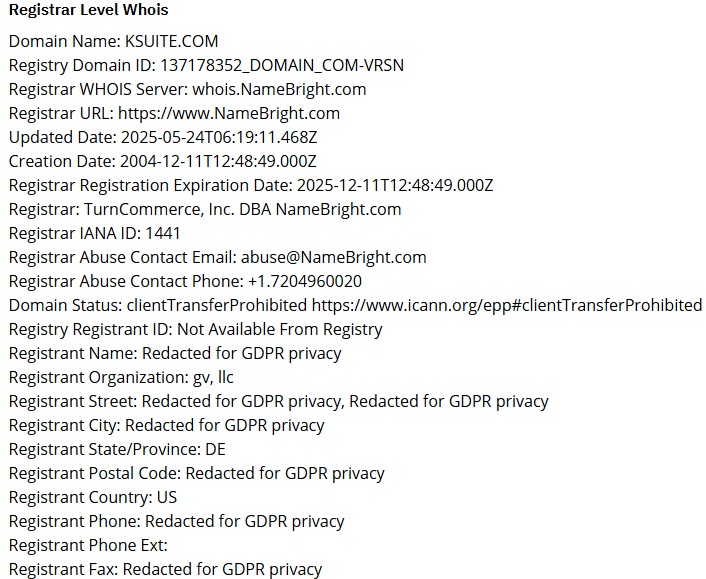
The Panelist stated, “the Respondent may have chosen to conceal its identity behind a privacy service”, noting that “that is not illegal or necessarily evidence of some sort of inappropriate behaviour”. Credit to the Panel for acknowledging that privacy protecting domain names is not in and of itself, anything wrong. Nevertheless, an important distinction must be made between employing a privacy service and the protections afforded by GDPR. Different registrars handle privacy differently. Some will employ related or third party privacy services by default. Some will have Whois registration data redacted, but not as a result of a privacy service, but rather as a result of GDRP regulations. As can currently be seen from the Whois for the Disputed Domain Name, in this particular case it appears to be the latter:
Moreover, as can be seen above, the GDRP redacted data includes the “Registrant Organization”, which is identified. [Hat tip to the Domain Name Law Show].
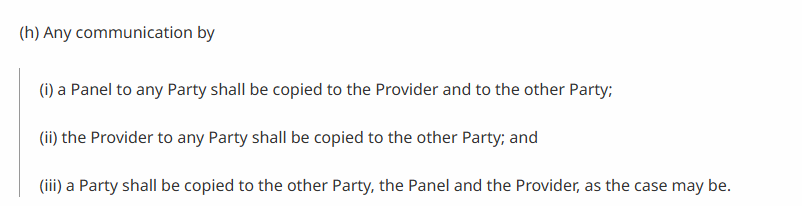
Secondly, in denying RDNH the Panelist stated that an associate of the Respondent’s “posted on social media accusing the Complainant of theft and trying to steal the Respondent’s domain name from it” and that this was a “breach of the Respondent’s obligations under the Policy to communicate in relation to the dispute with the Center and copy all other parties. Rules 2(h)”. What does Rule 2(h) state?
Does Rule 2(h) prevent a Respondent from posting on social media pending a case? This doesn’t appear to be the case. Rule 2 under the Rules deals with “Communications”, but those communications appear to relate exclusively to communications between the Provider, the Panel, and the Parties. There is no Rule whatsoever prohibiting public communication about a case during its pendency and had this been the intention of the Rules, it surely would have been expressly stated therein. The Panel’s claim that the Respondent breached the communications Rules strikes me as an overly expansive interpretation of the Rules and would be a concerning restriction on freedom of expression. That is not to say that a Respondent’s conduct overall, including such communications can perhaps be taken into account, but I respectfully think it is a bridge too far to consider this a breach of the Rules.
Dispute Exceeds the “Cybersquatting” Scope of the UDRP
Imiracle (Shenzhen) Technology Co., Ltd. v. Mustafa Celik, CAC Case No. CAC-UDRP-107620
<elfbar600 .bayern>
Panelist: Ms. Stephanie Hartung
Brief Facts: The Complainant is the owner of numerous trademark registrations relating to its brand ELFBAR, including, EU word mark ELFBAR, registered on May 19, 2021. The Complainant also owns several domain names relating to its ELFBAR trademark, inter alia, the domain names <elfbar .com> as well as <elfbar .de> which resolve to the Complainant’s official websites, promoting the Complainant’s disposable ELFBAR vapes and related products in various geographical regions. The disputed Domain Name was registered by the Respondent on January 7, 2025 and resolves to a website at <vpechamp. de> which prominently displays the Complainant’s ELFBAR trademark and official logo, while offering, inter alia, the Complainant’s ELFBAR 600 vapes and related products for online sale, without any reference being made to the Parties’ business relationship.
The Complainant alleges that the Respondent has no rights or legitimate interests in respect of the disputed Domain Name since the content of the website to which the disputed Domain Name resolves is highly relevant to the Complainant’s business, and the Complainant has never directly or indirectly authorized the Respondent to use its ELF BAR trademark and the corresponding disputed Domain Name in any way. The Complainant further alleges that the Respondent has registered and is using the disputed Domain Name in bad faith since the website to which the disputed Domain Name resolves does not accurately and prominently disclose the relationship between the Respondent and the Complainant.
The Respondent, in turn, claims to have a clear legitimate interest in the disputed Domain Name as it has invested over one million euros in marketing strategies, including SEO, SEA, and social media advertising which is why the platform under the disputed Domain Name has established a substantial customer base of over 137,000 regular consumers. Also, the Respondent rebuts the Complainant’s bad faith allegations and provides supportive evidence that the Respondent has engaged proactively with the Complainant’s representatives for many years, underscoring transparency and reaching a mutual understanding that the disputed Domain Name be used by the Respondent with some sort of consent by the Complainant.
Held: The Panel finds before it a broad picture made up of a variety of issues which range from an alleged case of clear-cut cybersquatting to a kind of sophisticated business relationship build over years in which the Respondent successfully distributed the Complainant’s ELFBAR 600 and other products, allegedly supported by the Complainant’s own staff members and various business partners in Germany. In view of these particular circumstances, the Panel considers that the disputed Domain Name is part of a much wider and more complex dispute that involves typical issues of a more complex business relationship and various other open issues between the Parties, and, therefore, is not taking part in a typical straightforward domain name dispute under the UDRP.
As such, the UDRP is not an appropriate process to adjudicate such a complex dispute, given that UDRP panels e.g. do not have the powers granted to a competent court to first enlighten and finally resolve disputes, including e.g. witness testimony, disclosure of documents, or other procedural instruments. Consequently, the Panel considers this dispute brought before it to exceed the typical “cybersquatting” scope of the UDRP and would be more appropriately addressed by a court of competent jurisdiction, or perhaps in mediation. Having said so, this Decision still does not prevent either the Complainant or the Respondent from pursuing this dispute in relation to the specific and obviously yet unanswered question of who should own the disputed Domain Name in a competent ordinary court proceeding or by means of dispute resolution.
Complaint Denied
Complainant’s Counsel: Internally Represented
Respondent’s Counsel: Self-represented
Case Comment by ICA General Counsel, Zak Muscovitch: I had to look up what “.bayern” was, as I had never heard of it. Apparently it is a new gTLD and means Bavaria in German.
More importantly however, the Panelist accurately and concisely laid out the appropriate considerations when considering whether this particular case was appropriate for adjudication under the UDRP. The Panelist stated inter alia;
Policy is not designed to adjudicate all types of disputes that relate in any way to domain names, but rather the Policy establishes a streamlined, inexpensive administrative dispute resolution procedure intended only for cases of “abusive cybersquatting” (see e.g. Boku, Inc. v. Phuc To, WIPO Case No. D2023-1338 [“The UDRP is not an appropriate process to adjudicate a complex business dispute such as this because the Panel does not have the benefit of witness testimony, disclosure of documents, or the other appropriate instruments that are typically available to assist a court to resolve such a dispute”].
As such, the UDRP is not an appropriate process to adjudicate such a complex (and most probably not yet fully disclosed) dispute, given that UDRP panels e.g. do not have the powers granted to a competent court to first enlighten and finally resolve disputes, including e.g. witness testimony, disclosure of documents, or other procedural instruments (see: Symphony Holdings Limited v. Jaimie Fuller, Fuller Consultancy F.Z.E., WIPO Case No. D2019-2887 [“This Panel is not a general domain name court, and the Policy is not designed to adjudicate all disputes of any kind that relate in any way to domain names”], Paradise International General Trading LLC v. Suwanna Mayeux, WIPO Case No. D2023-1569) [“The UDRP is not an appropriate process to adjudicate a complex business dispute such as this”].
I particularly appreciate the Panel’s concise statement that; “The Panel denies the Complaint, not on the merits, but on the broader ground that this dispute exceeds the ‘cybersquatting’ scope of the UDRP, and would be more appropriately addressed by a court of competent jurisdiction”.
Complainant Asserts Common Law Trademark in “Empire Industrial Park” Despite Only Recent Use
Empire Industrial Park LLC v. License Diamond / IT Services, NAF Claim Number: FA2506002160517
<empireindustrialpark .com>
Panelist: Mr. Bart Van Besien
Brief Facts: The Complainant asserts common law rights in its brand name “Empire Industrial Park,” based on long-standing and prominent use in connection with the operation and promotion of an industrial real estate development located in Eagle Pass, Texas. The Complainant states that it has conducted business under this name through various channels, including signage, digital advertising, and the website <theempireindustrialpark .com>. The Respondent owns and operates the “Empire Industrial Park”, located at 12310 to 12432 Highway 99 in Everett, Washington 98204, within the Seattle metropolitan area, since 1974. The Complainant alleges that the Respondent has no rights or legitimate interests in the domain name, as the domain name does not resolve to an active website providing a bona fide offering of goods or services. Rather, it appears to be parked or inactive, offering no legitimate business purpose or informational content.
The Complaint further alleges that the Domain Name is inactive or parked, with no content or service offered. The Respondent contends that over the past fifty years, the Respondent has developed substantial common law service mark rights in the name “Empire Industrial Park” in connection with its warehousing operations. By contrast, the Complainant was only formed as a Texas limited liability company on March 1, 2023. Finally, the Respondent requests a finding of Reverse Domain Name Hijacking. The Respondent emphasizes that it registered the domain name more than two years before the Complainant was even formed; that the Complainant has no enforceable rights in a descriptive or generic mark; and that a basic internet search would have revealed the longstanding operation of the Empire Industrial Park in the greater Seattle area and the domain name’s prior registration date.
Held: Neither party owns a registered trademark for “Empire Industrial Park,” but both claim common law rights to the term. The Complainant’s use of “Empire Industrial Park” is recent, as it was formed as a Texas LLC on March 1, 2023, with no earlier use specified. The Complainant failed to provide evidence of its alleged common law trademark and evidence regarding the duration and nature of use of the mark, the number of sales under the mark, the nature and extent of advertising using the mark, the degree of public recognition, consumer surveys, etc. The Panel finds that the Complainant has not established sufficient secondary meaning in the mark “Empire Industrial Park” to create common law or unregistered trademark rights.
The Panel further finds that the Respondent has demonstrated use of the disputed Domain Name for recent email communications, including through the email address ‘customerservice(@)empireindustrialpark .com’, prior to the commencement of these proceedings. Moreover, the Respondent has provided evidence of the existence of an industrial park in Everett, Snohomish County, Washington, named “Empire Industrial Park.” The Respondent has shown that, as early as 1974, a general partnership named “Empire Industrial Park” owned real estate in Snohomish County. Accordingly, the Panel concludes that the Respondent has established rights or legitimate interests in the disputed Domain Name.
Furthermore, the Complainant’s allegations of bad faith are particularly unconvincing in light of this timeline. Additionally, contrary to the Complainant’s position, the term “Empire Industrial Park” is, at least to a certain extent, generic or descriptive. The Panel regrets that the Complainant did not acknowledge, let alone address, this reasonable possibility in its Complaint. There is no evidence whatsoever that the Respondent has targeted the Complainant or attempted to unfairly benefit from any association with the Complainant. There is no likelihood of confusion among the parties’ customers, especially given the substantial geographic distance between their respective industrial properties.
RDNH: The Panel finds that the Complaint was indeed brought in bad faith, in an attempt at RDNH and constitutes an abuse of the administrative proceeding for the following reasons. First, the Complainant claims common law trademark rights in “Empire Industrial Park” based on alleged long-standing use, but fails to mention that its use of the name only began recently. Second, the Complainant does not address the fact that the disputed Domain Name consists of terms that, taken together, are to some extent generic or descriptive. Third, a simple Google search for “Empire Industrial Park” reveals that the Respondent’s commercial complex in Everett, Washington, appears prominently in the top search results.
In short, the Complainant appears to have failed to conduct a reasonable investigation and has advanced broad and unsupported claims – some of which are contradicted by publicly available evidence or even by its own argumentation. The Panel concludes that the Complainant brought a claim that it knew – or should have known upon reasonable inquiry – was without merit and had no reasonable prospect of success. The Panel notes that the UDRP is designed to resolve legitimate disputes, and that purpose is not served by declining to find Reverse Domain Name Hijacking in appropriate circumstances, such as the present case.
Complaint Denied (RDNH)
Complainant’s Counsel: Sonia V. Junfin, USA
Respondent’s Counsel: Alan Bornstein of Jameson Pepple Cantu PLLC, USA
Case Comment by ICA General Counsel, Zak Muscovitch: A thoroughly analysed and well-reasoned decision by the Panelist. Well done!
About the Editor:
Ankur Raheja is the Editor-in-Chief of the ICA’s new weekly UDRP Case Summary service. Ankur has practiced law in India since 2005 and has been practicing domain name law for over ten years, representing clients from all over the world in UDRP proceedings. He is the founder of Cylaw Solutions.
He is an accredited panelist with ADNDRC (Hong Kong) and MFSD (Italy). Previously, Ankur worked as an Arbitrator/Panelist with .IN Registry for six years. In a advisory capacity, he has worked with NIXI/.IN Registry and Net4 India’s resolution professional.