
When Losing the DropCatch Auction Becomes Reverse Domain Name Hijacking
This decision is notable for the Panel’s treatment of Reverse Domain Name Hijacking in the context of a self-represented complainant. While the underlying merits analysis was relatively straightforward, the Panel devoted significant attention to explaining why the Complainant’s lack of legal representation did not excuse the filing of a Complaint that, in the circumstances, should not have been brought. Continue reading commentary here.
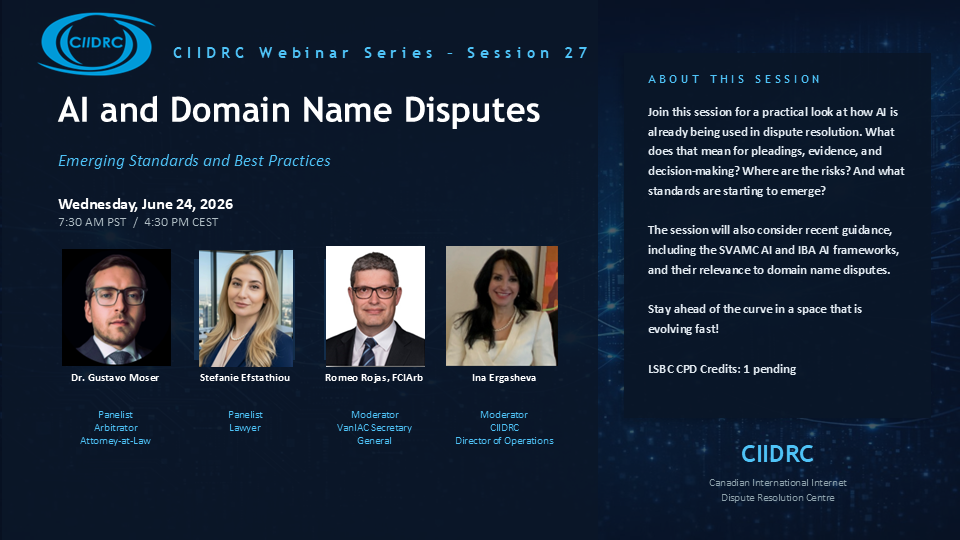
Register Here! | CIIDRC Webinar Series 27 | AI and Domain Name Disputes | June 24, 2026

Join us for this year’s Levine Lecture featuring Nick Gardner, who will present: “26 Years of Deciding UDRP Cases—What Does a Panelist Actually Do, and Why? How Will AI Change This?“ A veteran of UDRP practice, Nick’s experience ranges from early landmark English court cases to presiding over hundreds of disputes as a leading WIPO and Nominet panelist. The session will include an introduction by Zak Muscovitch, opening remarks by Tony Willoughby, and closing remarks from Gerald Levine.
We hope you will enjoy this edition of the Digest (vol. 6.23) as we review these noteworthy recent decisions with expert commentary. (We invite guest commenters to contact us):
‣ When Losing the DropCatch Auction Becomes Reverse Domain Name Hijacking (snglr.com *with commentary)
‣ You Can’t Build a UDRP Case on a Disclaimed Trademark (advanced-writers.com *with commentary)
‣ A Brief Decision, Several Unanswered Questions (artisticweaver.com *with commentary)
‣ From Failed Sunrise Bid to Failed UDRP (com.app *with commentary)
‣ A Distributor Is Not a Cybersquatter (cannariverbrasil.com *with commentary)
When Losing the DropCatch Auction Becomes Reverse Domain Name Hijacking
DANIEL DIEMERS v. Domain Admin, WIPO Case No. D2026-1004
<snglr.com>
Panelists: Mr. Sebastian M.W. Hughes (Presiding), Mr. Willem J. H. Leppink, and Mr. Gerald M. Levine
Brief Facts: The Complainant, an individual resident in Switzerland, is co-founder, chairman and shareholder of the SNGLR Group. The Complainant owns two registrations for the trade mark SNGLR in Switzerland (November 20, 2019); and international registration, designating Germany, France, and the Benelux countries, (May 4, 2020). The Complainant is also the owner of various domain names comprising the trademark, four of which <snglr.group>, <snglr.digital>, <snglr.vc>, and <snglr.tech>, resolve to active websites operated by the group. The companies associated with the Complainant provide a wide range of consulting, venture capital, technology, and artificial intelligence-related services under the trademark. The disputed Domain Name was acquired by the Respondent, as the successful anonymous bidder in the auction hosted by DropCatch, on March 3, 2026, and is being offered for sale. Critically, the Complainant had himself participated in that same auction, placing a back order and three unsuccessful bids, and after losing wrote to DropCatch.com on March 9, 2026, alleging infringement and signalling the imminent Complaint.
The Complainant alleges that the timing of the registration, via the DropCatch service specifically designed to catch expiring domain names, indicates that the Respondent was aware of the trademark and deliberately targeted the disputed Domain Name. The Complainant also points out that the Respondent’s profile, including its use of a privacy-focused email service, is consistent with the profile of a professional domain name investor rather than an entity with a legitimate connection to the SNGLR mark. The Respondent contends that, as a professional domain name investor with an existing portfolio of domain names, the Respondent has rights or legitimate interests in the disputed Domain Name, being a valuable vowel-elided abbreviation of the English word “singular”, acquired without any knowledge of the Complainant or its trademark. The Respondent seeks a finding of Reverse Domain Name Hijacking against the Complainant, contending that this case amounts to a “Plan B” scenario, whereby the Complainant has filed the Complaint herein, having first attempted to purchase the disputed Domain Name at the DropCatch.com Auction.
Held: The Panel notes that The Respondent, as a professional domain name investor, purchased the disputed Domain Name via the DropCatch Auction and subsequently offered it for sale. (See WIPO Overview 3.1 section 2.1:“Over the course of many UDRP cases, panels have acknowledged further grounds that, although not specifically articulated in the UDRP, may establish respondent rights or legitimate interests in a domain name.”). The Panel moreover notes the disputed Domain Name is comprised of a five-letter acronym and that there are no indications, based on the available record, of an intention to capitalize on the Complainant’s trademark, see WIPO Overview 3.1, section 2.10. Moreover, the evidence in the case file as presented does not indicate that the Respondent’s aim in registering the disputed Domain Name was to profit from or exploit the Complainant’s trademark.
In all the circumstances, the Panel is unable to conclude that the Respondent, in registering the disputed Domain Name and subsequently offering it for sale via the Afternic website, targeted the Complainant and its trademark. The Panel notes that the disputed Domain Name is comprised of a five-letter acronym, also used by third parties in different segments. The Panel also finds that the Respondent did not register the disputed Domain Name, under paragraph 4(b)(i) of the Policy, for the purpose of selling it specifically to the Complainant or a competitor of the Complainant, and the Complainant has failed to provide any evidence of its notoriety at the time of the registration of the disputed Domain Name which could indicate that the Respondent had knowledge of the Complainant’s trade mark rights and that the Respondent more likely than not registered the disputed Domain Name with those rights in mind.
RDNH: Although the Complainant is not legally represented, the Complainant is clearly a successful and highly educated individual. The Complainant, as the co-founder of the SNGLR Group, has significant personal experience since 2019 in registering and maintaining the Complainant’s portfolio of domain name and trademark registrations used by the SNGLR Group. Having participated in the DropCatch Auction himself, the Panel finds that the Complainant’s conduct in first sending a letter to DropCatch on March 9, 2026, and in subsequently filing this Complaint amounts to Reverse Domain Name Hijacking, in particular in light of the Complainant’s acknowledgments in the body of the Complaint that the Respondent is a professional domain name investor.
The Panel would also note that, whilst the Complainant is not legally represented, there is readily-available and accessible jurisprudence regarding domain name disputes online (including, in particular, WIPO Overview 3.1, which is publicly available via the WIPO website). The Panel considers that, in light of the fact the Complainant has been, since 2019, in charge of the registration of the SNGLR domain names and trademark (including, as acknowledged by the Complainant, the fact that he had, in 2019 and 2020, tried contacting the previous registrant), the Complainant is likely conversant with domain name registration and disputes procedure or, at the very least, ought to have conducted the necessary research and familiarised himself with the procedure before filing the Complaint.
Complaint Denied (RDNH)
Complainant’s Counsel: Self-represented
Respondent’s Counsel: Cylaw Solutions, India
Commentary Edited and Approved by ICA General Counsel, Zak Muscovitch:
This decision is notable for the Panel’s treatment of Reverse Domain Name Hijacking in the context of a self-represented complainant. While the underlying merits analysis was relatively straightforward, the Panel devoted significant attention to explaining why the Complainant’s lack of legal representation did not excuse the filing of a Complaint that, in the circumstances, should not have been brought.
The facts presented a particularly compelling RDNH scenario. The Complainant was not merely aware that the disputed domain name had been acquired through a public DropCatch auction – he had actively participated in the very same auction, placed multiple bids, lost, and then promptly attempted to challenge the winning bidder’s acquisition through the UDRP. The Panel appears to have viewed this sequence of events as a textbook example of an unsuccessful bidder attempting to use the Policy as a substitute acquisition mechanism after failing to secure the domain name through the marketplace.
Equally significant was the Panel’s willingness to hold the Complainant to a meaningful standard of diligence notwithstanding his self-represented status. The Panel emphasized that the Complainant was an experienced entrepreneur who had managed the SNGLR trademark and domain name portfolio for years and was sufficiently familiar with domain name matters to have previously attempted to acquire the domain name from an earlier registrant. In those circumstances, the Panel considered that he either knew, or ought to have known, that a professional domain investor’s acquisition of a five-letter acronym domain through an expiry auction, without evidence of targeting, was unlikely to satisfy the Policy.
The decision also reinforces an important principle in acronym and short-domain disputes. The mere fact that a respondent acquires a domain name corresponding to a trademark through a drop-catching service and offers it for sale does not establish bad faith. Where the domain name consists of a short acronym or abbreviation with value independent of the complainant, panels generally require persuasive evidence that the respondent specifically targeted the complainant’s mark. Here, the absence of such evidence proved fatal to the Complaint.
Ultimately, the Panel’s message was straightforward: losing a competitive domain auction does not create a UDRP claim, and sophisticated trademark owners cannot avoid an RDNH finding simply because they choose to proceed without counsel.
Congratulations to our Editor-in-Chief for successfully representing the Respondent in this matter.
You Can’t Build a UDRP Case on a Disclaimed Trademark
Writera Limited v. Igor Leskiv, CAC Case No. CAC-UDRP-108615
advanced-writers.com>
Panelist: Mr. Steven Levy
Brief Facts: The Complainant, since 2007, has been engaged in providing academic writing assistance and related educational services including the writing of essays, term papers, theses, capstone projects, and admission essays. The Complainant uses the domain name <advancedwriters.com> for its website address and it has 379 reviews on the ‘smart customer’ site. The Complainant owns USPTO registration dated December 17, 2019, for the graphic ADVANCEDWRITERS Logo trademark. The disputed Domain Name was registered on November 1, 2013, and resolves to a website offering custom-written academic essays, research papers, and dissertations.
The Complainant alleges that the Respondent has no rights or legitimate interests in the disputed Domain Name as it is not commonly known by the domain name and it hosts a website that provides the same academic writing services as the Complainant thus disrupting the Complainant’s business. The Complainant further alleges that the disputed Domain Name was registered and used in bad faith based on the Respondent’s prior knowledge of the Complainant’s trademark and the above-mentioned website activity. No administratively compliant Response has been filed.
Held: The Complainant relies on its USPTO registration for ADVANCEDWRITERS to establish rights under paragraph 4(a)(i) of the Policy; however, where the registration is for a design mark and the textual element has been disclaimed, the Complainant must provide additional evidence that the text has acquired secondary meaning and trademark significance. See UDRP Perspectives on Recent Jurisprudence, section 1.5 and also see WIPO Jurisprudential Overview 3.1, at paragraph 1.2.3. Here, the Complainant submits a screenshot from the USPTO database showing the details of its registration for the claimed ADVANCEDWRITERS trademark in a graphic logo form. The exhibit shows the notation “Disclaimer: “ADVANCED WRITERS””. All of this indicates that the USPTO has determined that the ADVANCEDWRITERS textual portion of the Complainant’s logo is generic or merely descriptive in relation to the Complainant’s services and thus not registrable as it does not, on its own, function as a trademark. This leads the Panel to find that paragraph 4(a)(i) of the Policy has not been satisfied by the Complainant’s submission of its USPTO Trademark Registration.
Further, one of the Complainant’s exhibits shows an archival screenshot of the Respondent’s <advanced-writers.com> website from 2013 which contains the headline “Where to Buy Top-Notch Academic Papers” and follows with “We are The Best Solution For College and University Students. It goes on to assert that “The Respondent’s interest in the disputed Domain Name is therefore not based on any legitimate intention to develop an independent business under its own distinctive name” but is “based on creating confusion with the Complainant’s Trademark and official website…” The Panel remains unconvinced as, according to the Complainant’s own evidence, it appears that the Respondent has been using the disputed Domain Name for at least twelve years prior to the commencement of these proceedings and its website shows no signs of being a contrivance but, rather, seems to offer actual writing services, albeit similar to those offered by the Complainant. Based on a preponderance of the evidence before it, the Panel is unable to find that the Complainant has made out a prima facie case that the Respondent is not using the disputed Domain Name to make a bona fide offering of goods or services.
Given the generic or merely descriptive nature of the phrase “Advanced Writers”, the Panel is unable to conclude that the Respondent’s choice of this phrase could not be coincidental. Under the standards set out in the seminal case of Telstra Corporation Limited v. Nuclear Marshmallows, D2000-0003 (WIPO Feb. 18, 2000), the Complainant has not shown that its claimed trademark is distinctive or enjoys a substantial reputation such that it is implausible for the Respondent to make a good faith use of the phrase “Advanced Writers”. Next, the Panel notes that the Respondent, based in Ukraine, registered the disputed Domain Name in 2013, a number of years after the Cyprus-based Complainant’s first use date of 2010, as stated in its USPTO Registration, or the 2007 launch of its own website. The distance in both geography and time at least indicate the plausibility that the Respondent may have independently conceived of the generic or merely descriptive phrase “Advanced Writers” and chosen the <advanced-writers.com> domain name because the <advancedwriters.com> domain name was unavailable. In sum, the Panel finds that the Complainant has not carried its burden of proving, by a preponderance of the evidence, that the Respondent has registered or is using the disputed Domain Name in bad faith.
Complaint Denied
Complainant’s Counsel: Internally Represented
Respondent’s Counsel: No Response
Commentary Edited and Approved by ICA General Counsel, Zak Muscovitch:
This decision is a useful reminder that not every trademark registration automatically establishes rights in the textual elements of a mark for UDRP purposes. The Panel carefully examined the Complainant’s evidence and concluded that its registration for a stylized logo containing the words “Advanced Writers” was insufficient where those words had been expressly disclaimed and no meaningful evidence of acquired distinctiveness had been submitted.
The Panel’s analysis under the first element is particularly noteworthy. Although UDRP panels often accept trademark registrations as sufficient to establish standing, the Panel emphasized that where the textual component of a design mark has been disclaimed as descriptive or generic, a complainant cannot simply point to the registration certificate and stop there. Additional evidence may be required to demonstrate that the words themselves function as a trademark. The decision therefore provides a useful application of the principle reflected in UDRP Perspectives §1.5.
The weakness of the Complainant’s trademark claim also permeated the Panel’s analysis of rights or legitimate interests and bad faith. “Advanced Writers” is an inherently descriptive phrase for a business offering academic writing services. Against that backdrop, the Respondent’s use of the disputed domain name for an apparently genuine essay-writing business dating back to 2013 was difficult to characterize as illegitimate, particularly where the Complainant’s own evidence showed a long-standing and substantive website rather than a pretextual operation created to target the Complainant.
Perhaps most importantly, the Panel resisted the temptation to infer targeting merely because the parties operated in the same industry. The fact that two businesses independently chose to use a descriptive phrase for similar services was entirely plausible, especially given the geographic separation between the Cyprus-based Complainant and the Ukrainian Respondent, the Respondent’s registration of the disputed domain name years before the Complainant obtained its trademark registration, and the absence of evidence demonstrating that the Complainant’s mark had acquired significant distinctiveness or reputation by the time of registration.
The decision serves as a useful caution to complainants relying on descriptive marks. Where the claimed trademark consists of words that directly describe the underlying services, a complainant must do more than establish priority of use. Without persuasive evidence that the words have acquired trademark significance and that the respondent was more likely than not targeting that significance, the UDRP is unlikely to provide a remedy. In that respect, the decision reinforces a fundamental principle of the Policy: the UDRP protects trademark rights, not merely business names or descriptive phrases that multiple parties may legitimately wish to use.
A Brief Decision, Several Unanswered Questions
Surya Carpet, Inc. v. jie zhu, Forum Claim No. FA2605002219848
<artisticweaver.com>
Panelist: Ms. Dawn Osborne
Brief Facts: The Complainant is the owner of the trade mark ARTISTIC WEAVERS registered, inter alia, in the USA for rugs since 2020. The disputed Domain Name was registered in 2023 and the Complainant alleges that it has been used for competing goods, namely rugs, using the Complainant’s exact mark ARTISTIC WEAVERS spelled correctly in its masthead and being used as a brand to offer products in the English language priced in dollars. The Complainant further alleges that the Respondent registered the Domain Name to direct it to a site to confuse Internet users into believing the website and Domain Name are associated with the Complainant for commercial gain. The Respondent failed to submit a Response in this proceeding.
Held: The web site attached to the Domain Name features the Complainant’s exact mark ARTISTIC WEAVERS spelt correctly as a masthead and does not make it clear that there is no connection with the Complainant. The site’s terms and conditions refer to “body piercing jewellery” and not rugs raising doubts as to whether the Respondent’s business is a genuine business offering rugs. Even if it is, the products are being sold in dollars and, therefore, targeting the USA. This is undoubtedly confusing and infringing the Complainant’s trade mark. Further as the site uses the exact mark of the Complainant AMERICAN WEAVERS (sic) (with an ‘s’ at the end) as a brand in its masthead, but the Domain Name contains ‘American Weaver’ (sic) without an ‘s’, the Domain Name appears to be a typosquatting registration. Typosquatting is also an indication of a lack of rights or a legitimate interest.
The Domain Name seeks to take advantage of the situation where Internet users may make a typographical error. Typosquatting itself is evidence of relevant bad faith registration and use. The use of the Complainant’s exact mark as a masthead, as a brand and not in a generic manner and the offering of competing products priced in dollars shows the Respondent is targeting the USA where the Complainant trades (and is protected by its registered trade mark). The Respondent has used a domain name that is confusingly similar to Complainant’s AMERICAN WEAVERS (sic) mark known for rugs to attract Internet users to its website for commercial gain, targeting the jurisdiction where the Complainant is based and, in the process, disrupting the Complainant’s business. As such, the Panelist believes that the Complainant has made out its case that the Domain Name was registered and used in bad faith and has satisfied the third limb of the Policy under para 4(b)(iii) and (iv).
Cancellation
Complainant’s Counsel: Mark L. Seigel, Georgia, USA
Respondent’s Counsel: No Response
Commentary Edited and Approved by ICA General Counsel, Zak Muscovitch:
The result may well be correct. The Respondent defaulted, the website reportedly offered competing rug products, and the use of the Complainant’s mark on the website naturally raises concerns about targeting. Nevertheless, the decision is notable for the brevity of its reasoning and the limited discussion of the facts that would ordinarily help a reader understand why this was properly characterized as a cybersquatting case rather than a trademark dispute involving competing sellers.
Most notably, the decision does not appear to discuss the Complainant’s reputation, market recognition, geographic reach, sales, advertising, or any other facts from which the Respondent’s awareness of the Complainant might reasonably be inferred. While the Complainant’s trademark registration establishes rights under the first element of the UDRP, it does not by itself establish that the Respondent registered the domain name because of the Complainant or its mark. Nor does the decision appear to identify evidence explaining how or why a registrant apparently located in China would likely have been aware of the Complainant at the time of registration.
The nature of the mark itself makes this omission particularly noteworthy. ARTISTIC WEAVERS is not an obviously coined or arbitrary term. Rather, it appears to be a phrase that bears a natural relationship to rugs, carpets, and woven products. One can readily imagine a business involved in the sale or manufacture of such products independently selecting the phrase because of its descriptive or suggestive qualities. That possibility does not preclude a finding of cybersquatting, particularly if there was evidence that the Respondent copied the Complainant’s branding, content, product offerings, or other indicia of source. The difficulty is that the decision does not appear to identify such evidence or otherwise explain why independent adoption was ruled out.
To be clear, none of this is to suggest that the Respondent necessarily lacked knowledge of the Complainant or that the outcome was incorrect. There may well have been evidence supporting such a conclusion. The concern is simply that the decision itself does not identify it. As written, the reasoning appears to move rather quickly from the existence of competing rug sales and use of the same mark to a conclusion of bad-faith registration and use, without fully articulating the facts that support an inference that the Respondent registered the domain name with the Complainant specifically in mind. Some readers may therefore be left wondering what transformed this dispute from a potential trademark infringement matter into a clear case of cybersquatting under the Policy.
The decision is also unusual in its remedy. The Panel ordered cancellation rather than transfer, but the decision does not indicate whether cancellation was specifically requested by the Complainant. If it was, it is a rather unusual and unfortunate request.
Ultimately, the decision may have reached the right result, but it leaves several important questions unanswered. Particularly where a mark consists of ordinary words with an apparent connection to the goods at issue, and where the respondent is located in a different jurisdiction, a fuller discussion of reputation, targeting, respondent knowledge, and the basis for the chosen remedy would have helped demonstrate more clearly why this was a cybersquatting case within the intended scope of the UDRP rather than a dispute whose facts also bear many of the hallmarks of a traditional trademark infringement claim.
From Failed Sunrise Bid to Failed UDRP
Norman Ortiz v. 童先生, 童先生 (Xian Sheng Tong), Tong Zekun (童泽坤), WIPO Case No. D2026-1543
<com.app>
Panelist: Mr. Matthew Kennedy
Brief Facts: The Complainant holds United States trademark registration for COM.APP, registered on May 21, 2019 (application filed on April 14, 2018) in class 42. The registration includes a claim of first use in commerce on August 8, 2018, and the USPTO accepted a statement of use on March 6, 2019. During the “.app” Top-Level Domain (“TLD”) Sunrise Period, the Complainant placed a pre-order for the disputed Domain Name with a digital brand services provider but he was unable to complete the order because his trademark application was merely pending. The Respondent acquired the disputed Domain Name through an open-market auction during the “.app” TLD Early Access Period, paying approximately USD 3,190 to register early and roughly USD 17,100 to the former registrar to acquire it on May 10, 2018, after the auction drew over 160 bids.
The domain resolved to a broker’s for-sale landing page from at least July 2019 to September 2021, and the Respondent presented evidence it was used in four email addresses between 2022 and 2025. Notably, the Complainant himself had contacted the Respondent through the broker’s platform in August 2019, identifying himself as the COM.APP trademark owner and offering USD 5,000 to avoid litigation; the Respondent replied that he had registered the domain before the Complainant owned any trademark. The Complainant alleges that if the Respondent had any genuine intention to use the disputed Domain Name for a commercial or descriptive purpose, he had nearly eight years to do so. The uninterrupted resale posture is inconsistent with any good faith descriptive use.
The Respondent contends that he acquired the disputed Domain Name based on the value of the generic terms “app” (an abbreviation for “application”) and “com”, (an abbreviation for “commercial”)… the combination of these two terms is scarce within the “.app” TLD and unrelated to any specific trademark. The Respondent further contends that the disputed Domain Name was registered before the Complainant’s claimed date of first use in commerce of his trademark, and before registration of that trademark. At the time, there was only a searchable pending trademark application without evidence of a product launch, media attention, relationship between the parties, insider information, actual knowledge, or other relevant evidence.
Held: The disputed Domain Name was acquired by the Respondent on May 10, 2018, one year before the Complainant obtained registration of his COM.APP trademark. The Panel recalls that where a respondent registers a domain name before a complainant’s trademark rights accrue, panels will not normally find bad faith on the part of the respondent. See WIPO Overview 3.1, section 3.8.1. The Panel sees no exceptional circumstances that might establish that the Respondent’s intent in registering the disputed Domain Name was to unfairly capitalize on the Complainant’s nascent, as yet unregistered, trademark rights. See WIPO Overview 3.1, section 3.8.2. The Complainant submits that he first used his trademark in commerce in August 2018, which was three months after the registration of the disputed Domain Name. The Complainant argues that the disputed Domain Name was registered “just 18 days” after he filed his trademark application. However, the Panel does not deem the Respondent to have constructive notice of the contents of the United States trademark register.
The Respondent provides a plausible alternative explanation for his choice to register the disputed Domain Name based on the value of the terms “app” and “com” as very common abbreviations for the English dictionary words “application” and “commercial”, respectively. The Panel has taken note that the Respondent paid over USD 20,000 to acquire the disputed Domain Name and that it was formerly advertised for sale. However, nothing on the record gives rise to the inference that the price paid indicated any awareness of the Complainant. The Respondent notes that the disputed Domain Name is a desirable (three-letter) domain name within the “.app” TLD. Moreover, generally speaking, prior UDRP panels have found that the practice as such of registering a domain name for subsequent resale (including for a profit) would not by itself support a claim that the respondent registered the domain name in bad faith with the primary purpose of selling to a trademark owner (or its competitor). See WIPO Overview 3.1, section 3.1.1. In view of the above circumstances, the Panel finds that the Respondent did not register the disputed Domain Name in bad faith targeting of the Complainant or its trademark rights because the Complainant had no trademark rights at the time when the Respondent registered the disputed Domain Name.
RDNH: The Panel notes that the Complainant is self-represented but the content of the Complaint shows that he is sufficiently familiar with the Policy to know that his case cannot succeed on one of the essential elements. He is aware that he had no trademark rights at the time when the disputed Domain Name was registered, that he did not begin using the mark in commerce until later, that the Respondent is not deemed to have constructive notice of his trademark application, and that there is no evidence of targeting. The Complainant was on notice of the Respondent’s defense since prior to this dispute, i.e., that the Respondent had registered the disputed Domain Name prior to the Complainant’s ownership of the trademark. Nevertheless, he brought the Complaint, putting the Respondent to the inconvenience of defending himself. The Complainant also failed to disclose that he had approached the Respondent and offered USD 5,000 to purchase the disputed Domain Name.
The above circumstances give the Panel reason to find that the Complaint was brought in bad faith. Consideration of evidence belatedly offered in the Complainant’s unsolicited supplemental filing regarding prior legal advice would not lead to a different conclusion; rather, it would confirm his bad faith. The Complainant received advice that a UDRP complaint against a parked, passively held domain name was unlikely to succeed absent evidence of active confusing commercial use. Yet the Complaint was brought without any evidence that the disputed Domain Name was being used in a manner that created confusion with, or otherwise infringed, the Complainant’s mark. The Complainant claims to have decided proceedings were now appropriate because there had been a transition from purely passive for-sale parking to active configuration for web use, and an absence of any substantive commercial use under the COM.APP mark. However, that is difficult to reconcile with the terms of the Complaint, which emphasized passive holding and continuous offering for sale.
Complaint Denied (RDNH)
Complainant’s Counsel: Self-represented
Respondent’s Counsel: Self-represented
Commentary Edited and Approved by ICA General Counsel, Zak Muscovitch:
This decision arises from an unusual set of facts rooted in the launch of the .app gTLD. The Complainant wanted the disputed domain name from the outset and attempted to secure it during the .app Sunrise process. However, because his trademark application was still pending, he was unable to complete the registration. The Respondent subsequently acquired the domain name through a highly competitive Early Access auction, paying more than $20,000 after bidding attracted more than 160 participants. Only later did the Complainant acquire trademark rights in COM.APP and ultimately bring the present UDRP proceeding.
Against that backdrop, the Panel’s Reverse Domain Name Hijacking finding appears fully warranted.
The chronology alone presented a fundamental obstacle to the Complaint. The Respondent acquired the disputed domain name in May 2018, before the Complainant’s claimed first use in commerce, before registration of the COM.APP trademark, and before any evidence that the Complainant had established protectable trademark rights. As the Panel correctly observed, the UDRP generally does not permit a finding of bad-faith registration where a domain name was registered before a complainant’s trademark rights arose, absent exceptional circumstances demonstrating anticipation of those future rights. No such circumstances were present here.
Indeed, the unusual launch history makes the Complaint particularly difficult to understand. The Complainant knew firsthand why he had been unable to acquire the domain name during the Sunrise process and knew that the Respondent had acquired it through the launch mechanisms established for the .app registry. Those facts did not merely weaken the Complaint; they underscored the absence of any plausible basis for concluding that the Respondent had registered the domain name in anticipation of, or in bad-faith targeting of, trademark rights that had not yet arisen.
What elevates this case from an ordinary denial to an RDNH finding is not merely the weakness of the Complaint, but the apparent knowledge with which it was brought. The Panel concluded that the Complainant was sufficiently familiar with the Policy to understand that his claim could not succeed on one of its essential elements. That conclusion is difficult to dismiss given the record. The Complainant knew that the Respondent acquired the domain name before any trademark rights had accrued, knew that he had unsuccessfully attempted to purchase it years earlier for $5,000, and apparently received legal advice warning that a UDRP complaint was unlikely to succeed. Yet the Complaint was filed anyway, leading to a result that appears to have been entirely predictable.
A Distributor Is Not a Cybersquatter
Canna River LLC v. Martin Balerio, MBAG Marketing LLC, WIPO Case No. D2026-1533
<cannariverbrasil.com>
Panelist: Mr. Evan D. Brown
Brief Facts: The Complainant sells hemp and CBD-based products, including e-cigarette liquids, tobacco substitutes, body and hand creams, and tinctures. It owns the CANNA RIVER trademark, registered with the USPTO on February 9, 2021. The disputed Domain Name was registered on August 31, 2024, pursuant to an oral agreement between the parties, which both parties acknowledge in their submissions. Under that arrangement, the Respondent used the disputed Domain Name in connection with the distribution of the Complainant’s products in Brazil. The record further indicates that the parties’ commercial relationship continued into 2026, with the Complainant listing the Respondent’s business as an authorized partner and supplying CANNA RIVER products to it.
In late 2025, Brazilian health regulator ANVISA issued resolutions restricting the commercialization and advertising of CANNA RIVER products by entities lacking the required authorization. Following the deterioration of the parties’ relationship, the Respondent stated that it intended to retain the disputed Domain Name and use it for referral traffic with appropriate disclaimers. The current website no longer offers products for sale and instead displays a notice concerning the ANVISA measures and a disclaimer of any affiliation with the Complainant. The Respondent relies on paragraph 4(c)(i) of the Policy, contending that before any notice of the dispute it used the disputed Domain Name in connection with a bona fide offering of goods or services, specifically the distribution of genuine CANNA RIVER products in Brazil pursuant to the parties’ agreed arrangement.
The Respondent further invokes the framework set out in Oki Data Americas, Inc. v. ASD, Inc., WIPO Case No. D2001-0903, and section 2.8.1 of the WIPO Overview 3.1. In its supplemental filing, the Complainant alleges that the Respondent’s modification of the website at the disputed Domain Name following the filing of the Complaint constitutes additional evidence of the Respondent’s lack of rights or legitimate interests and of bad faith. Specifically, the Complainant alleges that the Respondent’s current use of the disputed Domain Name to display a regulatory notice is pretextual; that the notice is false and tarnishing because the underlying ANVISA Resolutions are directed at entities other than the Complainant; and that the post-Complaint change in the website’s use constitutes defensive maneuvering that undermines the Respondent’s credibility.
Held: The Panel applied the Oki Data framework (Oki Data Americas, Inc. v. ASD, Inc., WIPO Case No. D2001-0903) and found all four cumulative requirements met: the Respondent was actually offering the genuine trademarked goods (corroborated by the Complainant’s own Shopify shipment records); the site sold only Canna River products; it displayed a Portuguese disclaimer of corporate affiliation, and the Respondent had not cornered the market in CANNA RIVER domains. The Panel notes that the Complainant’s own evidence corroborates the Respondent’s account of the relationship. The Complainant further argues under supplemental filing, that the Respondent’s post-Complaint change to a regulatory-notice website is pretextual and shows no current rights or legitimate interests. That argument fails for two reasons: the Respondent disclosed the change in its May 8, 2026 supplemental statement, citing Brazil regulatory considerations supported by the record; and, more fundamentally, the Respondent’s evidence regarding the parties’ agreed Brazil distribution arrangement outweighs any later change in website use.
The disputed Domain Name was registered on August 31, 2024. While neither of the Parties address the precise timing in which their oral agreement took place, by the Complainant’s own admission, the registration was made in the context of an oral agreement between the parties. Based on the available record, the Panel considers that at the time of registration, the Respondent was not an unaffiliated stranger but a commercial partner of the Complainant (acting with the Complainant’s knowledge and apparent encouragement). The Complainant alleges no facts suggesting that the Respondent harbored an undisclosed bad-faith intent at the time of registration. Critically, the Panel expressly rejected the Complainant’s retroactive bad faith argument, citing section 3.2.1 of the WIPO Overview 3.1 and observing that the “retroactive” bad faith concept “has not been followed in subsequent cases.” Because the Complainant has failed to establish bad faith at the time of registration, the conjunctive requirement of paragraph 4(a)(iii) is not satisfied.
RDNH: The mere lack of success of a complaint is not sufficient for a finding of Reverse Domain Name Hijacking. In this case, however, multiple factors set out in section 4.16 of the WIPO Overview 3.1 are present. The represented Complainant filed on theories that depended on subsequent events and ignored the conjunctive bad-faith requirement; it materially omitted facts within its own knowledge and control, namely its own continuing “Authorized Partners” listing of the Respondent and its own Shopify system’s continued fulfilment of orders to the Respondent’s business contacts through March 13, 2026; and it filed only after an unsuccessful attempt to acquire the domain from the Respondent. The Panel found these shortcomings “come close to the threshold for a finding of Reverse Domain Name Hijacking” and that “a more carefully prepared complaint, attentive to the conjunctive bad-faith requirement and the Complainant’s own course of dealing with the Respondent, would have been warranted.” Nevertheless, on balance, the Panel declined to make the finding, viewing the Complaint as a reasonable but legally flawed attempt to protect its trademark.
Complaint Denied
Complainant’s Counsel: Ferguson Case Orr Paterson LLP, United States
Respondent’s Counsel: Self-represented
Commentary Edited and Approved by ICA General Counsel, Zak Muscovitch:
At its core, this case was not a dispute between a trademark owner and an unaffiliated cybersquatter. It was a dispute arising out of a failed commercial relationship. That distinction proved decisive.
The Respondent registered the disputed domain name in the context of an acknowledged distribution arrangement under which he marketed genuine CANNA RIVER products in Brazil. Indeed, much of the evidence relied upon by the Respondent came from the Complainant’s own records, including shipment information and continued recognition of the Respondent as an authorized partner. Against that backdrop, the Panel had little difficulty concluding that the Respondent satisfied the Oki Data criteria and possessed rights or legitimate interests in the disputed domain name.
The Complaint also ran headlong into the requirement that bad faith must exist at the time of registration. As Panelist Brown correctly noted, the Respondent was not an unaffiliated stranger when the domain name was registered. He was a business partner acting with the Complainant’s knowledge and apparent encouragement. Whatever disputes later arose between the parties, and whatever concerns the Complainant may have developed regarding the Respondent’s subsequent conduct, those later events could not retroactively transform an initially authorized registration into bad-faith registration under the UDRP.
Perhaps the most interesting aspect of the decision is the Panel’s discussion of Reverse Domain Name Hijacking. The Panel identified several factors that commonly support an RDNH finding, including the Complainant’s reliance on post-registration events, the omission of facts within its own knowledge and control, and the filing of the Complaint only after an unsuccessful effort to obtain the disputed domain name from the Respondent. The Panel went so far as to observe that these shortcomings came “close to the threshold” for RDNH and that a more carefully prepared complaint would have been warranted.
Disclaimer: The facts are taken from the decisions themselves and have not been independently verified. The editors and publishers accept no responsibility for their accuracy.
 Ankur Raheja is the Editor-in-Chief of the ICA’s new weekly UDRP Case Summary service. Ankur has practiced law in India since 2005 and has been practicing domain name law for over ten years, representing clients from all over the world in UDRP proceedings. He is the founder of Cylaw Solutions.
He is an accredited panelist with ADNDRC (Hong Kong) and MFSD (Italy). Previously, Ankur worked as an Arbitrator/Panelist with .IN Registry for six years. In a advisory capacity, he has worked with NIXI/.IN Registry and Net4 India’s resolution professional.