

The Levine Lecture series honors Gerald Levine, recipient of the ICA Lifetime Achievement Award for his significant scholarly contributions to the UDRP. Gerry is the author of “Domain Name Arbitration” and the subsequent “The Clash of Trademarks and Domain Names on the Internet.”
Join us for this unique opportunity to hear from one of the most respected voices in IP and domain name law – Mr. David Bernstein. Introduction by Mr. Brian Beckham and Mr. Zak Muscovitch. Remarks by Mr. Gerald M. Levine.
David chairs the Intellectual Property Litigation Group at Debevoise & Plimpton and is widely recognized as one of the top IP litigators in the country. He’s been described as “a luminary in the field,” “the wizard of trademark law,” and “a real litigation rock star,” and is consistently ranked at the top by Chambers, The Legal 500, and World Trademark Review.
Registration is required – please register here.

We hope you will enjoy this edition of the Digest (vol. 5.28) as we review these noteworthy recent decisions with expert commentary. (We invite guest commenters to contact us):
‣ Limitations of UDRP Prevent Panel from Assessing Fair Use and Laches Defense (atlanticbeech .com *with commentary)
‣ Complainant Alleges Infringement Instead of Cybersquatting (canfirst .net *with commentary)
‣ Did the Respondent Have a Legitimate Business? (suncastglobal .com *with commentary)
‣ Is RDNH an Equitable Remedy? (weef .com *with commentary)
‣ Panel: Dispute Falls Outside Scope of UDRP Due to Business Relationship Between Parties (yourhomesoldguaranteedrealty-nancykowalikgroup .com)
Limitations of UDRP Prevent Panel from Assessing Fair Use and Laches Defense
<atlanticbeech .com>
Panelist: Ms. Karen J. Bernstein
Brief Facts: The Complainant is the general aviation business unit of the conglomerate Textron and was formed in March 2014 following the acquisition of Beech Holdings which included the Beechcraft and Hawker Aircraft businesses. The Complainant owns two US trademarks for BEECHCRAFT, issued on November 5, 1963 and February 6, 2024 respectively. In addition, the Complainant’s affiliated business, Textron Innovations, is the owner of the BEECHCRAFT design mark, which it licenses exclusively to Complainant issued by USPTO on December 18, 1945. The Respondent, who has been doing business as Atlantic Beechcraft Services, Inc. since 2002 and performs aircraft maintenance, originally registered the disputed Domain Name in 2013. The Respondent contends that the Complainant has been well aware of the Domain Name and Respondent’s company name and has done business with the Respondent’s company for over 20 years.
The Respondent further contends that its business does not compete with the Complainant, and the Respondent frequently purchases genuine Beechcraft airplane parts directly from Beechcraft/Textron Aviation in order to perform maintenance services for its customers. The Complainant alleges that the Oki Data only applies when an “authorized” sales or service agent of trademarked goods can use the trademark at issue in its domain name and advocates that the Respondent does not meet all of the Oki Data factors and that the Respondent has intentionally attempted to attract internet users to its website for commercial gain by creating a likelihood of confusion with the Complainant’s BEECHCRAFT trademark. The Respondent further adds that it has never taken any action to suggest a sponsorship by, affiliation with, or endorsement by, the Complainant, and that the website located at the Domain Name provided a link to Complainant’s website for the purpose of convenience to its customers interested in purchasing Complainant’s goods.
Held: Over the years since the Oki Data decision was rendered in 2001, panels have taken a less rigid approach when applying the Oki Data factors. Contrary to Complainant’s assertion that Oki Data applies only when the respondent is an authorized dealer is misplaced, some Panels have applied Oki Data where the Respondent was not an authorized dealer, for example, see Volvo Trademark Holding AB v. Auto Shivuk, D2005-0447 (WIPO October 14, 2014). Whether Oki Data applies in this matter, it is the Panel’s view that it does not, especially because the screenshot the Complainant provided of Respondent’s website located at the Domain Name provides links to other aircraft manufacturers. Nevertheless, in considering the parties’ evidence, on balance, the Panel finds that the Respondent has rebutted that it is operating a legitimate business since as evidenced by its corporate registration with the Florida Secretary of State and is making offering bona fide services and, therefore, Respondent is commonly known as Atlantic Beechcraft Services and appears to be offering bona fide services.
Further, the Complainant has not provided an explanation as to why it took over 12 years to bring these proceedings. To evidence Complainant’s 12-year delay in bringing these proceedings, the Respondent submitted blurry copies of multiple sales orders and a summary from Complainant, which the Panel found hard to read. Further, under the limited scope of this proceeding, it makes it difficult for this Panel to assess whether the purchase/sales orders are authentic and why Complainant waited over 12 years to bring these proceedings over the Domain Name, which all go to the concept of laches, which is not applicable in UDRP proceedings. Based on all of the above, a summary procedure with narrow limitations such as an UDRP does not afford the Panel the ability to assess whether Respondent’s use of the Domain Name is a fair use and whether laches is an appropriate defense. Given such uncertainty, the Panel cannot come to the decision that Respondent has rights or legitimate interests in the Domain Name and such matters are better left for a court of law.
In the proper forum, the Complainant may sue the Respondent under theories of trademark infringement, dilution, tarnishment, and counterfeiting, among others, and the Respondent may have the opportunity to assert defenses of fair use, acquiescence, and laches.
Complaint Denied
Complainant’s Counsel: Jeremiah A. Pastrick, USA
Respondent’s Counsel: Lori T. Milvain, USA
Case Comment by ICA General Counsel, Zak Muscovitch: The Panelist deftly navigated the facts and legal issues and came to the right conclusions. Notably, on the issue of Oki Data, the Panel noted that the strict application of the doctrine has considerably evolved over the years.
As noted in UDRP Perspectives at 2.3 (“Nominative Fair Use”), the Oki Data case from the early days of the UDRP has been relied upon for criteria as to when a respondent can rely upon a nominative fair use defense. Although the Oki Data test has consistently been applied since 2001, it is best used as a guide and adapted as necessary by Panels. In other words, it is not enshrined in stone but rather can be a helpful yardstick by which to measure the good or bad faith of a particular reseller.
More recently, a modified version of the Oki Data test has been adopted by some panelists that adopt a more holistic approach to the Oki Data criteria. For example, in Textron Innovations Inc. v. Joerg Dogondke, Forum FA2504002151258 <cessna150150. com>, Denied, “applying a holistic approach, the Panel finds on balance that the changes the Respondent made illuminate the overall bona fide offering of goods using the disputed Domain Name” and that “Respondent appears to be engaged in a good-faith aftermarket business whose products originate with genuine Cessna products”. Also see; Textron Innovations Inc. v. Robert Vondersaar, Forum FA2407002106243, <lycomingoverhaul.com>, Denied:
“On its face, the Respondent’s use of the disputed domain name appears to violate the second element of the Oki Data test. However, the Fluke summary of the Oki Data test does accurately summarize the entirety of element 2 of the Oki Data test. Element 2 of Oki Data states “Respondent must use the site to sell only the trademarked goods; otherwise, it could be using the trademark to bait Internet users and then switch them to other goods.” (emphasis added) In other words, the primary concern underpinning element 2 is to prevent Respondents from using “the trademark to bait Internet users and then switch them to other goods.” The decision further clarifies that “It is important to keep in mind that the Policy was designed to prevent the extortionate behavior commonly known as cybersquatting. It cannot be used to litigate all disputes involving domain names.” …
Following this approach, the Panel’s overall assessment is that, on balance, the Respondent’s references to providing support for other non-Complainant engines do not constitute bait-and-switch selling or an attempt to divert Internet users in a manner contrary to the Complainant’s interests.”
Under this more holistic and less rigid approach, Panels look at multiple factors including domain name composition, website content that may either confirm or deny affiliation with the Complainant as well as any other circumstances relating to the use of the domain name and Respondent’s business.
In the present case, the Panel found that the Respondent would not meet the Oki Data test because the Respondent was featuring aircraft manufacturers other than the Complainant – but that it didn’t need to. It didn’t need to because Oki Data is not the only way of determining whether a Respondent has rights or legitimate interest. Rather, as the Panel found in this case, the Respondent was operating a bona fide business under a registered business name corresponding to the Disputed Domain Name and therefore was “commonly known” as understood by the UDRP.
The Panel also deserves credit for making an important observation about the scope of the UDRP. In considering the Complainant’s delay, the Panel notably held that:
“A summary procedure with narrow limitations such as an UDRP does not afford the Panel the ability to assess whether Respondent’s use of the Domain Name is a fair use and whether laches is an appropriate defense.
Given such uncertainty, the Panel cannot come to the decision that Respondent has rights or legitimate interests in the Domain Name and such matters are better left for a court of law.”
Well said. Even if laches, acquiescence, and condonation, are not legal defenses acknowledged by most Panelists in the UDRP, the fact is that they nevertheless are genuine legal defenses available in a court of law. If a Respondent cannot raise these defenses and have them duly considered in a UDRP proceeding, then a Respondent can raise them in a court proceeding. But to deprive a Respondent of these legal defenses in a UDRP proceeding when they may very well turn out to be valid defenses in a court proceeding, is a fundamental miscarriage of justice. It is fundamentally unfair to transfer a going concern’s business after 20 years of use, acquiescence, and condonation by a Complainant, just because the UDRP for some reason will not acknowledge these as bona fide defenses. Under such circumstances, the Panel did the eminently right thing; the Panel found that since the UDRP is a summary procedure for clear cases of cybersquatting and because there may be genuine issues surrounding the Complainant’s delay which could give rise to legal defense by the Respondent in a court of law, the case should be deferred to the courts where it has the mandate to make such determinations in what are unclear circumstances. Otherwise, a Respondent would be in an untenable and grossly unfair situation. Kudos to the Panel.
Complainant Alleges Infringement Instead of Cybersquatting
CanFirst Capital Management Inc. v. Efim Denysenko, CIIDRC Case No. 25089-UDRP
<canfirst .net>
Panelist: Mr. Zak Muscovitch
Brief Facts: The Complainant claims to be Canadian industry leader in commercial real estate investing and management of multiple real estate funds and has online presence at <canfirst .com>. The Complainant owns a Canadian registered word mark for CANFIRST, registered October 4, 2023, and a Canadian registered design mark for CANFIRST CAPITAL MANAGEMENT & Design, also registered on October 4, 2023. In or around the end of March, 2025, the Complainant discovered the disputed Domain Name and other sites allegedly infringing its CANFIRST trademark and filed an abuse report with the Registrar seeking suspension of the disputed Domain Name.
The Complainant alleges that the consumers visiting the website would likely be confused and misled into thinking that the <canfirst .net> website was somehow affiliated with, sponsored by, endorsed or otherwise approved directly or indirectly by the Complainant. The Complainant also points out that there is “flagrant evidence of the fraudulent purposes of the Respondent’s website, since the contact email address published on the Respondent’s website is actually the Complainant’s contact email address (i.e. @Canfirst .com, not @Canfirst .net). The Respondent did not respond to the Complaint.
Held: The Complainant provided no evidence of its reputation such that the Panel can reasonably conclude that the Respondent was likely aware of the Complainant and that it intentionally targeted the Complainant’s trademark rights. Nevertheless, the Panel can take judicial notice of the fact that the Respondent registered a .net Domain Name that corresponds nearly identically to the Complainant’s trademark and to the Complainant’s own website address. Nevertheless, awareness alone of a Complainant’s prior trademark rights is generally insufficient to demonstrate bad faith registration and use, or even a lack of rights or legitimate interest. A Complainant must take it one step further and also demonstrate that the primary purpose of the Domain Name registration was to purposefully and unfairly capitalize on the Complainant’s goodwill, i.e. cybersquatting.
Here, the Complainant doesn’t do enough to take it this ‘one step further’ and relies upon mere infringement together with a vague and unsupported allegation that the Respondent’s website is fraudulent, essentially asking the Panel to infer that the Respondent targeted the Complainant. The Complainant could have supported its case with evidence of its reputation or exclusive rights to the term CANFIRST, to satisfy the requirements of paragraphs 4(b)(iii) and 4(b)(iv) of the Policy. Additionally, the Complainant could have possibly provided the numerous complaints that it received from third party consumers, as this may have better demonstrated that the Respondent’s website was in fact a fraudulent enterprise. As things stand now however, the Complainant has not provided the requisite level of supporting evidence necessary to make its case under the UDRP, which as aforesaid must be of a different nature than the kind of evidence necessary to make a mere infringement claim.
Given the circumstances, the Panel dismisses the Complaint, but without prejudice to the Complainant refiling.
Complaint Denied
Complainant’s Counsel: Beth Trister, DE GRANDPRÉ CHAIT
Respondent’s Counsel: No Response
Case Comment by ICA General Counsel, Zak Muscovitch: I won’t comment on my own case, but since I comment on others’ cases, it is only fair to once in a while see how I handle a case myself as a Panelist. Like other Panelists, most of my cases tend to be transfers given the circumstances. This one was a little different however and you may find it interesting.
Did the Respondent Have a Legitimate Business?
<suncastglobal .com>
Panelist: Ms. Sandra J. Franklin
Brief Facts: The Complainant offers a variety of outdoor products and holds registrations for SUNCAST mark with the USPTO (registered on August 5, 1997). The Respondent registered the disputed Domain Name on May 15, 2025. The Complainant alleges that the Respondent fails to use the disputed Domain Name for a bona fide offering of goods or services or legitimate noncommercial or fair use as Respondent uses the domain name to divert users to its website. The Complainant further alleges that the Respondent registered and uses the disputed domain name in bad faith to attract Internet traffic to Respondent’s competing website. Using a disputed domain name to divert traffic to a competing site evinces bad faith attraction for commercial gain under Policy 4(b)(iv). The Respondent did not file a Response.
Held: The Complainant provides screenshots showing that Respondent uses the disputed domain name to appear to offer Complainant’s or to offer competing products. The Panel finds that this is not a bona fide offering of goods or services or a legitimate noncommercial or fair use, and thus Respondent has no rights under Policy ¶¶ 4(c)(i) or (iii). See Invesco Ltd. v. Premanshu Rana, FA 1733167 (Forum July 10, 2017) (“Use of a domain name to divert Internet users to a competing website is not a bona fide offering of goods or services or a legitimate noncommercial or fair use.”)
The Panel also finds that Respondent registered the <suncastglobal .com> domain name with knowledge of Complainant’s rights in the SUNCAST mark, since Respondent uses Complainant’s mark to directly compete with Complainant, and which constitutes further bad faith under Policy ¶4(a)(iii). See Minicards Vennootschap Onder FIrma Amsterdam v. Moscow Studios, FA 1031703 (Forum Sept. 5, 2007) (holding that respondent registered a domain name in bad faith under Policy ¶4(a)(iii) after concluding that respondent “actual knowledge of Complainant’s mark when registering the disputed domain name”).
Transfer
Complainant’s Counsel: Maria Jose Rivera of McHale & Slavin, P.A., USA
Respondent’s Counsel: No Response
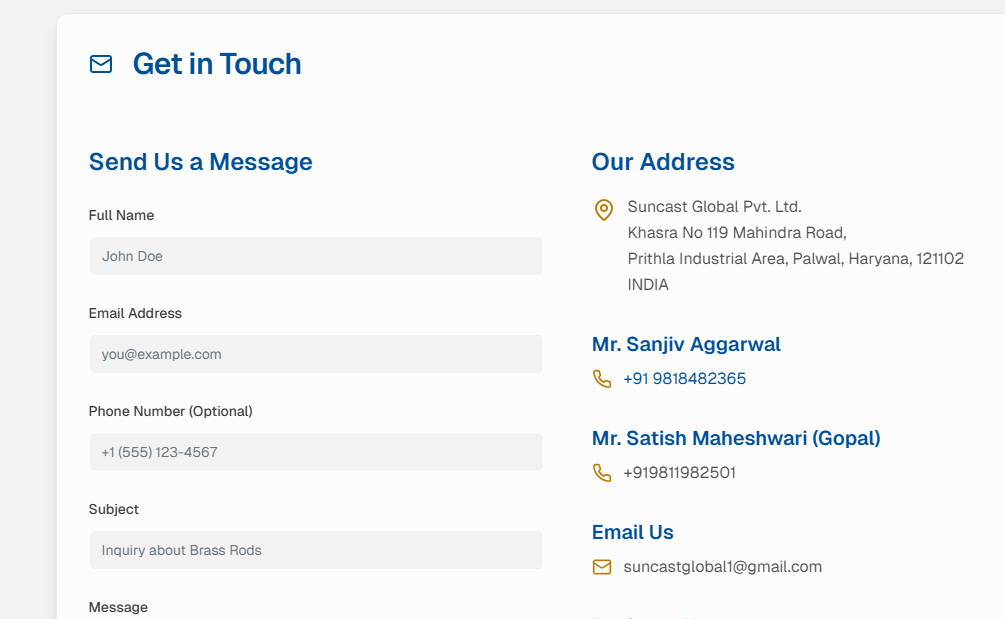
Case Comment by ICA General Counsel, Zak Muscovitch: The Disputed Domain Name currently redirects to <suncast .co .in> which is an active website operated by an Indian company, “Suncast Global Pvt. Ltd.” This website appears legitimate and contact details, including an individual who shares the surname of the Respondent:
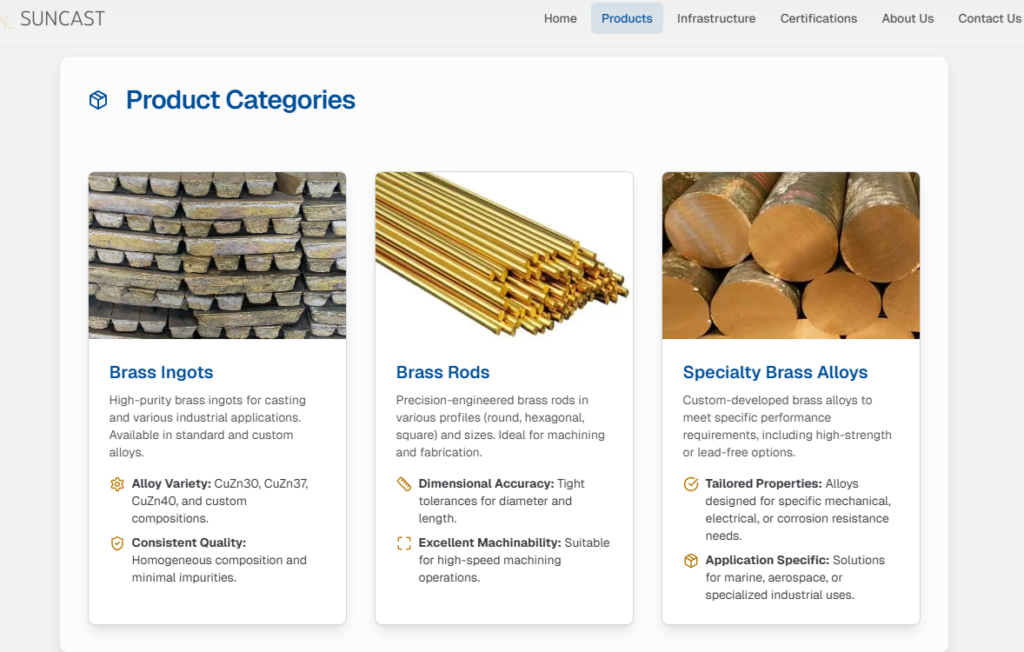
The website features a brass ingots, brass rods, and specialty brass alloys:
The website features images of its apparent facilities, which look substantial:
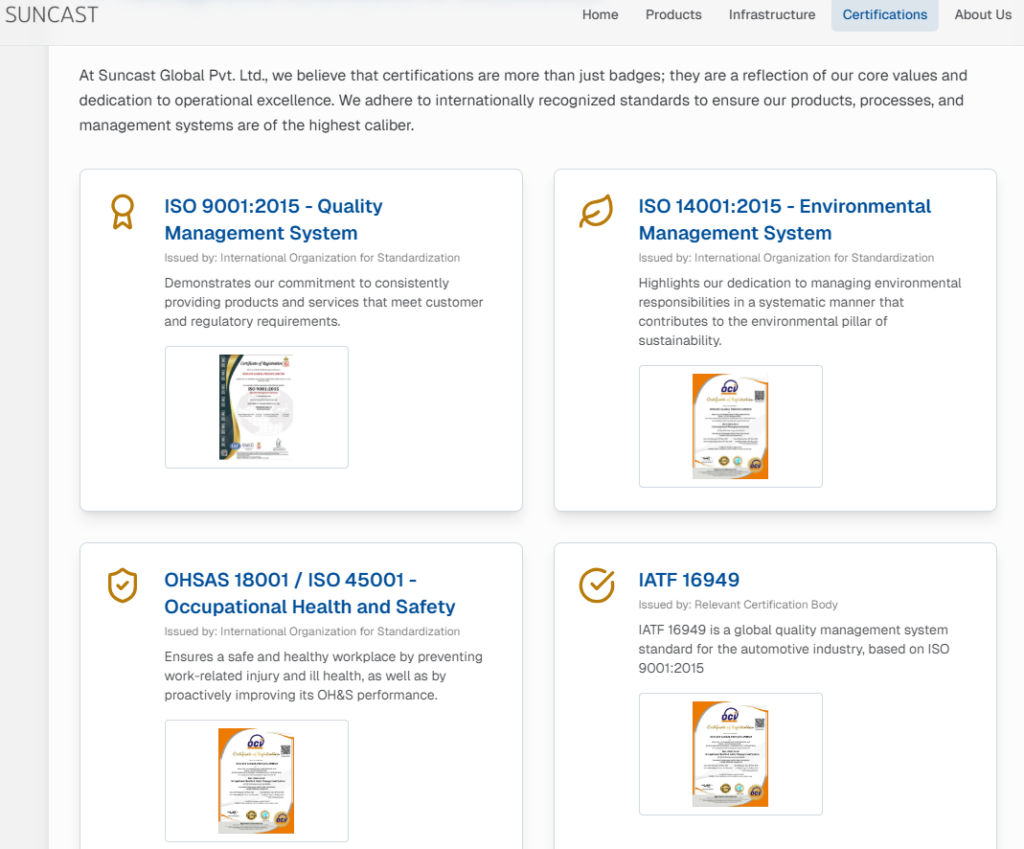
The website lists a number of certifications including images of their apparently official certificates:
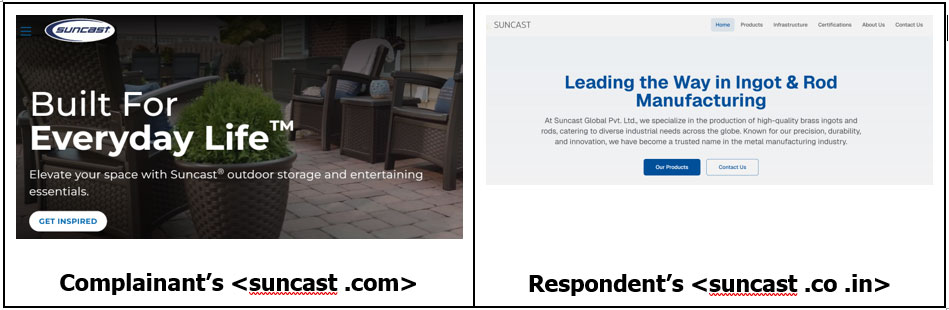
The website looks nothing like the Complainant’s. Moreover, the Complainant’s business is outdoor products, such as patio tables and deck chairs which is markedly different from the Respondent’s apparent business. Given that SUNCAST is not exactly the most unique of brands given its an amalgam of two common words that is the subject of numerous third party trademarks, including in India (See WIPO Global Brand Database), it may have been nothing more than a coincidence that the Respondent adopted a similar brand to the Complainant’s, without any targeting or cybersquatting.
The Panel determined that the Respondent lacks rights and legitimate interest in the Domain Name because inter alia, the “Complainant provides screenshots showing that Respondent uses the disputed domain name to appear to offer Complainant’s or to offer competing products”.
What could explain this apparent discrepancy between the evidence relied upon by the Panel and the evidence obtainable today from the Respondent’s website? According to the decision, the Disputed Domain Name was only registered recently, on May 15, 2025. The Complaint was commenced shortly thereafter, on June 10, 2025. So it is possible that between the registration of the Domain Name on May 15 and the commencement of the Complaint on June 10, 2025, the Respondent had not yet set up a redirect to its .co.in website, and there appeared only a registrar landing page featuring PPC links related to the Complainant. That would (if it occurred) explain the discrepancy between the Complainant’s apparent evidence of “screenshots showing that Respondent uses the disputed domain name to appear to offer Complainant’s or to offer competing products”.
The Panel was appointed on July 2, 2025 and may have only viewed the evidence provided by the Complainant which may have been obtained prior to the Respondent redirecting the Domain Name. However Archive.org shows July 10, 2025 as the earliest archived screenshot as a redirect to <suncast .co .in>. That means that subsequent to the Panel being appointed, the Respondent’s redirected website likely would have appeared online.
Should a Panel review a current website or strictly rely upon the evidence submitted, particularly in a no-Response case? Generally speaking, a Panel should avoid investigating Complaints and should rely upon the evidence submitted by a Complainant. As explained in UDRP Perspectives at 0.2, Panelists are not charged with investigating allegations. Rather, a Panelist has a much more modest duty; to decide a case based upon the evidence presented by the parties themselves. Where that evidence is found wanting, that is not the Panelist’s problem to solve, nor should they attempt to. Nevertheless, it is sometimes a Panelist’s duty and well within a Panelist’s ambit, to verify some basic factual allegations, such as the existence and content of a relied upon trademark registration and the existence and content of a website associated with the disputed domain name. Beyond that, a Panelist should be wary of wading into an inquisitorial approach to cases rather than relying upon the adversarial process.
Was this a case where reviewing the website associated with the Domain Name at the time that the Panelist was reviewing the case file, would have been appropriate? It may have been. Although the general rule is that a Panelist should not seek evidence outside of the filings, checking the website to confirm the evidence filed by the Complainant may have been appropriate. Had the Panelist done so, the Panelist would have likely been struck by the disconnect between the Complainant’s allegations and evidence and the content of the Respondent’s website, and as a result invited the Complainant to update its evidence and arguments.
But even if a Panelist decided not to take into account the evidence as it appeared on what may have been the newly created website, relying so heavily on what may have been a mere registrar post-registration landing page, may have skewed the outcome of this case. Such landing pages, especially erected by a registrar automatically post-registration until a website is created, should raise red flags for Panelists because they likely do not reflect the intent of the registrant-Respondent whatsoever.
In any event, this is a quixotic case and it will be interesting to know exactly what transpired here.

Is RDNH an Equitable Remedy?
WE-EF LEUCHTEN GmbH v. wang yajun, WIPO Case No. D2025-1723
<weef .com>
Panelist: Mr. David H. Bernstein
Brief Facts: The Complainant, founded in 1950, sells lighting, specializing in lighting solutions for urban spaces and architectural environments and has online presence at <we-ef .com>. The Complainant owns more than 24 trademark registrations for variations of its WE-EF mark. One of the Complainant’s earliest registered trademarks is for WE-EF in Hong Kong (applied: July 10, 1991; registered: October 2, 1996). The Complainant’s International trademark registration for WE-EF (dated April 1, 1996) covers the jurisdiction of China. The disputed Domain Name was registered on March 8, 2003 and currently resolves to a landing page. The Complainant alleges that the Respondent is not making legitimate noncommercial or fair use of the disputed domain name and is instead taking advantage of the Complainant’s brand by use of its recognized registered trademarks.
The Complainant further alleges that the Respondent registered the disputed domain name in bad faith, as the Respondent owns several domains consisting of misspellings of well-known brands; his phone number links them to four previous UDRP cases, and the email address identifies them as “Marksmile,” a party accused in news articles of harassing domain owners and scamming. The Respondent denies ownership of the other domain names and argues that these other domain names are not his but rather are affiliated with the accredited Chinese registrar Marksmile. The Respondent finally argues that the Complainant engaged in Reverse Domain Name Hijacking by providing false evidence, or otherwise attempting to mislead the panel, and also by basing the Complaint on bare allegations without supporting evidence.
Held: In the present case, the Complainant alleges that the Respondent knew or should have known about the Complainant’s brand when the Respondent registered the disputed domain name in 2003 but it does not allege any facts that substantiate that claim. Equally weak are the Complainant’s arguments that the Respondent registered the disputed domain name in bad faith based on allegations that the Respondent owns several domain names which are typos of well known brands. Also unsupported is the Complainant’s allegation that the Respondent’s use of the disputed domain name for email establishes bad faith because of the potential for misuse such as phishing and/or misleadingly contacting the Complainant’s customers. Rather, in order to establish bad faith, a complainant needs to submit evidence that the respondent has sent deceptive emails or at least circumstantial evidence that such misconduct is more likely than not.
The Panel further finds that the record with respect to the Respondent’s identity and potential connection to these other parties is opaque; neither party has submitted clear evidence to support its position. In any event, even if found to be an alter ego of these other parties, the Respondent’s bad faith can’t be proven solely by these other parties’ history; there must be current circumstantial evidence showing bad faith against this Complainant’s trademark. In this regard, the Panel notes that the disputed domain name is a four-letter domain name, that the use of the disputed domain name generally references the disputed domain name itself (rather than the Complainant) on a basic landing page, and that the Complainant has put forwarded limited evidence regarding the reputation of its trademark in the Respondent’s jurisdiction at the time of registration of the disputed domain name.
RDNH: The Panel is, though, sympathetic to the Respondent’s request given the weakness of other aspects of the Complaint, including some speculation and conclusory allegations in the Complaint. Moreover, the Complainant does not address the fact that the disputed domain name is a four-letter domain name that may have some value independent of the Complainant’s trademark, or why the Respondent is more likely to have been targeting the Complainant rather than the disputed domain name itself. At the same time, the Panel has questions about the Respondent’s conduct. The Respondent’s response is opaque in a number of respects.
As is in its right, the Respondent has questioned the quality of the evidence submitted by the Complainant, but the Respondent has done little to shed light on its rights or legitimate interests in the disputed domain name, or its use of the disputed domain name over the past two decades, or its relationship, if any, with MarkSmile, whom the Respondent says is a Chinese accredited registrar (but with whom the Respondent appears to share an email address). The Panel is also troubled by the Respondent’s failure to respond to the Complainant’s argument that the Respondent is the owner of MarkSmile and that MarkSmile has been linked to domain name spamming in news reports.
Because a finding of RDNH is a matter of equity, it should not be granted when the Respondent itself has engaged in questionable conduct either in the registration and use of the disputed domain name or in the UDRP proceeding itself.
Complaint Denied
Complainant’s Counsel: Brimondo AB, Sweden
Respondent’s Counsel: Self-represented
Case Comment by ICA General Counsel, Zak Muscovitch: Is RDNH a “matter of equity”, i.e. an “equitable remedy” under the UDRP? Certainly a Respondent’s conduct can factor into a Panelist’s discretion in ordering or denying RDNH. If a Respondent has come with unclean hands, it may be appropriate to deny what may have otherwise been a successful claim of RDNH, even though the availability of RDNH is written right into the Policy itself. But if equity is to be applied to deny RDNH in appropriate circumstances, surely equity can be invoked to deny other remedies which are available under the UDRP, such as transfer, on the basis of laches or condonation, which are also equitable remedies. I think the answer here is best pointed to by the above, atlanticbeech .com case, where the Panel dismissed the Complaint because laches was a factor and had to be dealt with in court.
Panel: Dispute Falls Outside Scope of UDRP Due to Business Relationship Between Parties
YHSGR Holdings, LLC v. Nancy Kowalik, NAF Claim Number: FA2506002160114
<yourhomesoldguaranteedrealty-nancykowalikgroup .com>
Panelist: Mr. Héctor Ariel Manoff
Brief Facts: The Complainant owns the federally registered US trademark for the design mark YOUR HOME SOLD GUARANTEED REALTY OUR NAME IS OUR PROMISE and the pending design mark YOUR HOME SOLD GUARANTEED. The Complainant’s marks are registered in connection with “real estate agency services; real estate brokerage; real estate consultation; residential real estate agency services.” The Complainant owns the domain name <www.yourhomesoldguaranteedrealty-corporate .com> to offer those services in connection with its marks. The Complainant states that Respondent is a previous affiliate of Complainant and entered into a licensing agreement for the use of the Complainant’s marks. The Complainant further alleges that the Respondent has no legitimate interest in the disputed domain name and that the Respondent uses the disputed domain name in bad faith. The Respondent failed to submit a Response in this proceeding.
Held: The Complainant states that Respondent is a previous affiliate of Complainant and entered into a licensing agreement for the use of the YHSG marks, and provided a copy of the contract. Based on the evidence provided by Complainant (the license contract between both parties), the Panel finds that it is necessary for the arbitrator to review and interpret said agreement to reach a decision, which is outside the scope of the UDRP.
The Panel finds that this is a business and/or contractual dispute between two parties that falls outside the scope of the UDRP. See Love v. Barnett, FA 944826 (Forum May 14, 2007) (“A dispute, such as the present one, between parties who each have at least a prima facie case for rights in the disputed domain names is outside the scope of the Policy … the present case appears to hinge mostly on a business or civil dispute between the parties, with possible causes of action for breach of contract or fiduciary duty.”); see also Luvilon Indus. NV v. Top Serve Tennis Pty Ltd., DAU2005-0004 (WIPO Sept. 6, 2005).
Based upon the aforementioned cases and grounds this Panel finds that the present dispute is outside the UDRP and declines to consider the case under the three elements of the Policy. See Frazier Winery LLC v. Hernandez, FA 841081 (Forum Jan. 2, 2007) (holding that disputes arising out of a business relationship between the complainant and the respondent regarding control over the domain name registration are outside the scope of the UDRP).
Complaint Denied
Complainant’s Counsel: Melanie K. Lane of Bekiares Eliezer LLP dba Founders Legal, USA
Respondent’s Counsel: No Response
About the Editor:
 Ankur Raheja is the Editor-in-Chief of the ICA’s new weekly UDRP Case Summary service. Ankur has practiced law in India since 2005 and has been practicing domain name law for over ten years, representing clients from all over the world in UDRP proceedings. He is the founder of Cylaw Solutions.
He is an accredited panelist with ADNDRC (Hong Kong) and MFSD (Italy). Previously, Ankur worked as an Arbitrator/Panelist with .IN Registry for six years. In a advisory capacity, he has worked with NIXI/.IN Registry and Net4 India’s resolution professional.