
Panel’s Insistence on Evidence of Targeting: Price and Passive Holding Are No Substitute for Bad Faith
The decision reflects a measured and structured application of settled UDRP principles to a fact pattern that often invites overreach. The Panelist, Mr. Nick J. Gardner, approaches the case with a disciplined focus on targeting, resisting the temptation to conflate high resale value or long-term passive holding with bad faith. Continue reading commentary here.
We hope you will enjoy this edition of the Digest (vol. 6.17) as we review these noteworthy recent decisions with expert commentary. (We invite guest commenters to contact us):
‣ Panel’s Insistence on Evidence of Targeting: Price and Passive Holding Are No Substitute for Bad Faith (agena.com *with commentary)
‣ Failed Acquisition and Weak Targeting Support RDNH in $2.9 Million Two-Letter Domain Dispute (qb.com *with commentary)
‣ Failure to Prove Common Law Rights at the Relevant Time Defeats Complaint (lyricalassetmanagement.com *with commentary)
‣ Passing Off Using Identical Mark Supports Transfer in <.ai> Domain (lafitness.ai *with commentary)
‣ Disclaimer of Entire Text Leaves No Rights to Enforce Under the Policy (betterfax.com *with commentary)
‣ Panelist: Affiliate Site Satisfies Oki Data Under a More Flexible, Holistic Approach (kirkland-golf.com *with commentary)
Panel’s Insistence on Evidence of Targeting: Price and Passive Holding Are No Substitute for Bad Faith
<agena .com>
Panelist: Mr. Nick J. Gardner
Brief Facts: The first Complainant, Centaurus Group (formerly Centaurus Développement), is a French simplified joint stock company (société par actions simplifiée) incorporated in Angers, France. It is the holding company of the other three Complainants. The corporate group trades under the name “AGENA 3000”, providing software, enterprise resource planning (ERP), and data management solutions, and has operated under the “AGENA” brand for approximately 45 years. The first Complainant is the registered owner of a French semifigurative trademark, described as the A3 AGENA 3000 mark, registered on June 10, 1999 and also holds a portfolio of domain names incorporating the term “agena.” The disputed Domain Name was registered by the Czech Respondent on August 10, 2000, and resolves to a website offering the disputed Domain Name for sale at a price of USD $81,025.
The Complainant alleges that the disputed Domain Name is listed for speculative commercial resale on BrandBucket at a price grossly disproportionate to any documented registration costs. The passive holding of the disputed Domain Name over 25 years, combined with its commercial listing for resale, constitutes bad faith pursuant to the principles articulated in Telstra Corporation Limited (WIPO D2000-0003). The Respondent contends that the “AGENA” is a common generic term with multiple well-established meanings that long predate any rights the Complainants could claim. The Respondent holds the disputed Domain Name for its inherent value as a short, memorable, premium generic-word .com domain. The asking price of USD $81,025 was set by BrandBucket’s standard valuation model for premium generic-word domains and was not directed at the Complainants.
Held: The fact that the Respondent offers the disputed Domain Name for sale for a substantial price is not of itself indicative of lack of rights or legitimate interests. If a domain name is legitimately held the registrant can as a general rule ask whatever price it wishes, as long as it is not specifically targeting a trademark owner, see WIPO Overview 3.1, section 2.1. In the present case, the Panel finds that “agena” is not a word that is in common usage but the Respondent’s evidence shows it is nevertheless a word with a range of documented, independent, pre-existing meanings. Further, there is no evidence as to the fame or reputation the Complainants enjoyed in the year 2000 and no evidence to suggest the Czech Respondent should have had any knowledge of the Complainants or their use of the term AGENA. In all the circumstances, the Panel finds that the Complainants have failed to establish a prima facie case that the Respondent lacks rights or legitimate interests in the disputed Domain Name.
The Panel further declines to find bad faith on the evidence before it, given that the disputed Domain Name was registered on August 10, 2000 – some 26 years ago. The Complainants’ registered trademark is the composite mark A3 AGENA 3000, was first registered on June 10, 1999. However, there is no evidence of the Complainant’s reputation at the time or that the Respondent registered the disputed Domain Name with the Complainants and their trademark in mind. Further, as regards the offer for sale on BrandBucket, Policy Paragraph 4(b)(i) requires that the domain name be registered primarily for the purpose of selling it to the complainant or a competitor of the complainant for an amount exceeding out-of-pocket costs. There is no evidence in the record that the Respondent registered the disputed Domain Name in 2000 with any particular purchaser in mind, still less the Complainants specifically. In cases where a domain name is legitimately held, and there is no evidence of targeting, the registrant is generally entitled to offer it for sale at whatever price it likes. Finally, the passive holding doctrine does not assist the Complainants on these facts.
RDNH: Having considered the matter carefully, the Panel finds that a finding of RDNH is warranted in this case. The Complainants, legally represented by experienced counsel, have no registered trademark in the standalone word “AGENA,” which is part of the composite, semi-figurative A3 AGENA 3000 mark. Further, the disputed Domain Name was registered in August 2000, a quarter of a century ago. Well-established UDRP precedent, amply documented in the WIPO Overview 3.1, cautions that establishing bad faith in respect of a long-standing domain name registration requires cogent evidence of targeting. The Complainants provided none.
Finally, the Complainants rely on the passive holding of the disputed Domain Name for 25 years, combined with its listing for sale, to argue that it necessarily constituted bad faith registration and use. This overstates the position significantly. The Panel considers that the Complainants long knew they did not own the disputed Domain Name and took no action until now. The Panel suspects that is because the Complainants understood the fundamental weakness of their case. What has prompted them to bring the present complaint now is unknown but it seems to the Panel to be an entirely speculative attempt which had no real prospects of success.
Complaint Denied (RDNH)
Complainant’s Counsel: H2O Avocats, France
Respondent’s Counsel: Self-represented
Commentary Edited and Approved by ICA General Counsel, Zak Muscovitch:
The decision reflects a measured and structured application of settled UDRP principles to a fact pattern that often invites overreach. The Panelist, Mr. Nick J. Gardner, approaches the case with a disciplined focus on targeting, resisting the temptation to conflate high resale value or long-term passive holding with bad faith.
On rights or legitimate interests, the Panel’s reasoning is appropriately grounded in the evidentiary burden. While “agena” is not a dictionary word in the strict sense, the Panel accepts that it carries multiple independent meanings and is capable of being held for its intrinsic value as a short, brandable .com. This is an important clarification: the UDRP does not require a term to be strictly generic to support a legitimate investment rationale. The Panel’s analysis aligns with section 2.1 of the WIPO Overview 3.1 in recognizing that offering a domain name for sale, even at a substantial price, is not inherently illegitimate absent evidence of targeting.
The bad faith analysis follows in a similarly orthodox manner. The 2000 registration date proves decisive, and the Panel properly insists on contemporaneous evidence of the Respondent’s awareness of the Complainants. The record contained none. Notably, the Panel does not allow the Complainants to bridge this evidentiary gap through retrospective arguments based on current business activity or later-developed reputation. This temporal discipline is critical in maintaining coherence in UDRP jurisprudence and is likewise emphasized in UDRPPerspectives.org, “Bad Faith – Timing and Targeting” underscores that bad faith must be assessed at the time of acquisition and cannot be reconstructed ex post facto based on subsequent developments. The treatment of the BrandBucket listing is also well handled: without evidence that the domain was registered with a specific trademark owner in mind, paragraph 4(b)(i) is simply not engaged.
The Panel’s rejection of the passive holding argument is equally sound. Telstra is not a shortcut to bad faith; it requires a factual matrix that supports an inference of targeting. Here, the absence of evidence as to reputation at the time of registration, combined with the plausibility of a domain investment rationale, makes reliance on passive holding untenable. This aligns with UDRPPerspectives.org, “Passive Holding (Telstra Doctrine)”, which treats passive holding as a context-dependent doctrine requiring indicia of targeting rather than giving rise to any presumption of bad faith.
The RDNH finding is justified and provides a good example to other Panelists for determining which circumstances should lead to RDNH. The Panel places appropriate weight on the age of the domain name, the usage of the term beyond the Complainant, the absence of rights in the standalone term “AGENA,” and the complete lack of evidence of targeting. Particularly notable is the Panel’s conclusion that the Complainants, represented by experienced counsel, should have appreciated these deficiencies from the outset. The characterization of the Complaint as speculative underscores a broader concern – also reflected in UDRPPerspectives.org, “Reverse Domain Name Hijacking (RDNH)” – with attempts to use the UDRP as a backdoor acquisition mechanism for valuable, long-held domain names.
This decision is a careful and credible application of established doctrine. The Panel’s disciplined insistence on evidence – particularly as to targeting at the time of registration – serves as a useful reminder that neither price, longevity, nor passive holding can substitute for the core requirement of bad faith.
Failed Acquisition and Weak Targeting Support RDNH in $2.9 Million Two-Letter Domain Dispute
可信公司 (Intuit Inc.) v. 闫川 (Chuan Yan), ADNDRC (HKIAC) Case No. HK-2502057
<qb .com>
Panelists: Ms. Zhang Ping (Presiding), Mr. Lian Yunze, and Mr. Yang Anjin
Brief Facts: The Complainant, a U.S.-based financial technology company, owns Chinese figurative “qb” marks (registered 2016–2017) and U.S./EU “QB” word marks, claiming they have acquired distinctiveness through long-term use. The Respondent, a Chinese national, acquired the disputed Domain Name on 29 December 2017 for approximately RMB 18.85 million (approx. USD 2.9 million). From 2018 to 2020, he operated a cryptocurrency exchange called “QB Exchange” using the disputed Domain Name. After discontinuing operations due to compliance concerns, he listed the Domain Name for sale. In early 2024, the Complainant anonymously offered USD 2.5 million to purchase the disputed Domain Name through a broker. Negotiations failed after the Respondent declined to finalize due to internal ownership uncertainties.
Procedural Issues: The Complainant filed a Complaint in English, the language of the registration agreement. The Respondent requested the language be changed to Chinese, noting both parties’ counsels were proficient in Chinese and most evidence was in Chinese or from Chinese sources. The Complainant agreed and filed an amended Complaint in Chinese, adding new allegations that the Respondent’s cryptocurrency operations were illegal under Chinese regulations. The Respondent sought to exclude these supplemental submissions. Respecting the parties’ agreement, the Panel determined Chinese as the language of the proceeding.
However, given the factual complexity and sharp disputes, and to ensure procedural fairness, the Panel permitted one round of supplemental submissions on: (i) whether the Respondent’s crypto currency operations constituted illegal activity depriving him of legitimate rights; and (ii) whether the Complainant’s conduct amounted to Reverse Domain Name Hijacking (“RDNH”). After reviewing the parties’ submissions, the Panel found them substantially helpful in clarifying key facts and not unduly delaying the proceedings, and therefore accepted them as an evidentiary basis for the decision.
Held: The disputed Domain Name is a two-letter short domain name with inherent value and multiple possible meanings. Here, the Respondent paid RMB 18.85 million for the disputed Domain Name, evidencing good-faith acquisition based on its inherent value. “QB” is the pinyin abbreviation for “QianBao” (wallet), relevant to his intended cryptocurrency business. From 2018 to 2020, he actively used the Domain Name for legitimate business operations under “QB Exchange,” with evidence of website operation and social media promotion. The Panel decided that the Respondent has a legitimate interest in the disputed Domain Name.
The Complainant’s allegation of illegality was rejected. The cited “Announcement on Preventing Risks of Token Issuance Financing” is a policy notice issued by several Chinese government departments with low legal effect, primarily targeting token issuance platforms. The Complainant provided no evidence that the Respondent’s operations fell within the scope of platforms defined by the Announcement. For two-letter domain names, a higher threshold applies: the complainant must show the respondent knew of its mark at registration, or that the letters “uniquely or at least predominantly” point to the complainant (Banco do Brasil S.A. v. The Universal Kingdom, LLC, D2008-0389).
The Complainant’s Chinese “qb” marks were registered only 1.5 years and 1.5 months before the Respondent’s acquisition of the domain name, and its evidence of “QB” recognition, limited to a few online forum references, was insufficient to establish that “QB” pointed uniquely or predominantly to the Complainant in China. The Respondent actively used the Domain Name for two years and current non-use was explained by compliance adjustments. Offering the domain name at a price consistent with its acquisition cost does not constitute bad faith.
RDNH: The Complainant’s failure to purchase the Domain Name demonstrated that its true motive was not to combat infringement or protect its own rights, but rather to exploit legal proceedings in an attempt to acquire, at low cost, a high-value asset. With professional assistance, the Complainant knew or should have known that the disputed Domain Name had been actively used, yet the initial complaint omitted this fact. Its unsupported illegality claim, based solely on a policy notice, forced the Respondent to incur unnecessary costs and risked reputational damage.
While the Complaint’s denial alone does not establish RDNH, the combination of the failed purchase attempt, the omission of material facts, the unsupported illegality allegations and other facts demonstrated an attempt to misuse the UDRP to acquire a valuable asset after commercial negotiations failed.
Complaint Denied (RDNH; Chinese Language)
Complainant’s Counsel: Xuan Feng, Hanzhong Bai of Beijing NTD Law Office
Respondent’s Counsel: Wang Jin, Zhang Ying of Beijing Jincheng Tongda & Neal Law Firm
Commentary Edited and Approved by ICA General Counsel, Zak Muscovitch:
We are very pleased this week to include a very important case from the ADNDRC. This decision arises from a failed attempt to acquire a high-value two-letter domain name, followed by a complaint supported by a weak targeting case and an unsupported allegation.
On rights or legitimate interests, the Panel gives appropriate weight to the nature of the asset. The disputed Domain Name is a two-letter .com, and the Respondent’s RMB 18.85 million acquisition cost (approximately USD 2.9 million) is not incidental – it is probative of a good-faith investment in a scarce digital asset. The Respondent’s use of “QB” as a pinyin abbreviation for “QianBao” (wallet) in connection with a cryptocurrency exchange further grounds the registration in a plausible, independent rationale. This is not merely asserted – the Respondent operated “QB Exchange” for two years with supporting evidence of active use.
The Panel’s reliance on the well-established approach in cases involving two-letter domain names, where the complainant must show that the string uniquely or predominantly refers to it, is well placed. In this regard, its citation to Banco do Brasil S.A. v. The Universal Kingdom, LLC (WIPO Case No. D2008-0389) (Mr. Adam Taylor (Presiding), Mr. Scott Blackmer, with Gabriel F. Leonardos dissenting) is particularly significant. Although that case included a dissent, it articulated a principled framework for short domain names, requiring a complainant to show that the disputed string “uniquely or at least predominantly” refers to it. That formulation has carried weight well beyond the case itself. Nearly two decades later, this decision reflects the continued influence of that reasoning, particularly where the domain name has multiple plausible meanings – including pinyin-based usage – and is capable of independent commercial value.
On bad faith, the Panel focuses on what was known, or could reasonably have been known, at the time of acquisition. The Complainant’s rights were relatively recent, and its evidence of recognition in China was limited. There was no basis to conclude that “QB” pointed uniquely, or even predominantly, to the Complainant in 2017. This is consistent with UDRPPerspectives.org, “Bad Faith – Timing and Targeting,” which emphasizes that bad faith must be assessed at the time of acquisition, not reconstructed after the fact.
The Complainant’s reliance on alleged illegality were unpersuasive to the Panel. The Panel examines the cited Chinese policy notice and finds that it does not establish that the Respondent’s activities were unlawful. More importantly, the allegation cannot substitute for evidence of targeting. Even if regulatory concerns were engaged, they do not relieve a complainant of the burden of showing that the domain name was registered with the complainant in mind. The UDRP is not a forum for resolving contested regulatory questions.
The RDNH finding follows from the record. The Complainant attempted to purchase the Domain Name for USD $2.5 million and, after negotiations failed, filed a complaint supported by a weak record on targeting and an unsupported allegation of illegality. The Respondent’s prior active use of the Domain Name further undermined the Complaint, yet was not meaningfully addressed. Against that backdrop, the Respondent’s acquisition of the Domain Name for approximately USD 2.9 million makes the Complainant’s position particularly difficult to sustain. The Panel was entitled to conclude that this was not an effort to stop infringement, but an attempt to acquire a valuable asset after a failed commercial negotiation. This aligns with UDRPPerspectives.org, “Reverse Domain Name Hijacking (RDNH),” which identifies failed acquisition attempts combined with weak or incomplete cases as indicia of abuse.
This decision reinforces two points. First, domain names, particularly domain names that can lend themselves to any number of enterprises such as two and three letter .coms, but not only such domain names, require clear evidence that the respondent targeted the complainant at the time of acquisition. Second, a failed purchase attempt, coupled with a weak evidentiary record, will support a finding that the UDRP has been used as a fallback acquisition strategy.
Failure to Prove Common Law Rights at the Relevant Time Defeats Complaint
Lyrical Asset Management LP v. Jonathon Platt, WIPO Case No. D2026-0853
<lyricalassetmanagement .com>
Panelist: Mr. Lawrence K. Nodine
Brief Facts: The Complainant and its predecessor have, since 2004, used the trademark LYRICAL in various business names, including Lyrical Holdings, LLC, Lyrical Partners, L.P., and Lyrical Asset Management, L.P., in connection with financial services, namely “investment management and advisory services to institutional investors, high-net-worth individuals, and broadly held mutual funds.” In 2003, the Complainant registered the domain name <lyricalpartners .com>, and on January 30, 2013, the Complainant registered <lyricalam .com>, which resolves to its official website. The Complainant’s affiliate and licensor, Lyrical Corp. II, owns a U.S. registration for the mark “Lyrical,” registered on August 19, 2025. The disputed Domain Name was registered on June 21, 2012, and does not currently resolve to an active website. However, at some point it redirected to the Financial Times, a third-party media website, <markets .ft .com/data/funds/us>, that offered information about the financial industry.
The Complainant alleges that its Internet presence since 2003 established common law trademark rights that predate the Respondent’s registration of the disputed Domain Name in 2012. The Complainant has operated as Lyrical Asset Management since 2008 and has extensively promoted its financial services under this mark, further supporting its claimed rights. The Respondent contends that the Respondent selected and registered the Domain Name in 2012 to reflect his musical background (“Lyrical”) and his professional focus (“Asset Management”), with the genuine intent to use it as the online identity of a future-focused private infrastructure investment and advisory firm, not to target or exploit the Complainant. The Complainant has adduced no evidence that, as of 2012, the composite phrase “Lyrical Asset Management” had acquired distinctiveness or secondary meaning uniquely identifying the Complainant. Any trademark rights asserted by the Complainant are therefore inherently weak and must be narrowly construed under the Policy.
Held: The Complainant claims it has extensively promoted its financial services under the mark but provides no evidence to support this claim. The Complainant does not offer any evidence about the character, quantity, or scope of its use of the mark before 2012. The Complainant does submit several articles appearing in financial industry publications that mention the Complainant in 2026 or 2025, but this is fourteen years after the disputed Domain Name was registered. The Complainant also submits an article from 2017 in an online resource entitled “Institutional Investor,” but the Complainant does not submit any information about the distribution or circulation of this article, which, in any event, was published five years after the disputed Domain Name, was registered. This evidence is not sufficient to support a finding of common law rights in 2012 under the Policy. WIPO Overview 3.1.
Even if the Panel were to assume that the Complainant had acquired common law rights before 2012, the Complainant offers no evidence about the strength of the Complainant’s reputation in 2012. The need for such evidence is fundamental because the question is not simply whether the Complainant had acquired trademark rights by 2012, but whether the Respondent was aware of those rights and targeted them in bad faith. To persuade the Panel that the Respondent probably knew of the Complainant’s mark, the Complainant must offer some evidence that the Complainant promoted the mark and that it was well known in 2012. The Complainant did not do so. Accordingly, the Panel finds that the Complainant has not proved, by a preponderance of the evidence, that the Respondent registered the disputed Domain Name in bad faith.
Complaint Denied
Complainant’s Counsel: Faegre Drinker Biddle & Reath, United States
Respondent’s Counsel: Self-represented
Commentary Edited and Approved by ICA General Counsel, Zak Muscovitch:
This decision turns on a straightforward but often overlooked point – the relevant inquiry is not whether trademark rights exist at the time of filing, but whether they were sufficiently known at the time of registration. Evidence of post-registration common law rights may establish standing, but it does not address the requirement to prove bad faith registration.
The Panel focuses on the Complainant’s failure to provide evidence of the nature, extent, and recognition of its alleged mark as of 2012. While the Complainant asserted long-standing use of “Lyrical” in various business names, it provided no meaningful evidence of the character, scope, or recognition of the composite term “Lyrical Asset Management” as of 2012. The materials submitted were largely retrospective, including articles published years after the Domain Name was registered. As the Panel makes clear, such evidence does not establish common law rights at the relevant time under the Policy.
Even assuming some level of prior use, the Panel correctly distinguishes between the existence of rights and their market recognition. The critical question is not simply whether rights existed, but whether the Respondent was likely aware of them and registered the Domain Name with the Complainant in mind. On that point, the record was silent. This is consistent with UDRPPerspectives.org, “Bad Faith – Timing and Targeting,” which emphasizes that bad faith requires evidence of targeting at the time of registration.
The decision also reflects a reasonable approach to the Respondent’s explanation. The combination of “lyrical” and “asset management” is not so unique that it is unimaginable that it was conceived of independently, and the Respondent’s asserted rationale – linking a musical background with a professional focus – was not implausible on its face. In the absence of evidence of reputation or targeting, the Panel was not prepared to infer bad faith in such circumstances.
Without contemporaneous evidence of recognition and targeting, claims based on later-developed reputation or conclusory assertions of use will not succeed under the UDRP.
Passing Off Using Identical Mark Supports Transfer in <.ai> Domain
Fitness International, LLC v. Pinkesh Zaveri, Omnipractice Inc, WIPO Case No. DAI2026-0010
<lafitness .ai>
Panelist: Ms. Kathryn Lee
Brief Facts: The Complainant, founded in 1984, is a United States-based chain of health fitness centers, currently operating approximately 700 centers with 10,000 employees across the United States and Canada. It holds multiple trademark registrations for the LA FITNESS/L.A. FITNESS marks across the United States, Canada, Japan, and Mexico, the earliest being the U.S. trademark registered on November 23, 1993. The disputed Domain Name was registered on November 4, 2024, and resolves to a website advertising a commercial fitness-related business by the name of “LA Fitness”, while displaying the LA FITNESS at the top center of the page, a photo of an interior of a gym, the text “Copyright © 2025 LA Fitness – All Rights Reserved” at the footer, the slogan “Get Fit, Stay Active” over a large banner image, and an interactive form for collecting inquiries from users regarding the website’s services.
The Complainant alleges that given the fame of the LA FITNESS mark, it is implausible to believe that the Respondent was not aware of the mark at the time of registration. Rather, the Complainant contends that the circumstances of the case show that there was bad faith registration, specifically, that the Respondent used the disputed Domain Name to set up a website imitating the Complainant to pass itself off as the Complainant and divert Internet users seeking the Complainant to the Respondent’s website. The Respondent did not formally reply to the Complainant’s contentions. According to the emails forwarded by the Complainant, the Respondent replied to the Complainant’s email after the filing of the Complaint, stating: “We bought the domain. We are happy to transfer the domain for a fee. Would you like to make a fair offer?” and “We can settle this for $5000. Sounds fair?”
Held: Having reviewed the available record, the Panel finds the Complainant has established a prima facie case that the Respondent lacks rights or legitimate interests in the disputed Domain Name. The Respondent has not rebutted the Complainant’s prima facie showing and has not come forward with any relevant evidence demonstrating rights or legitimate interests in the disputed Domain Name such as those enumerated in the Policy or otherwise. Furthermore, the Respondent is using the disputed Domain Name to display a website confusingly similar to the official website of the Complainant which indicates that the Respondent passed itself off as the Complainant. Panels have held that the use of a domain name for illegitimate activity – here, claimed passing off – can never confer rights or legitimate interests on a respondent. WIPO Overview 3.1, section 2.13.1.
The Panel further notes that the Respondent registered the disputed Domain Name containing the Complainant’s mark, and linked it to a website displaying the LA FITNESS mark advertising fitness-related services. The Panel finds that the Respondent most likely was aware of the Complainant and its trademark and targeted the Complainant by registering the disputed Domain Name. Further, Panels have found that the mere registration of a domain name that is confusingly similar to a widely-known trademark by an unaffiliated entity can by itself create a presumption of bad faith. WIPO Overview 3.1, Section 3.1.4. Panels have also held that the use of a domain name for illegitimate activity – here, claimed passing off constitutes bad faith. WIPO Overview 3.1, section 3.4. Having reviewed the record, the Panel finds the Respondent’s registration and use of the disputed Domain Name constitutes bad faith under the Policy.
Transfer
Complainant’s Counsel: Neal & McDevitt, United States
Respondent’s Counsel: Self-represented
Commentary Edited and Approved by ICA General Counsel, Zak Muscovitch:
This is a straightforward case of targeting, where the Respondent registered a domain name identical to a well-known mark and used it to operate a website that closely mimicked the Complainant’s business.
On rights or legitimate interests, the Panel’s reasoning follows established principles. The Respondent used the disputed Domain Name to host a fitness-related website prominently displaying the LA FITNESS mark, along with imagery and content consistent with the Complainant’s business. This was not a case of descriptive or coincidental use. Rather, the use supported an inference of passing off, which cannot confer rights or legitimate interests.
On bad faith, the circumstances point clearly to targeting. The LA FITNESS mark is long-established and widely used, and the Respondent registered a domain name identical to that mark and used it in connection with similar services. The design and content of the website reinforce the conclusion that the Respondent sought to create an impression of affiliation. This is consistent with UDRPPerspectives.org, “Bad Faith – Timing and Targeting,” which recognizes that targeting may be inferred where a respondent adopts a well-known mark and uses it in a manner that trades on its goodwill.
The Respondent’s post-complaint communications further support the Panel’s conclusion. The suggestion that the dispute could be resolved for USD $5,000 does not reflect a bona fide explanation for registration, but rather reinforces the inference that the Domain Name was registered with the Complainant in mind.
This case illustrates a clear application of the Policy: where a domain name identical to a well-known mark is used to operate a lookalike commercial website, panels will readily infer both lack of legitimate interest and bad faith registration and use.
Disclaimer of Entire Text Leaves No Rights to Enforce Under the Policy
Deposit Dox, Inc. v. Farjad Fani/Saascentral, Forum Claim No. FA2603002209991
<betterfax .com>
Panelist: Mr. Nick J. Gardner
Brief Facts: The Complainant operates an online internet fax service under the trademark FAXBETTER, holding USPTO registration dated April, 9, 2013. The disputed Domain Name was registered on January 19, 2022 by the Respondent and is apparently being used to operate an online internet fax service in direct competition with the Complainant’s FAXBETTER-branded service. The Complainant alleges that the disputed Domain Name constitutes a simple transposition, a reversal of the word order, of the two constituent elements of its mark, “Fax” and “Better,” and that UDRP panels have consistently held that rearrangement of a trademark’s constituent terms does not negate confusing similarity.
The Complainant further alleges that the Respondent’s use of the Domain Name to operate a directly competing internet fax service does not constitute a bona fide offering of goods or services. Critically, the Complainant also alleged that on or about March 5, 2026, following receipt of the Cease and Desist letter and without any communication to the Complainant, the Respondent altered the branding on its website from “BetterFax” to Complainant’s exact registered mark, “FaxBetter,” and simultaneously manipulated its search engine metadata to cause Respondent’s website to appear in search results under the “FaxBetter” designation. The Respondent failed to submit a Response in this proceeding.
Held: The difficulty that arises here is that Complainant’s registered trademark is for a stylised mark which contains a disclaimer of textual elements. This was not an issue that was mentioned in the Complaint although it is clearly apparent on inspection of the annexed trademark certificate – “NO CLAIM IS MADE TO THE EXCLUSIVE RIGHT TO USE “FAX BETTER”. Whilst the effect of this registration is a matter of US law it appears to the Panel that the trademark registration does not give Complainant any rights in the term faxbetter and does not entitle the Complainant to prevent others using that term unless portrayed in graphic form within the scope of the mark as shown and described. See Minibar North America Inc. v. Ian Musk & GEMS Global Electronic Minibar Systems AS, WIPO Case No. D2005-0035, wherein the domain name at issue was <minibarsystems .com> and complainant’s registered mark was a device mark which included in stylised form the words “MINIBAR SYSTEMS”. It contained a disclaimer that “it does not provide the exclusive right to use the words “Minibar Systems”, save where it is used as part of the device trademark”.
The panel went on to state in <minibarsystems .com>: “The fact that words incorporated into either a longer word trademark or in a device mark have been disclaimed does not necessarily mean that a finding of confusing similarity with a domain name using those words is not possible.” The words “Minibar Systems” have been disclaimed and constitute essentially the entire domain name. With the disclaimer discounted, little remains to support confusing similarity. The panel concluded the complainant lacked relevant trademark rights. The Panel agrees with that approach adopted in the <minibarsystems .com> and as set out in WIPO Overview 3.1 at ¶1.10. The situation in the present case is precisely the same. The Complainant has disclaimed the entirety of the textual content in the trademark relied upon Respondent’s adoption of the term BETTERFAX on its own is not confusingly similar to any term that the Complainant has relevant trademark rights in. There is no evidence in the present case to support a finding that the Complainant has common law trademark rights in the term FAXBETTER.
Complaint Denied
Complainant’s Counsel: Ramanathan Chinnaiah, USA
Respondent’s Counsel: No Response
Commentary Edited and Approved by ICA General Counsel, Zak Muscovitch:
This decision turns on a threshold issue that is sometimes overlooked – whether the complainant has enforceable trademark rights in the textual string reflected in the domain name.
The Panel focuses on the effect of the Complainant’s USPTO registration, which is for a stylised mark that includes a disclaimer of the words “FAX BETTER.” As the Panel notes, this means the registration does not confer exclusive rights in the textual elements themselves. Where the entirety of the textual content is disclaimed, there may be little or nothing left that can support a finding of confusing similarity under the Policy. This is consistent with UDRPPerspectives.org, “Disclaimed Words,” which notes that a disclaimer removes any claim to exclusive rights in the disclaimed terms apart from the mark as a whole, and requires additional evidence that those terms have acquired secondary meaning. This is a good reminder to Panelists to always check for disclaimers, particularly when a mark contains what appears to be a potentially descriptive word or phrase.
In reaching this conclusion, the Panel relies on WIPO Case No. D2005-0035 (<minibarsystems .com>), where a similar issue arose. There, the panel held that while disclaimers do not automatically preclude a finding of confusing similarity, they can be decisive where the disclaimed terms effectively constitute the whole of the mark. That reasoning is applied directly here. With the disclaimer discounted, the Complainant is left without enforceable rights in “faxbetter” as a textual string.
The Panel also notes the absence of any evidence of common law rights. The Complainant provided no material showing that “FAXBETTER” had acquired distinctiveness or recognition as a standalone mark. In those circumstances, the claim could not succeed even before reaching questions of rights or legitimate interests or bad faith.
This decision illustrates a basic but important point: a trademark registration that disclaims the entirety of the textual elements relied upon may be insufficient to support a UDRP complaint, particularly in the absence of evidence of acquired distinctiveness.
Panelist: Affiliate Site Satisfies Oki Data Under a More Flexible, Holistic Approach
Costco Wholesale Corporation v. Muhammad Sufyan Afzal, Forum Claim No. FA2603002210260
<kirkland-golf .com>
Panelist: Mr. Jeffrey M. Samuels
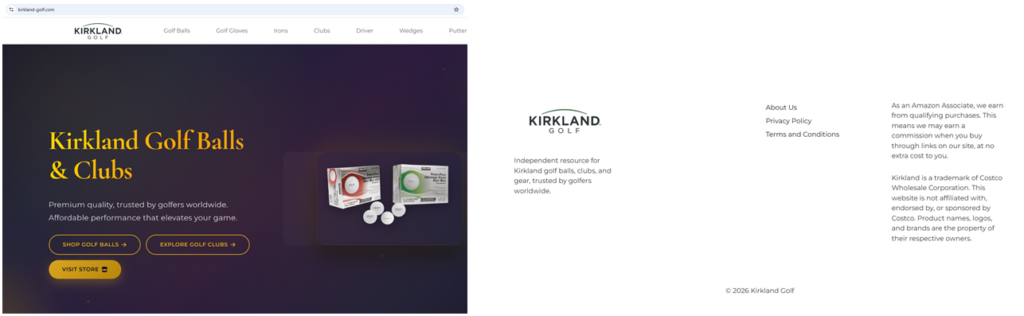
Brief Facts: The Complainant is a global warehouse club retailer operating 914 stores worldwide with approximately 145 million cardholders. It owns multiple trademark registrations for its KIRKLAND SIGNATURE marks, including U.S. registrations, and has used the mark since at least 1992 on a wide variety of products including sporting equipment. The disputed Domain Name was registered on September 8, 2025, and resolves to a website using the KIRKLAND SIGNATURE marks to promote golf products described as from the “Trusted Costco Brand” and “Backed by Costco’s reputation,” with “Check Price” buttons redirecting users to Amazon affiliate links for secondary market listings of Complainant’s genuine golf products.
The Complainant alleges that the Respondent is not using the disputed Domain Name for bona fide offerings of goods or services or for making a legitimate noncommercial or fair use of the disputed Domain Name. Instead, the Respondent is using the Infringing Domain name and the offer of Complainant’s products to redirect users to affiliate links for Respondent’s commercial gain. The Respondent contends that it “registered and used <kirkland-golf .com> as an independent affiliate and informational website that reviewed and listed golf products sold under the Kirkland brand. The Respondent states that the site provided genuine product information to consumers and linked to legitimate product listings. This constitutes a bona fide use of the domain. The Respondent says that it is not an impersonator of Costco and was not selling counterfeit goods.”
Held: The disputed website indicates that the Respondent is an Amazon Associate and, thus, the Respondent earns a commission when one buys through links to the disputed website. The WIPO Overview 3.1. ¶2.8.1 refers to the four-part test first set forth in 2001 in Oki Data America, Inc. v. ASD Inc, WIPO Case No. 2001-0903, as the applicable standard to determine whether a reseller or distributor has established a legitimate interest in the disputed Domain Name. The Panel applies the Oki Data four-part test, noting that other UDRP panels have applied Oki Data criteria even where the complainant has not authorized the respondent to use its trademark, and finds that the Respondent satisfied its factors: the Respondent was offering genuine KIRKLAND brand golf products via Amazon affiliate links; the site sold only KIRKLAND brand goods; the website included a disclaimer stating “Kirkland is a trademark of Costco Wholesale Corporation. This website is not affiliated with, endorsed by, or sponsored by Costco,” albeit on the last page; and there was no evidence of the Respondent cornering the market in the Complainant’s trademark.
The Panel also refers to the reformulated “Lost Mary” criteria (Dashing Joys Ltd v. Mohammed Zafar, CAC July 16, 2025), under which a disclaimer is not a strict condition sine qua non and any clarity about the website’s origin is sufficient to demonstrate fair use. Further, as noted in the July 30, 2025 (Volume 5.30) issue of the Internet Commerce Association, “a modified version of the Oki Data test has been adopted by some panelists that adopt a more holistic approach to the Oki Data criteria under which “the absence of a specific disclaimer isn’t fatal to a reseller’s legitimate interest.” In this case, as pointed out above, the disputed website includes a specific disclaimer of affiliation with the Complainant, albeit on the last page of the site and in the same font size as the surrounding text. However, the Panel refers to some recent UDRP decisions that found the existence of legitimate interests under the Policy where the respondent’s website lacked any disclaimer until the case was filed. See, Textron Innovations Inc. v. Joerg Dogondke, Forum Claim Number: FA2504002151258; and Doosan Bobcat North America, Inc. v. mohit jagwani, engine world usa, WIPO Case No. D2024-3191.
The Panel believes this may be the first UDRP case to apply an Oki Data-type or modified Oki Data-type analysis to a case involving a commercial affiliate site and concludes that, on the present record, the facts narrowly tip the preponderance of evidence standard in Respondent’s favor on the question of rights or legitimate interests.
Complaint Denied
Complainant’s Counsel: David K. Caplan, Kilpatrick Townsend & Stockton LLP, USA
Respondent’s Counsel: Self-represented
Commentary Edited and Approved by ICA General Counsel, Zak Muscovitch:
This decision addresses the application of the Oki Data framework to an Amazon affiliate website, and reflects a continued shift toward a more flexible, fact-specific assessment of reseller use.
The Panel applies the Oki Data criteria to an Amazon affiliate site offering genuine KIRKLAND-branded golf products and concludes that the Respondent satisfied the test. The site was limited to the Complainant’s products, used the mark in connection with those products, and included a disclaimer of affiliation, albeit not prominently. On that record, the Panel was prepared to find rights or legitimate interests, notwithstanding the Respondent’s commercial motivation through affiliate commissions.
Of particular note is the Panel’s reliance on a more recent, reformulated approach to Oki Data. The reference to the “Lost Mary” line of cases reflects a growing tendency to treat the Oki Data factors as a holistic inquiry, rather than a rigid checklist. In this context, the Panel accepts that the absence or placement of a disclaimer is not determinative, provided the overall presentation does not mislead users as to source or affiliation. This is consistent with UDRPPerspectives.org, “Oki Data Test / Resellers, Distributors, and Affiliates,”, which recognizes that panels increasingly assess reseller cases based on the totality of circumstances rather than strict formal compliance with each factor.
The case is also notable in applying an Oki Data-type analysis to a commercial affiliate website, which the decision suggests may be the first case of its kind. In doing so, it treats an Amazon affiliate model as capable of satisfying the Oki Data criteria, extending the framework beyond traditional reseller scenarios.
However, the case is not without difficulty. The disputed Domain Name itself – <kirkland-golf .com> – contains no wording that would signal to users that the site is operated by an unaffiliated third party. Coupled with the use of the KIRKLAND SIGNATURE branding and statements such as “Trusted Costco Brand” and “Backed by Costco’s reputation,” the overall presentation is capable of conveying an impression of affiliation. The disclaimer, placed at the bottom of the site and not prominently displayed, does little to dispel that impression. On one view, this is a clear case of trading on the Complainant’s goodwill to redirect users to the Respondent’s Amazon affiliate links for commercial gain.
The outcome ultimately reflects a close call as the Panel itself noted, with plenty of room for disagreement depending on one’s perspective. While the Panel found that the Respondent narrowly satisfied the Oki Data criteria, the case illustrates the tension between a flexible, holistic approach and the risk that domain names and site content may still function, in practice, to capitalize on a complainant’s goodwill.
 Ankur Raheja is the Editor-in-Chief of the ICA’s new weekly UDRP Case Summary service. Ankur has practiced law in India since 2005 and has been practicing domain name law for over ten years, representing clients from all over the world in UDRP proceedings. He is the founder of Cylaw Solutions.
He is an accredited panelist with ADNDRC (Hong Kong) and MFSD (Italy). Previously, Ankur worked as an Arbitrator/Panelist with .IN Registry for six years. In a advisory capacity, he has worked with NIXI/.IN Registry and Net4 India’s resolution professional.