
Rapper Tried to ‘Reverse Hijack’ Domain Name
This case contains several notable aspects. The Panel provides us with a helpful reminder of what the WIPO Overview says about “Rights and Legitimate Interest”: WIPO Overview 3.0, section 2.10.2 indicates that “For a respondent to have rights or legitimate interests in a domain name comprising an acronym, the respondent’s evidence supporting its explanation for its registration (and any use) of the domain name should indicate a credible and legitimate intent which does not capitalise on the reputation and goodwill inherent in the complainants mark.” [emphasis added] Continue reading commentary here.
We hope you will enjoy this edition of the Digest (vol. 5.47) as we review these noteworthy recent decisions with expert commentary. (We invite guest commenters to contact us):
‣ Rapper Tried to ‘Reverse Hijack’ Domain Name (snsg .com *with commentary)
‣ Complainant Tried “Renewal in Bad Faith” Gambit, Ended Up With “Plan B” RDNH (everpeak .com *with commentary)
‣ Respondent Redirected Domain Name to Complainant’s Old Website (stottpilates .com)
‣ Is Short-Term Passive Holding Insufficient to Establish Bad Faith? (leroymerlin .live *with commentary)
‣ Panelist Makes Short Work of Dismissing Misplaced “Passive Holding” Argument (boku .net *with commentary)
Rapper Tried to ‘Reverse Hijack’ Domain Name
SNSG Company, LLC v. Info, WIPO Case No. D2025-3736
<snsg .com>
Panelist: Mr. Ian Lowe
Brief Facts: The Complaint is very brief and gives almost no details about the Complainant. However, it appears that the Complainant is the corporate persona of Manuel Alex Cabanyog Mendoza, a Californian rapper known as SNSG. The Complaint states that the Complainant “actively uses ‘SNSG’ as a music artist name and brand name” and it is the proprietor of the United States trademark for SNSG registered on March 15, 2022. The disputed Domain Name was registered on June 18, 2003 and appears never to have resolved, to an active website. On January 25, 2024, the Complainant asked if the Respondent would sell the domain. The Respondent asked USD $60,000. The Complainant replied it was well beyond their budget, apologized, noted they own the trademark, and said he will choose a different name.
On September 18, 2025, after being notified of the Complaint, the Respondent emailed to the Complainant it had registered the Domain Name on June 18, 2003, before the Complainant obtained trademark rights, so proving bad faith would be nearly impossible. The Respondent urged withdrawal of the Complaint to avoid an adverse decision and extra costs. The Parties then negotiated a sale of the Domain Name for USD $10,000, but the deal collapsed due to disagreement over payment terms. The Complainant alleges that the Respondent’s demand for USD $60,000 for the Domain Name and the passive holding of the Domain Name evidence supports a finding of registration and use in bad faith.
The Respondent contends that it has acquired a number of four-letter domain names because it regards them as inherently valuable and registered the Domain Name because it was a short, brandable acronym. The Respondent further adds that there can be no question therefore of its having registered the Domain Name in bad faith, particularly since the Respondent was entirely unaware of the Complainant until it received the email in January 2024. In addition, the Respondent points out that the initial approach was made by the Complainant (as it turned out) who did not in any event disclose at that stage that it owned a trademark for SNSG.
Held: The evidence in the case file does not indicate that the Respondent’s aim in registering the Domain Name was to profit from or exploit the Complainant’s trademark. The Domain Name was registered some 15 years before the Complainant came into existence and almost 19 years before the Complainant acquired trademark rights in the Mark. There is no evidence before the Panel that the Respondent became aware of the Complainant before the email from the Complainant in January 2024, and no evidence supporting a finding that the Respondent was likely to have become aware of the rapper behind the Complainant known as SNSG before that time.
It follows that the Panel finds that the Respondent did not register the Domain Name in bad faith targeting of the Complainant or its trademark rights because the Complainant had no trademark rights at the time that the Respondent registered the Domain Name. WIPO Overview 3.0, section 3.8.1. Although immaterial, therefore, the Panel further finds that there is no evidence of bad faith use by the Respondent. In circumstances where there was no bad faith registration, neither passive use of the Domain Name, nor offers to sell the Domain Name, can be relevant, and there is no other evidence supporting bad faith use.
RDNH: In this case, although the Complaint was prepared by the Complainant acting through its lay representative, even the most casual research into how to prepare a complaint under the UDRP would have made it quite apparent that a complaint based on trademark rights acquired some 19 years after the Domain Name was registered, and 15 years before the Complainant came into existence, could not possibly succeed. Indeed, without any credible evidence of bad faith registration it should also have been quite apparent that the Complainant could not succeed as to any of the three elements; indeed this was pointed out by the Respondent but ignored by the Complainant.
Complaint Denied (RDNH)
Complainant’s Counsel: Internally Represented
Respondent’s Counsel: Cylaw Solutions, India
Case Comment by ICA General Counsel, Zak Muscovitch: This case contains several notable aspects.
The Panel provides us with a helpful reminder of what the WIPO Overview says about “Rights and Legitimate Interest”:
“WIPO Overview 3.0, section 2.10.2 indicates that “For a respondent to have rights or legitimate interests in a domain name comprising an acronym, the respondent’s evidence supporting its explanation for its registration (and any use) of the domain name should indicate a credible and legitimate intent which does not capitalise on the reputation and goodwill inherent in the complainants mark.” [emphasis added]
Here, the Respondent registered the Domain Name long before the Complainant had even adopted the acronym, as part of his stock in trade of inherently valuable four-letter domain names. The above WIPO Overview formulation suggests the Respondent made out a “credible and legitimate intent which does not capitalise on the reputation and goodwill inherent in the Complainant’s mark”, nevertheless the Panel declined to make a finding on this issue, instead stating that “in light of the Panel’s findings [under Bad Faith], the Panel does not need to address the question of the Respondent’s rights or legitimate interests in respect of the Domain Name”. This is unfortunate as it leaves the Respondent rather short changed. Under Paragraph 4(c) of the Policy, the Respondent is entitled to an affirmative finding of its rights and legitimate interest, where warranted:
“How to Demonstrate Your Rights to and Legitimate Interests in the Domain Name in Responding to a Complaint. When you receive a complaint, you should refer to Paragraph 5 of the Rules of Procedure in determining how your response should be prepared. Any of the following circumstances, in particular but without limitation, if found by the Panel to be proved based on its evaluation of all evidence presented, shall demonstrate your rights or legitimate interests to the domain name for purposes of Paragraph 4(a)(ii):…”
A Respondent who has had its bona fides challenged and been falsely accused of what essentially amounts to a type of fraud, may deserve some vindication and confirmation of its rights and interests as the Policy provides for, rather than merely focus on what the Complainant wants out of the UDRP.
The Panel also made a particularly salient point in its examination of Bad Faith, noting the irrelevance of non-use and offers to sell, where there is no bad faith registration in the first place;
“In circumstances where there was no bad faith registration, neither passive use of the Domain Name, nor offers to sell the Domain Name, can be relevant, and there is no other evidence supporting bad faith use.”
This observation reinforces the important principle that absent other relevant indicia of bad faith use, a registrant is free to use or not use, sell high or sell low, any domain name that they registered in good faith.
Lastly, the Panel made the right finding on RDNH, to its credit, despite the fact that the Complainant was represented by a lay individual, noting that “even the most casual research” would have exposed the futility of the Complaint, following the Panel’s decision in Miami Skyline Cruises v. savy grant, WIPO Case No. D2025-3163 where it was stated:
“The Panel is cognizant of the fact that the Complainant is self-represented, and was not represented in these proceedings by counsel. That, however, cannot excuse an effort to abuse the UDRP process. The UDRP is more than a quarter century old, and there are substantial educational materials available to educate participants about the requirements of a successful UDRP complaint, including the WIPO Overview 3.0. Even a cursory review of these materials would have educated the Complainant about the weakness of its claims.” [emphasis added]
Congratulations to the Panel on the decision and also congratulations to the Respondent’s representative who successfully argued the case, Ankur Raheja, our Editor-in-Chief.
For more on this case, see the article on Domain Name Wire “Rapper tries to reverse hijack four-letter domain name”).
Complainant Tried “Renewal in Bad Faith” Gambit, Ended Up With “Plan B” RDNH
Cake Insure, Inc. v. J Hsu, NAF Claim Number: FA2510002182982
<everpeak .com>
Panelist: Mr. Alan L. Limbury
Brief Facts: The Complainant claims to have established common law rights in its EVERPEAK INSURANCE and EVERPEAK trademarks through long term, continuous and exclusive use of these trademarks in commerce in the United States. Since at least as early as May 2024, the Complainant has continuously used the EVERPEAK trademark in the United States in connection with the provision of workers’ compensation insurance and related services. The Complainant operates the website at <everpeakinsurance .com>. The Complainant alleges that the Respondent has no rights or legitimate interest in the disputed domain name, which was registered on January 3, 2002, but as shown by the archives, it has resolved to a registrar-hosted parked page since then and has been completely inactive since 2016. Passively holding a confusingly similar domain name can be evidence of bad faith registration for the purposes of Policy ¶ 4(a)(iii).
The Complainant contacted the Registrant through an aftermarket domain broker in an effort to acquire the disputed Domain Name. The broker represented, in an email to the Complainant dated November 10, 2023, that “I contacted the owner of EVERPEAK.COM throughout the month but unfortunately never received a response.” Based on these contacts, it can be presumed that the Registrant has been aware of the Complainant and its EVERPEAK INSURANCE and EVERPEAK marks since at least November 2023. The Registrant then renewed the <everpeak .com> domain name in December 2023 and December 2024. Registrant’s continued renewal and passive holding of the disputed domain name thereafter with notice of Complainant’s superior rights constitutes bad faith. See Guidehouse LLP, FA 2505002155164. The Respondent has also used a privacy protection service to register the disputed domain name, which conceals the true identity of the Registrant.
Held: The disputed domain name was registered on January 3, 2002, several years before Complainant’s first claimed use of its EVERPEAK mark; it has never resolved to an active website and appears to have been passively held since registration, so the Panel finds the Respondent could not have been aware of Complainant or its marks, and thus could not have registered the domain name in bad faith. The Panel notes Complainant’s November 2024 contact through a domain broker and its reliance on Guidehouse LLP, FA 2155164, but in that case the GUIDEHOUSE mark predated the 2025 domain registration, whereas here the disputed Domain Name was registered many years before Complainant began using its marks, so Respondent could not have been aware of them or have registered in bad faith.
Further, the issue is whether a domain name registered in good faith can, through continued renewal and passive holding after notice of Complainant’s claimed rights, amount to bad faith, but the Panel considers this case similar to Substance Abuse Management, Inc. v. Screen Actors Modesl [sic] International, Inc. (SAMI), WIPO Case No. D2001-0782, and Weatherall Green & Smith v. Everymedia.com, WIPO Case No. D2000-1528, and finds Respondent’s 2023 and 2024 renewals do not support bad faith registration in 2002. Finally, use of a privacy or proxy registration service is a common, legitimate practice to protect against spam, identity theft, and security risks, and absent additional evidence that privacy was used to conceal wrongful conduct or prevent a trademark owner from identifying the registrant, it does not by itself support a finding of bad faith.
RDNH: In the Panel’s view, this is a classic “Plan B” case, i.e., using the Policy after failing in the marketplace to acquire the domain name. This stratagem has been described in several UDRP cases as “a highly improper purpose” and has contributed to findings of RDNH. See, e.g., Patricks Universal Export Pty Ltd. v. David Greenblatt, WIPO Case No. D2016-0653 and BERNINA International AG v. Domain Administrator, Name Administration Inc. (BVI), WIPO Case No. D2016-1811. The Panel therefore finds that the Complainant and its Legal Representative must have known that this is not a case of bad faith registration and that the Complaint was brought in bad faith and constitutes an abuse of this administrative proceeding.
Complaint Denied (RDNH)
Complainant’s Counsel: Benjamin Lieb of Talus Law Group LLC, USA
Respondent’s Counsel: Roger Hauptman of Hauptman, LLC, USA
Case Comment by ICA General Counsel, Zak Muscovitch: I was impressed by the Panel’s investigation and refutation of certain case citations relied upon by the Complainant. From the decision, it appears that the Complainant relied upon Guidehouse LLP v. Isaac Ngumi, Forum Claim Number: FA2505002155164 (June 9,2025, Charles A. Kuechenmeister, Panelist) for the proposition that renewal of a domain name can constitute bad faith (the “Registrant’s continued renewal and passive holding of the <everpeak .com> domain name thereafter with notice of Complainant’s superior rights constitutes bad faith”. This stood out to me as a likely misplaced case citation, and the Panel apparently thought likewise finding that the Guidehouse decision was actually a mark which had long predated the disputed domain name and moreover, that the mere fact of passive holding does not automatically result in a finding of bad faith. Panels would do well to follow the Panel’s example by checking out case citations where appropriate.
The Panel also provided a very helpful refutation of the discredited concept of “renewal in bad faith”, citing Substance Abuse Management, Inc. v. Screen Actors Modesl [sic] International, Inc. (SAMI), WIPO Case No. D2001-0782 (August 14, 2001, Barbara A. Solomon, Panelist), in which the Panelist found:
“The issue of whether renewal of a registration made in bad faith can convert a name originally registered in good faith to a name registered in bad faith was addressed head-on in Weatherall Green & Smith v. Everymedia.com, WIPO Case No. D2000-1528. The Panel in that case, like the Panel here, found no evidence that the original registration was obtained in bad faith. The Panel did find that the registration was renewed in bad faith and that at the time of the renewal the domain name was being used in bad faith.
However, even with this evidence, the Panel did not find a violation of the UDRP, concluding “a registration of a domain name that at inception did not breach Rule 4(a)(iii) but is found later to be used in bad faith does not fall foul of Rule 4(a)(iii).”
The Panel also relied on the Report of the WIPO Internet Domain Name Process (April 30, 1999) which states that the Report was not intended to extend the definition of abusive registration “to include domain names originally registered in good faith.” See also Teradyne, Inc. v. 4tel Technology, WIPO Case No. D2000-0026.”
Since these early decisions, the consensus approach to the Policy has solidified even further to the point that it can be firmly said that the whole concept of “renewal in bad faith” is firmly dead (see “The Rise and Fall of the UDRP Theory of ‘Retroactive Bad Faith’”(Cohen and Muscovitch, CircleID, 2017). Panelists must be ever vigilant as once in a while an eager Complainant attempts to resurrect it, sometimes unaware that it is not the law, and sometimes opportunistically.
The Panel also got exactly right its understanding of the way that GoDaddy brokers typically operate, stating: “GoDaddy aftermarket domain brokers do not generally reveal the identity of their client to the domain name registrant, so Respondent is also unlikely to have been aware of Complainant and its [mark]”. Well done, Panel. Panelists should, of course, be familiar with the industry in which they adjudicate disputes as the Panelist demonstrated here.
Lastly, the Panel provided helpful references to two RDNH cases which I consider to be seminal and which I too keep referring back to, namely the Patricks case (Karen Fong presiding, Leon Trakman, Richard G. Lyon, Panelists) and the Bernina case (Adam Taylor presiding, David Bernstein, Richard Lyon, Panelists). Another helpful case is TOBAM v. M. Thestrup / Best Identity, WIPO Case No. D2016-1990 (Adam Taylor, Panelist), which includes the phrase: “using the Policy after failing in the marketplace to acquire the disputed domain name”. This triumvirate of cases provides excellent explanatory citations for RDNH.
Respondent Redirected Domain Name to Complainant’s Old Website
Merrithew International Inc. v. Heinrich Wunder, CIIDRC Case No. 25614-UDRP
<stottpilates .com>
Panelist: Ms. Maria Alejandra López García
Brief Facts: The Complainant is a recognized Canadian company, focused on the culture of wellness and mindful movement since 1999. The Complainant produces and provides on a worldwide basis, Pilates equipment, mentors, training, and wellness spaces. The Complainant owns, among others, the trademark registrations for STOTT PILATES in Canada (March 3, 2004); United States (April 5, 2005), and United Kingdom (February 21, 2005). The disputed Domain Name was registered on June 25, 1999, and resolves to a website that features the Complainant’s STOTT PILATES products, services, and trademarks. The Complainant contends that the disputed Domain Name was initially registered on June 25, 1999, to host a website by a predecessor-in-title to the Complainant; that in 2013, around 300 domains were transferred from various entities into the ownership and control of the Complainant, including the disputed Domain Name; that, as part of a business decision, the redirection of the internet traffic from ‘stottpilates .com’ to ‘merrithew .com’ was made.
The Complainant contends that at some point the disputed Domain Name reverted back to the old version (of 2011) of the Stott Pilates website, and that the registrant’s email address was changed without the Complainant’s knowledge or permission. The Complainant contends that such event (believed to have occurred in 2013 or after) constituted a “transfer” or “fresh registration” of the disputed Domain Name since it went from being owned by a company to an unauthorized individual; as a result, the disputed Domain Name is currently owned and operated by an unknown entity, where the Complainant has no control over it. The Complainant, as a result of an amalgamation process, was aware of such a scenario in 2022 and conducted the corresponding actions with the concerned registrar without success. No Response or any kind of communication has been submitted by the Respondent.
Held: The Respondent has not submitted any communication during the entire proceeding. According to the evidence submitted by the Complainant, this Panel finds that given the background of the disputed Domain Name, in particular, its unexpected acquisition by an unaffiliated party, in this case, the Respondent’s use of the disputed Domain Name, to resolve in an old version (of 2011) of the Complainant’s website, which creates a risk of implied affiliation, see WIPO Overview 3.0, section 2.5.1. The Panel finds that [none of it] can be qualified as a demonstrable preparation of use in connection with a bonafide offering of goods or services, and/or a legitimate noncommercial or fair use, as set out by paragraphs 4.(c)(i) and (iii) of the Policy. Therefore, to the satisfaction of the Panel, the Complainant has made out its prima facie case. In this case, in the absence of a Response, this Panel accepts the Complainant’s undisputed factual assertions and submitted evidence as true. Thus, the Complainant has satisfied the second element under the Policy.
Despite the Complainant’s apparent oversight and the challenges in pinpointing the exact date of the registrant change, this Panel is compelled to wonder: what legitimate purpose could there be for registering and maintaining a domain name identical to a third party’s wellness-sector trademark and operating a website that copies or references the Trademark Owner’s 2011 site? To this Panel, this question underscores one answer: bad faith. Additionally, given the circumstances of this case, the Panel finds that, even if the registration of the disputed Domain Name resulted from the Complainant’s oversight, apparently in 2013, the evidence demonstrates that the legitimate owner of the disputed Domain Name is the Complainant, who held the trademark rights over STOTT PILATES at least since 1995. Therefore, the Panel finds that the change of registrant without the Complainant´s authorization, and the use given to the disputed Domain Name, creates a high risk of implied affiliation with the Complainant. Thus, the Complainant has satisfied the third element under the Policy.
Transfer
Complainant’s Counsel: Daniel Anthony, Principal of Smart & Biggar LP
Respondent’s Counsel: No Response
Is Short-Term Passive Holding Insufficient to Establish Bad Faith?
GROUPE ADEO v. Traffic Jet, CAC Case No. CAC-UDRP-108043
<leroymerlin .live>
Panelist: Mr. Etienne Wéry
Brief Facts: The Complainant is a French company operating in the home improvement and DIY (do it yourself) retail sector. Its flagship brand, LEROY MERLIN, founded in 1923, is described as the leading DIY retailer in France, employing 30,000 people. The Complainant owns several LEROY MERLIN trademarks (international trademarks – registered in 1992 and 1998; EU trademarks – registered in 2012). It operates domain names incorporating the mark, including <leroymerlin .fr> and <leroymerlin .com>. The disputed Domain Name was registered on 3 October 2025. According to the Complainant, it resolves to a blank page and has not been used in any manner. The Complainant alleges that the disputed domain name was registered and is being used in bad faith, relying on the strong notoriety of the LEROY MERLIN mark, the exact identity between that mark and the domain name, and the total absence of use. No administratively compliant Response has been filed.
Held: The Panel recalls that the mere fact that the trademark at issue is well known does not, in itself, suffice to establish bad faith under the Policy. Two points are relevant here. First, the domain name leads to a completely blank page, with no content, advertising, or activity. The Panel is aware that some cybersquatters deliberately keep a domain name inactive (“passive holding”) to avoid revealing bad faith. While passive holding can be relevant to assessing bad faith, its significance depends on how long it lasts. This is where the second point becomes important. Second, the passive holding here was extremely brief: the domain name was registered on 3 October 2025 and the Complaint was filed on 10 October 2025, only seven days later. Such a short period cannot reasonably be treated as prolonged inactivity and, by itself, cannot support a finding of bad faith.
See Telstra, cited by the Complainant, passive holding had continued for a significant period, the Respondent had remained completely unreachable throughout that time, and the persistent absence of activity enabled the Panel to infer that no plausible use other than abusive use existed. It was the duration of the holding, combined with other corroborating elements, that gave significance to the inactivity. In Toeppen, also cited by the Complainant, passive use was only one factor: the Respondent engaged in repeated and well-documented abusive registrations, which informed the Panel’s assessment. None of these characteristics is present here. A period of one week cannot be equated with prolonged passive holding nor with a comparable strategy of abusive conduct. In these circumstances, the Panel finds that the elements submitted do not suffice to establish that the domain name was registered and is being used in bad faith within the meaning of the Policy.
Complaint Denied
Complainant’s Counsel: NAMESHIELD S.A.S.
Respondent’s Counsel: No Response
Case Comment by ICA General Counsel, Zak Muscovitch: I respect the Panel’s attention to the often misunderstood concept of “passive holding” and in particular his attention to the short length of time that the domain name was passively held. Panelists should always give care and thoughtful consideration to such issues as the Panel did here. Nevertheless, I must respectfully disagree with the disposition of the case here. In my view, there was no reasonably conceivable good faith use with such a distinctive mark, despite the brief period of registration and non-use.
Since the disputed domain name was registered only a few days before the Complaint was filed, it is “possible” that the Respondent has a legitimate interest in mind for the Disputed Domain Name, such as for a criticism site, but has not had time to develop such a site. The problem for the Respondent however, is that the Complainant’s mark is both prominent and highly distinctive. The only reasonable conclusion that can be drawn is that the Respondent had the Complainant’s mark in mind when registering the Domain Name, especially considering that the Disputed Domain Name uses a .live extension and the Complainant uses a .com extension. No one generally registers a .live without first checking if the .com is available. Under these circumstances, the balance of probabilities favor the Complainant such that the burden is on the Respondent to appear with a credible explanation for why it should be considered plausible that it had a good faith reason to register a domain name matching the Complainant’s well-known and highly distinctive mark. Lacking an appearance from the Respondent to offer such an explanation, the Telstra factors are applicable here such that there is on the balance of probabilities no plausible good faith reason for the Respondent to have registered the disputed domain name. [Hat Tip to Nat Cohen for sharing his thoughts on this case with me.]
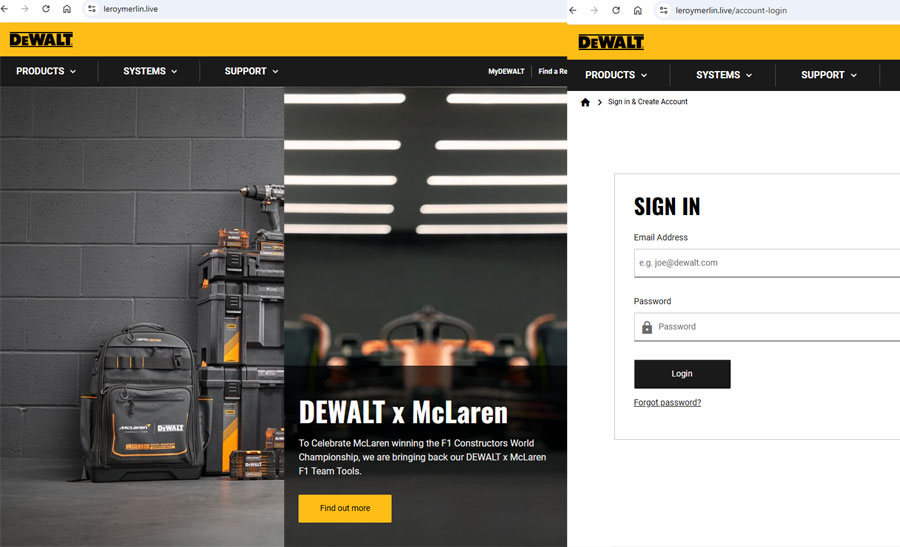
I note that as of today, the Disputed Domain Name resolves to a website selling DEWALT tools, something which clearly indicates awareness by the Respondent of the Complainant as well as a likely bad faith registration and use. Moreover, it appears to be used for a phishing website.
I would expect that the Complainant may bring a subsequent Complaint, which the Panel to its credit clearly acknowledged as a possibility: “Nothing prevents the Complainant, should new or more complete evidence arise (for example, any active use, or prolonged passive use), from filing a new, properly substantiated Complaint”.
Panelist Makes Short Work of Dismissing Misplaced “Passive Holding” Argument
Boku, Inc. v. peter eisch / Afton’s Endeavors, NAF Claim Number: FA2510002185839
<boku .net>
Panelist: Mr. Kendall C. Reed
Brief Facts: The Complainant, founded in 2009, currently provides one of the largest mobile payments network in the world. The Complainant claims that its mobile payments network features more than 200 mobile payment types in 90 countries worldwide, processes more than $9 billion of payments per year, and has more than 28 million active users monthly. Many of the most valuable companies in the world live on the Complainant’s platform today, including Google, Sony, Spotify, Microsoft and Meta. The Complaint owns a number of United States and foreign trademark registrations for the word mark BOKU. The Complaint first obtained two US Trademark registrations for BOKU on October 18, 2011.
The Complainant alleges that the Respondent is not making any legitimate non-commercial or fair use of the domain name. This is evidenced by the fact that the URL of the Domain Name directs to a holding web page, which simply includes the word “boku .inc”, an image of the sea, and the slogan. Given the distinctiveness of the BOKU mark and its worldwide reputation in the payments industry, the Respondent must have been aware of Complainant’s rights. The Complaint further alleges that the passive holding of the domain, combined with concealment of identity via a proxy service, constitutes bad faith use under UDRP precedent (e.g., Telstra v. Nuclear Marshmallows, WIPO D2000-0003).
The Respondent contends that on June 3, 1996, he registered Boku, Inc. as an S Corporation with the State of Wisconsin, and thereafter registered the domain name on July 20, 1996. Thereafter, he launched its first website in early 1997 and built a strong local brand over the following years, using various website versions to describe its services, products, and customers; it then operated for 10 years before the USPTO registered the BOKU mark for transactional processing services that did not conflict with , and continued its operations unchanged until 2021, when it shifted from retail-focused services to consulting and providing internet-related services and networks.
Held: The disputed Domain Name was registered before the Complainant acquired rights in the Complainant’s mark. The disputed Domain Name was initially registered on July 20, 1996, and the Complainant first acquired rights in Complainant’s mark on October 18, 2011. This state of affairs is inconsistent with a finding of bad faith because the Complainant must demonstrate both registration and use of the disputed Domain Name in bad faith. See Integrity Marketing Group, LLC v. Sunil Bheda, FA 204445 (Forum June 26, 2023) (“[A]s a simple matter of logic…a domain name registrant cannot, at the time a domain name is registered, intend to cyber squat on a trademark before the trademark exists.”). The Complainant argues that the Respondent is passively holding the disputed Domain Name in such a way as to warrant a finding of bad faith under Telestra Corporation Limited v. Nuclear Marshmallows, D2000-0003 (WIPO February 18, 2000). However, that decision is distinguishable and provides no guidance in the present matter because that decision did not involve a prior registered domain name.
Complaint Denied
Complainant’s Counsel: Frederick Besant of Boku, Inc., USA
Respondent’s Counsel: Self-represented
Case Comment by ICA General Counsel, Zak Muscovitch: Kudos to the Panel for appropriately dismissing the Complainant’s apparently misplaced arguments on passive holding and misapplication of the Telstra doctrine. As the Panel noted, in the present case the Domain Name predated the Complainant’s trademark rights. As the Panel stated in the SNSG case;“In circumstances where there was no bad faith registration, neither passive use of the Domain Name, nor offers to sell the Domain Name, can be relevant, and there is no other evidence supporting bad faith use.”
There are perhaps no more misunderstood and misapplied concepts than passive holding and Telstra. It is gratifying to see a Panel make short work of dismissing misapprehensions of these concepts. For more information on these topics, see UDRPPerspectives.org.
The Panelist also made a clear finding that “the Disputed Domain Name was registered before Complainant acquired rights in the Complainant’s Mark”. The Complainant however seems to have been under the misimpression that its trademark rights predated the Respondent’s Domain Name registration, as recited in the decision: “Boku’s trademark rights predate the registration and use of the domain name by many years.” That may provide an explanation for why the Panel did not consider RDNH in this case, a question which was raised in this DNW article. If the Complainant was unable to determine when the Respondent had registered the Domain Name, that is one thing. But it would be an entirely different issue if the Complainant either ignored this fact or could have easily uncovered it.
 Ankur Raheja is the Editor-in-Chief of the ICA’s new weekly UDRP Case Summary service. Ankur has practiced law in India since 2005 and has been practicing domain name law for over ten years, representing clients from all over the world in UDRP proceedings. He is the founder of Cylaw Solutions.
He is an accredited panelist with ADNDRC (Hong Kong) and MFSD (Italy). Previously, Ankur worked as an Arbitrator/Panelist with .IN Registry for six years. In a advisory capacity, he has worked with NIXI/.IN Registry and Net4 India’s resolution professional.