
Panel: Investing in Potentially Brandable Domain Names to Resell at Higher Price Can Constitute Legitimate Interest
There is no requirement that a Complainant’s trademark be particularly well-known but this factor nevertheless can play an important role, as it did here. The Panel found that the Complainant “failed to substantiate its claim of being well-known” but this did not matter per se. Rather, it became central to the case when the Panel had to determine whether the Respondent registered the Domain Name to take advantage of the Complainant as opposed to acquiring it based upon being a potentially brandable term used by many. In failing to substantiate that its mark was well-known, the Complainant also “failed to provide any evidence establishing or suggesting that Respondent more likely than not registered the disputed domain name to trade off of Complainant’s limited rights in the OVENLY mark”. The lesson here is that a Complainant must often prove its reputation, not for its own sake, but for the sake of proving that it was targeted. Continue reading commentary here.
WIPO and ICA Conclude Comprehensive Review of the UDRP
This initiative was driven by a robust international process that included nearly a dozen consultations with industry leaders, legal experts, and stakeholders. The goal was to identify best practices, establish areas of consensus, and pinpoint potential improvements to the policy. Coordinated by Zak Muscovitch, General Counsel to the ICA and Brian Beckham, WIPO, the project team, comprising experts and UDRP stakeholders from around the world.
Following a period of public comment on the draft, the Final Report is now being shared, including submission to ICANN for consideration in any future UDRP review undertaken by its Generic Names Supporting Organization (GNSO). By clearly identifying where stakeholder agreement and disagreement lie, this independent report is expected to significantly benefit and streamline ICANN’s official review process, ensuring any future changes are well-informed and reflective of community input.
The UDRP is the cornerstone for resolving domain name disputes globally, and its effectiveness relies on continuous review and refinement. We thank everyone involved. You can access the complete WIPO/ICA UDRP Review Final Report and background information on WIPO’s website. The Executive Summary Table of Recommendations in the Final Report, is also available here.
We hope you will enjoy this edition of the Digest (vol. 6.3) as we review these noteworthy recent decisions with expert commentary. (We invite guest commenters to contact us):
‣ Panel: Investing in Potentially Brandable Domain Names to Resell at Higher Price Can Constitute Legitimate Interest (ovenly .com *with commentary)
‣ Concurring Panelist Holds Legitimate Interest in Favor of GoDaddy Portfolio (e-beauty .com *with commentary)
‣ Why the TEMCO.com UDRP Decision Fails the Logic Test (temco .com *with commentary)
‣ Why Wasn’t RDNH Found? (virginiabiologicaldentist .com *with commentary)
‣ Selling a Common-Word Domain Name Alone is Not Bad-Faith (estafetas .com)
Panel: Investing in Potentially Brandable Domain Names to Resell at Higher Price Can Constitute Legitimate Interest
<ovenly .com>
Panelist: Mr. Georges Nahitchevansky (Chair), Ms. Lynda M. Braun, and Mr. Steve Levy
Brief Facts: The Complainant asserts that its OVENLY mark is a distinctive and well-known brand that has continuously been used in commerce since October 15, 2009. The Complainant owns and uses the domain name <oven .ly> for its bakery products and café in New York City. The Complainant owns a trademark registration in the United States for its OVENLY mark in connection with its bakery goods and retail bakery services, dated December 6, 2011. The Respondent acquired the disputed Domain Name on February 24, 2024 through an auction at Droptcatch for USD 709. The Respondent adds that on the same date it also acquired several other short, pronounceable, brandable domain names and that during the period 2023-24 it also registered other domain names that combine a common word with the suffix “-ly.” The Complainant alleges that the disputed Domain Name over the last 10+ years “has featured a variety of ‘for-sale’ pages as well as a landing page insinuating a bakery business that infringes upon our trademarks.”
The Complainant further alleges that the Respondent has sought to monetize the disputed Domain Name through pay-per-click ads; attempted to sell it for USD 9,999, an amount that is more than Respondent’s out-of-pocket costs; used the disputed Domain Name for phishing or misrepresentation and/or traffic diversion for profit. The Respondent contends that “ovenly” is understood “as a portmanteau of the common words ‘oven’ and ‘only'” and is capable of several meanings such as ‘from the oven only” and that a search of registered domain names containing “ovenly” reveal hundreds of bakeries using the name “Ovenly” around the world, including several in the United States. The Respondent further contends that the Complaint is a “Plan B” to hijack the disputed Domain Name. The Respondent notes that the Complainant attempted to buy the disputed Domain Name anonymously through a landing page and that an offer was then presented to the Complainant through a GoDaddy broker in the amount of USD 9,999.
The Respondent further adds that after the instant proceeding was initiated, it reached out to the Complainant to resolve the matter and offered to transfer the disputed Domain Name for its acquisition cost of USD 709. The Complainant did not accept that offer and apparently offered USD 100 and relied on a prior UDRP proceeding Respondent had lost to justify Complainant’s counter in an effort to drive the price down for the disputed Domain Name. The Respondent also attacks various assertions by the Complainant as lacking evidentiary support, including the claimed past use of the OVENLY mark by the Complainant, the claim that the Complainant and its OVENLY mark enjoys a broad reputation, the claim that the Respondent has used the disputed Domain Name for various purposes, including phishing or misrepresentation. The Respondent also comments on Complainant’s reliance on a prior UDRP decision against the Respondent by arguing that due to exceptional circumstances it could not defend that UDRP matter and hence it resulted in a transfer.
Held: The Respondent makes a prima facie case that “ovenly” is not per se uniquely associated with the Complainant. Notably, while the Complainant contends its OVENLY mark is a “distinctive, well-known brand,” the Complainant did not provide the type of evidence one would expect to see to establish such claimed notoriety or distinctiveness – including distinctiveness from other users of the same mark. There is no evidence of past use by the Complainant of the OVENLY mark or of third party recognition of the OVENLY mark, brand rankings, awards or accolades or the like that would typically support a claim of notoriety. In all, absent supporting evidentiary support, Complainant’s assertion of being well known is unsubstantiated and conclusory and entitled to little weight. With regards to Complainant’s assertion that the Respondent has sought to sell the disputed Domain Name for an inflated price, the Respondent contends that he was never made aware by the GoDaddy broker that the Complainant was attempting to acquire the disputed Domain Name and was merely replying to an anonymous offer.
To be sure, the price of USD 9,999 appears on its face as well in excess of the USD 709 paid at auction by the Respondent for the disputed Domain Name. But that alone does not render the price offered illegitimate or done in bad faith. The business of investing in and selling a domain name at a higher price based on a common or potentially brandable word or descriptive indication can constitute a legitimate interest when it is done not to trade off of the trademark rights associated with the trademark of another. Here, the Panel is of the view that the Respondent acted legitimately. To begin, the disputed Domain Name at issue does not involve a well-known mark per se. While the Complainant claims that its OVENLY mark is distinctive and well known, the Complainant has failed to substantiate that claim. Additionally, the Respondent has provided evidence showing that the term “ovenly” is used by many third parties, including in connection with bakery services and that “ovenly” is used as a portmanteau combining the words “oven” and “only” to imply for example something that is warm, baked or straight out from the oven.
Thus from the evidence before the Panel it is hard to conclude that the value of the disputed Domain Name derives from any trademark value associated with the Complainant as opposed to the value the domain name might enjoy on account of its common term meaning and the widespread use of “ovenly” by multiple third parties. And certainly the price of USD 9,999 is not atypical or outlandish for a single word domain name based on a common term or expression. The evidence submitted by the Respondent shows that the Respondent as part of his legitimate business as a domain name investor, has in addition to the disputed Domain Name acquired or registered a number of domain names that include a common word in combination with the suffix “-ly.” Lastly, while the Respondent lost a prior UDRP proceeding, that alone does not per se establish that the Respondent is a known cybersquatter. These decisions simply confirm that each case has to be treated in accordance with its facts and evidence.
RDNH: Here, the Complainant owns a trademark registration for the OVENLY mark that predates Respondent’s registration of the disputed Domain Name in 2024. While the Panel has ruled against the Complainant for the reasons set forth herein, it was not unreasonable for the Complainant to initiate a proceeding that concerned a disputed Domain Name that on its face could be seen as based on Complainant’s OVENLY mark. The Complainant may have presented a weak case, but it was not objectively baseless or devoid of any merit such that it rises to the level of abusing the Policy. Accordingly, the Panel finds that the Complainant did not initiate this UDRP proceeding in bad faith or primarily to harass the Respondent. The request for a finding of reverse domain name hijacking is denied.
Complaint Denied
Complainant’s Counsel: Internally Represented
Respondent’s Counsel: Ankur Raheja of Cylaw Solutions, India
Case Comment by ICA General Counsel, Zak Muscovitch: This appears to be a particularly hard-fought case by the Respondent, who was represented by our Editor-in-Chief, Ankur Raheja. The Panel also was apparently put to considerable effort in sifting through the conflicting pleadings, analysing them, and applying the UDRP in a particularly exacting and adept manner.
There is no requirement that a Complainant’s trademark be particularly well-known but this factor nevertheless can play an important role, as it did here. The Panel found that the Complainant “failed to substantiate its claim of being well-known” but this did not matter per se. Rather, it became central to the case when the Panel had to determine whether the Respondent registered the Domain Name to take advantage of the Complainant as opposed to acquiring it based upon being a potentially brandable term used by many. In failing to substantiate that its mark was well-known, the Complainant also “failed to provide any evidence establishing or suggesting that Respondent more likely than not registered the disputed domain name to trade off of Complainant’s limited rights in the OVENLY mark”. The lesson here is that a Complainant must often prove its reputation, not for its own sake, but for the sake of proving that it was targeted. In this regard, the Panel’s point is particularly important to keep in mind:
“In all, absent supporting evidentiary support, Complainant’s assertion of being well known is unsubstantiated and conclusory and entitled to little weight. See, e.g., Budge Industries, LLC v. Joe Carrero, WIPO Case No. D2010-0392 (“unsupported factual allegations, even if not denied, are of no moment, and unsworn statements of counsel as to factual matters easily verifiable with documentary evidence or of which counsel has no personal knowledge are not evidence and carry little or no weight in a Policy proceeding”). Most importantly, Complainant’s evidence does not in any way address or rebut Respondent’s evidence that the OVENLY mark is used by other businesses that have no association with Complainant.”
With regard to the evidence that other businesses use the OVENLY mark beyond the Complainant, this is a particularly material consideration that is sometimes misapprehended by Panels. While it is correct that the existence of multiple users of a mark does not necessarily mean that the particular complainant was not targeted, it may serve to negate a complainant’s claim that it was the target of the registration. The more contemporaneous users of a mark exist, the more difficult it generally is to prove targeting. Kudos to the Panel for appreciating this consideration.
With regard to pricing, the Panel made a particularly insightful and helpful finding. The Panel noted that of course the price of $9,999 was well in excess of the $709 paid by the Respondent, but “that alone does not render the price offered illegitimate or done in bad faith”, noting that “the business of investing in and selling a domain name at a higher price based on a common or potentially brandable word or descriptive indication can constitute a legitimate interest when it is done not to trade off of the trademark rights associated with the trademark of another”. Well said. Notably, the Panel did not limit its observation to just dictionary words, but also “potentially brandable words”. Potentially brandable words are also considered investable domain names akin to acronyms, dictionary words, surnames, proper names, and descriptive terms. For more on this see UDRP Perspectives at 2.7 (“Investing in Brandable Domain Names”).
Keep this case handy for future disputes as it contains a lot of very helpful analysis and findings for citation. Well done, counsel and Panelists!
Concurring Panelist Holds Legitimate Interest in Favor of GoDaddy Portfolio
<e-beauty .com>
Panelist: Mr. Cai Weiping, Mr. Nicholas Smith and Ms. Xue Hong
Brief Facts: The Complainant claims to be a leading cosmetics e-commerce and brand operation service provider in Asia. The Complainant argues that it is the parent company of the eBeauty Group and was also a listing entity that had submitted an application to the Hong Kong Stock Exchange and passed the hearing in 2021. The Complainant owns the registered trademark “eBeauty” and has continuously and extensively used this trademark in cosmetics e-commerce and brand operation services since 2021. The Respondent is a domain portfolio business owned by GoDaddy. It is one of the most distinguished companies in the U.S. in the business of acquiring and reselling domain names composed of generic or common words and descriptive phrases, such as E-Beauty. The Respondent acquired the disputed Domain Name on 19 October 2017, in the normal course of its business and offered it for sale.
The Complainant alleges that the disputed Domain Name has shown no signs of substantive content or business use for a long period after its registration, and until recently has existed only as an asset for sale at a price significantly exceeding normal registration costs. The Respondent contends that whether as “E-Beauty” or “EBeauty”, this combination of generic/descriptive terms is currently used by other businesses for marketing goods or services in the beauty sector and that the Policy does not prohibit the acquisition of domain names for resale in the secondary market. The Respondent further adds that bad faith is established only where the Respondent registered the disputed Domain Name with actual knowledge of the complainant’s rights and with the intent to exploit the complainant’s goodwill and reputation. Panels have consistently rejected the notion that pricing alone constitutes evidence of bad faith in the absence of proof of targeting.
Held: The Panel finds that the Complainant has not met its burden of proving bad-faith registration and use, as the Respondent’s domain name registration predates the Complainant’s acquisition of trademark rights. The disputed Domain Name was acquired by the Respondent on 19 October 2017, while the Complainant’s trademark rights in “eBeauty” were not obtained until 2021. Further, although the Respondent has listed the domain name for sale, the evidence shows that the listings promote it generically, citing its inclusion of the “widely used keyword ‘e’” and the “.com” extension, with no reference whatsoever to the Complainant, its “eBeauty” mark, or its business.
For bad faith to be found, the Complainant must demonstrate that the Respondent registered and used the domain name with the Complainant’s trademark in mind. The majority of the Panel found no evidence of such targeting. The Respondent appears to have acquired a dictionary-style, descriptive domain name as part of its domain investment business and offered it for sale in a manner unrelated to the Complainant’s later-established trademark. In these circumstances, the majority of the Panel cannot conclude that the domain name was registered or has been used in bad faith as defined by paragraph 4(a)(iii) of the Policy.
Concurring Opinion (Ms. Xue Hong): The Panelist with the minority view, although having no objection to the decision, dissents from the majority view with respect to the reasoning under Paragraph 4(a)(ii) of the Policy. The Panelist with the minority view notes from the Complainant’s consistent submissions that its trademark “eBeauty” has been used in commercial activities since 2021. On the other hand, the Respondent that is in the business of “arbitraging domain names” acquired the disputed Domain Name in 2017. Given the totality of the circumstances, the Panelist with the minority view finds it insufficient to conclude that the Respondent intends to take advantage of the Complainant’s “eBeauty” mark and to primarily profit from selling the disputed Domain Name to the Complainant or the Complainant’s competitor.
According to the Respondent’s submission, the Respondent, arguably, uses the disputed Domain Name in connection with an offering of services of selling the domain name itself, before receiving any notice of the dispute. Therefore, even though the disputed Domain Name has been possessed “only as an asset for sale”, it does not mean that the Respondent cannot establish a legitimate business not conflicting with the Complainant’s “eBeauty” mark that has not “established stable and extensive brand recognition in the cosmetics e-commerce industry in China and Southeast Asia” until 2021. The Panelist with the minority view, therefore, finds that the Respondent has rights or legitimate interests in the disputed Domain Name under Paragraph 4(c)(i) of the Policy i.e. it has used the disputed Domain Name in connection with a bona fide offering of services before any notice of the dispute.
Complaint Denied
Complainant’s Counsel: Internally Represented
Respondent’s Counsel: Gerald M. Levine, USA
Case Comment by ICA General Counsel, Zak Muscovitch: First of all, congratulations to the Panel and to the Respondent’s counsel in this case, Gerald Levine, author of The Clash of Trademarks and Domain Names on the Internet, for the right outcome.
The Concurrence is particularly noteworthy. The Concurring Panelist, intra alia, found that the Respondent had Rights and a Legitimate Interest, whereas the Majority found it “unnecessary to consider the second element for the reasons discussed in relation to bad faith”. The Concurring Panelist to her credit, found that even though the Disputed Domain Name was an asset held for resale by the Respondent, “only as an asset for sale”, this still constitutes “use” in connection with a bona fide offering of services before any notice of the dispute. This has long been the case (see for example; Allocation Network GmbH v. Steve Gregory, WIPO Case No. D2000-0016, where a Domain Name forms part of a Respondent’s stock-in-trade (as it does here), it constitutes “use of the domain name in connection with a bona fide offering of goods or services”).
As I have written in this Digest on numerous occasions, Panels should not necessarily skip over an affirmative finding of a Respondent’s Rights and Legitimate Interest even when the finding is not necessary given the finding under Bad Faith. As noted in UDRP Perspectives at 2.1, Panels may be tempted to skip over determining whether a Respondent has rights and a legitimate interest. This is often done for reasons of judicial economy, as strictly speaking a case can be dismissed on one prong of the three-part test and therefore the decision need not address any additional, extraneous grounds. Nevertheless, Panelists should generally make an affirmative finding of rights and legitimate interest if the facts so warrant, due to the implicit obligations of Rule 4(c).
Paragraph 4(c) of the Policy expressly entitles a Respondent to “prove” its rights and legitimate interests and implicitly directs a Panel to make such a finding if so proven:
“How to Demonstrate Your Rights to and Legitimate Interests in the Domain Name in Responding to a Complaint. When you receive a complaint, you should refer to Paragraph 5 of the Rules of Procedure in determining how your response should be prepared. Any of the following circumstances, in particular but without limitation, if found by the Panel to be proved based on its evaluation of all evidence presented, shall demonstrate your rights or legitimate interests to the domain name for purposes of Paragraph 4(a)(ii):…”
A Respondent who has had its bona fides challenged and been falsely accused of what essentially amounts to a type of fraud, may deserve some vindication and confirmation of their rights and interests as the Policy provides for.
Why the TEMCO.com UDRP Decision Fails the Logic Test
Temco Industrial v. Mira Holdings, WIPO Case No. D2025-3913
<temco .com>
Panelist: Mr. Christopher S. Gibson (Presiding), Mr. Matthew Kennedy and Mr. John Swinson
Brief Facts:
The Complainant is a tool manufacturer located in central Texas, U.S., specializing in the manufacture and distribution of tools for industrial users and tradespeople, since 1968. Since 1999 has been selling its products exclusively online through its website at <temcoindustrial .com> and via ecommerce sites. The Complainant owns several registered trademarks including US registrations for TEMCO INDUSTRIAL (with a January 2018 first use in commerce and registered on April 16, 2019) and TEMCO (with a January 2, 2018, first use in commerce, and registered on August 6, 2024). The Domain Name was purchased by the Respondent at an auction organized by NameJet on March 18, 2022, for USD 12,540.
The Complainant submits evidence that on February 22, 2023, a GoDaddy broker stated that the owner of TEMCO .COM was seeking USD 150,000. The Complainant’s representative then offered $5,000, and followed that up with several other offers of undisclosed amounts. At other times, brokers quoted prices as high as USD 180,000. In November 2024, Complainant’s representative contacted the GoDaddy broker again, this time to submit a reduced offer of only $1,000. The broker responded with an asking price of $48,500, while asserting that five‑letter domain names are scarce and command higher prices, making reference to <temcoindustrial .com>.
The Complainant alleges that the disputed Domain Name has not been used in connection with any legitimate goods or services and has instead been listed for prices that far exceed any reasonable out-of-pocket registration costs. According to the Complainant, this is not mere speculation but a direct acknowledgment that the Respondent acquired and is holding the disputed Domain Name for the purpose of selling it to the Complainant, the trademark owner. Such conduct, the Complainant argues, is inconsistent with any claim of rights or legitimate interests under the Policy.
The Respondent, a professional domain investor, contends this dispute involves the Domain Name that consists of the merger or blending of the common abbreviation word “tem” with the abbreviation word “co,” which together form the common business name “Temco” used by numerous companies worldwide. The Respondent further adds that the disputed Domain Name has never been offered for sale directly to Complainant, and that offering a generic, common phrase domain name for public sale, in itself, does not constitute bad faith targeting of Complainant’s trademark rights in what is otherwise a common business name. The Respondent provides results from a search of the term “temco” in the USPTO trademark database, which returned a number of results for both Complainant and other trademark owners, with some TEMCO trademarks predating Complainant’s mark.
Held: The Complainant asserts against the Respondent in terms of clause 4(b)(i), that is, the respondent registered or acquired the disputed domain primarily to sell, rent, or transfer it to the complainant for valuable consideration in excess of the respondent’s documented out-of-pocket costs. The Panel agrees with the panel in a previous case brought against Respondent (SRL BOWTEX v. Mira Holdings, WIPO Case No D2024-1632), which recognized that “as a general rule, a person such as the respondent [a professional domain investor] has the right to acquire a domain name containing a dictionary word or phrase based upon its dictionary meaning and to offer this for sale at a price of its choosing, provided that in so doing it does not target the trademark value of the term” (italics added). See WIPO Overview 3.0, section 3.1.1. In the present case, the Domain Name consists of the term “temco,” a combination of the “common abbreviation word” “tem” with the abbreviation “co.” Respondent’s own description of the Domain Name acknowledges that “temco” is not a dictionary word or phrase. However, Respondent argues that it chose “temco” based on its quality and memorable nature as a five-letter domain name. It shows that it has sold three other domain names similarly comprised of a word or syllable and the abbreviation “co.”
The Panel also observes Respondent has acknowledged that prior to purchasing the Domain Name at auction, Respondent conducted research: “Respondent’s research before purchasing Temco .com showed that there were numerous companies worldwide that used “Temco” in commerce.” Moreover, the Respondent has submitted a number of exhibits in this case which demonstrate that Respondent is capable of conducting sophisticated research using different domain name and trademark databases, as well as Google searches, to identify TEMCO trademark owners and/or companies using the Temco name. The Respondent tactically states “Respondent was not specifically familiar with TemcoIndustria l.com until the filing of this UDRP” (italics added). However, Respondent easily could have, but did not, deny that it was aware of Complainant’s TEMCO mark when registering the Domain Name. A trademark search, such as those submitted by Respondent in evidence in this case for the U.S. trademark registry, would have revealed Complainant’s TEMCO mark as well as the TEMCO marks held by other companies, see WIPO Overview 3.0, section 3.2.3.
In this case, Complainant’s activities are supported by a U.S. trademark that had been used in commerce for many years and registered as a trademark for approximately three years before Respondent acquired the Domain Name. This evidence of Respondent’s targeting of Complainant (or another business using the TEMCO trademark or name) is also supported by the November 4, 2024, communication between Complainant and the GoDaddy broker. The Panel considers that this evidence shows an almost textbook example of running afoul of Policy paragraph 4(b)(i). And it is also highly suggestive that Respondent was likely aware of Complainant’s mark (and of TEMCO marks owned by third parties) when acquiring the Domain Name through the drop-catch auction, for purposes of reselling it to Complainant (or a TEMCO mark owner). Moreover, it is not disputed that Respondent registered the Domain Name primarily to sell it for a price in excess of its documented out-of-pocket costs directly related to the Domain Name. Finally, the Panel notes that this case can be distinguished from the other cases involving the Respondent.
Transfer
Complainant’s Counsel: Internally represented
Respondent’s Counsel: Internally represented
Case Comment by ICA Diector, Nat Cohen:
The recent TEMCO.com dispute represents a concerning departure from established UDRP principles. The decision is problematic because the Panel substituted the requirement for bad faith toward a specific complainant with a discredited view of bad faith in general.
A Dangerous Precedent for Domain Investors
The reasoning in TEMCO is particularly problematic for domain name investors. It undercuts the legitimacy of acquiring domain names based on non-dictionary terms that are widely adopted commercially—often for substantial sums—where no single company holds exclusive rights.
As a prominent domain investor commented:
Under this poor decision logic, no names with multiple existing trademarks before acquisition are safe. The panel thinks Respondent was supposed to do a trademark search and see a bunch of trademarks then back off from buying the name. But a bunch of different trademarks is evidence of varied use, not one specific targeted end user. And pretty much all 5-figure wholesale domains these days have multiple related trademarks, so investors are simply not supposed to buy them? Bleh.
Awareness Is Not Targeting
The Panel found that the Respondent was aware of the Complainant at the time of registration. However, awareness is a necessary but not sufficient precondition to targeting. The Respondent was aware that “TEMCO” was a term used by many companies globally, not just the Complainant.
During the proceedings, the Respondent argued that UDRP panels have historically allowed respondents to own domain names with numerous potential buyers and to sell them on their own terms. The Respondent’s research prior to purchase showed numerous companies worldwide using “Temco” in commerce.
The Panel’s finding of targeting relied heavily on a communication between a GoDaddy broker and the Complainant. The broker stated:
“The seller [Respondent] said they are willing to wait for the right end user to purchase this name with a stronger offer (ex. temcoindustrial.com, temcologistics.com, and temcoparts.com would all greatly benefit from owning this name)”.
While this indicates the Respondent knew the domain would be valuable to the Complainant, it also demonstrates that the Complainant was merely one of several entities that could benefit. Under the UDRP, suggesting that multiple unrelated companies might want a domain indicates market-driven value, not bad-faith targeting of a single entity.
Factually Flawed Reasoning
The Panel relied on flawed reasoning to reach its transfer decision. Specifically, the Panel determined:
In sum, the Panel determines, based on a review of all of the circumstances in this case, that Respondent acquired the Domain Name primarily for the purpose of selling, renting, or otherwise transferring it to Complainant (or a competitor of Complainant) for valuable consideration in excess of documented out-of-pocket costs directly related to the Domain Name.
The inclusion of the phrase “(or a competitor of Complainant)” is critical yet factually inaccurate. Temco Logistics and Temco Parts—the other entities mentioned by the broker—are not competitors of Temco Industrial. They operate in entirely different industries. If they were indeed competitors, there would be serious trademark infringement issues.
A more accurate assessment is that the Respondent acquired the domain to sell it to the Complainant or to one of the many other unaffiliated companies that concurrently use the term “TEMCO”. This is not a violation of the UDRP and does not demonstrate bad faith.
Market Distortion and Historical Context
The term “TEMCO” has been used by dozens of unrelated companies for decades. The domain itself was created in February 1996 and has been used by various commercial entities peacefully coexisting with the Complainant.
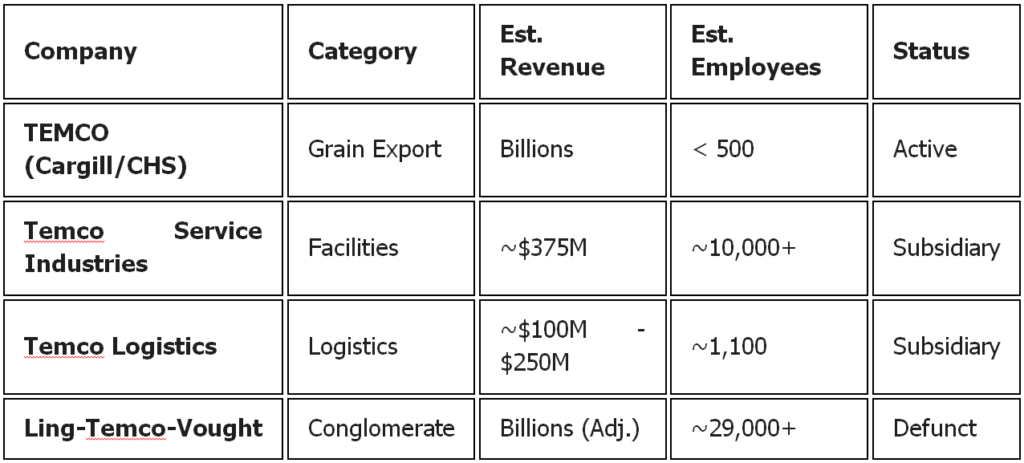
Prominent Historical Users of the TEMCO Name according to Gemini AI:
None of these major entities are the Complainant, illustrating that “TEMCO” is not exclusively associated with them. By hand-selecting Temco Industrial as the most deserving owner, the Panel has disadvantaged all other companies named Temco and distorted the operations of the marketplace.
Economic Realities of the Marketplace
The Respondent paid $12,540 in a competitive bidding process for the domain. They eventually lowered their asking price to $48,500. This return—less than 4x—is below the 5x–10x return typically required to sustain a domain investment business model where only 1%–2% of inventory sells annually. I discuss making inferences from pricing in the section on Pricing in the CircleID article, Smells like Cybersquatting? How the UDRP “Smell Test” Can Go Awry.
In contrast, the Complainant initially offered $5,000 before dropping their offer to $1,000. This behavior suggests the Complainant would obtain very little utility from the domain—likely far less than many other companies using the “Temco” name. By interfering, the Panel has misallocated a high-value asset to a company unlikely to make the best use of it.
Conclusion
The Complainant failed to acquire the domain before it dropped, failed to participate in the auction, and then attempted to buy it through anonymous, lowball offers. Using evidence of the domain’s widespread appeal as proof of “targeting” is misguided. Given these circumstances, the evidence strongly supports a finding of Reverse Domain Name Hijacking (RDNH) against the Complainant.
Why Wasn’t RDNH Found?
<virginiabiologicaldentist .com>
Panelist: Mr. Robert A. Badgley
Brief Facts: The Complainant operates a dental business in the Commonwealth of Virginia, United States and claims to own “strong and established common-law trademark rights” in VIRGINIA BIOLOGICAL DENTISTRY “based on exclusive use since July 20, 2022 under an official Fictitious Name Registration with the Commonwealth of Virginia: SCC Filing No. 2207204761336.” In addition, the Complainant asserts that its common law trademark rights derive from its ownership of the domain name <virginiabiologicaldentistry .com> since December 20, 2021, as well as “extensive marketing, SEO, clinical educational content, and public presence under the mark.” The record contains a screenshot of Complainant’s official website, but contains no other evidence of Complainant’s use of the alleged mark VIRGINIA BIOLOGICAL DENTISTRY or of the extent to which that alleged mark is known by consumers. The disputed Domain Name was registered on July 13, 2025 and resolves to a commercial website entitled “Karande Biological Dentistry – Virginia,” which promotes Respondent’s dental services, and is operated about an hour away.
The Complainant alleges that the website at the disputed domain advertises the very same specialized biological dentistry services as the Complainant. The Respondent contends that it registered the disputed Domain Name for its purely descriptive sense, in order to attract consumers seeking biological dentistry services in Virginia. The Complainant further points out that it had a falling out with its website operator, Ekwa Marketing, in mid-2025, around when the disputed Domain Name was registered. The Complainant alleges Ekwa may have been involved in the registration, citing the site’s “Powered by ekwa(.com)” legend and Ekwa-related name servers as evidence that Ekwa designs, maintains, and publishes the disputed Domain Name. The Respondent rejects this, providing evidence that Ekwa broadly serves the dental industry and that the Respondent’s relationship with Ekwa is independent of the Complainant’s. The Respondent further contends that this dispute involves an obvious geographically descriptive term, and the Complainant has not proven acquired distinctiveness or substantially exclusive use.
Held: The Panel declines to decide whether the Complainant owns rights in a trademark. The Panel need not address this issue because the Complaint fails on the “Rights or Legitimate Interests” element.
The Panel concludes that the Respondent has a legitimate interest in the Domain Name. As the Respondent argued persuasively, the Domain Name is descriptive of a dentist licensed in Virginia who renders “biological dentistry” services. Because the record contains little or no evidence that the Respondent had knowledge of the Complainant or its alleged trademark at the time Respondent registered the Domain Name, Respondent’s conduct falls within the above-quoted Policy paragraph 4(c)(i), as it constitutes a bona fide offering of services before any notice of a dispute. The Panel sees no basis in the record to conclude that the Respondent registered or used the Domain Name in bad faith, but the Panel need not decide this issue given its ruling above on the “Rights or Legitimate Interests” element.
With regard to Complainant’s argument that non-party Ekwa Marketing may be behind the Respondent’s allegedly abusive Domain Name registration, the Panel is inclined to accept the Respondent’s assertion (and supporting evidence) that Ekwa Marketing is active within the dental industry. The Panel notes further that the Complainant provided no evidence that Ekwa and the Respondent were somehow in cahoots vis-à-vis the Domain Name, or that Ekwa Marketing had any role whatsoever in Respondent’s decision to register the disputed Domain Name. Given Ekwa Marketing’s apparently robust presence in the dental field and the lack of anything beyond speculation offered by the Complainant, the Panel will not credit Complainant’s “Ekwa Marketing” argument.
Complaint Denied
Complainant’s Counsel: Maciej Bartkowski, United States
Respondent’s Counsel: John Berryhill, Ph.D., Esq., United States
Case Comment by ICA General Counsel, Zak Muscovitch: This was a clearly written dismissal of a meritless Complaint. I wonder however, why RDNH was not considered as this is a case that should never have been brought. There were no and could be no trademark rights in the term corresponding to the Domain Name. If there were good reasons for not finding RDNH, such as for example that the Complainant had a credible basis to suspect bad faith, then such considerations could have been set out in a discussion of RDNH. As set out in UDRP Perspectives at 4.1, declarations of Reverse Domain Name Hijacking play a critical role in the UDRP by deterring abusive use of the Policy and preserving the integrity of the UDRP for legitimate claims. A Panel will not have satisfactorily discharged its duty under the UDRP without an express consideration of RDNH where the facts and circumstances. Rule 15(e) requires a Panel to consider RDNH where the circumstances warrant, whether or not it is requested by a Respondent.
Selling a Common-Word Domain Name Alone is Not Bad-Faith
ESTAFETA MEXICANA, S.A. DE C.V. v. Salman Ahmed Bajwa, WIPO Case No. D2025-4613
<estafetas .com>
Panelist: Mr. Evan D. Brown
Brief Facts: The Complainant is in the business of providing courier and logistics services in Mexico, handling millions of shipments per year. It has operated since 1979, employs more than 12,400 people, and operates its own cargo airline in Mexico and the United States under the ESTAFETA mark. The Complainant owns the trademark ESTAFETA and enjoys the benefits of registration in several jurisdictions, including in the United States (registered on August 20, 1996). The disputed Domain Name was registered on January 30, 2019, but the Respondent does not appear to have used it in connection with an active website. Instead, the Respondent has made the disputed Domain Name available for purchase, at times through a brokerage service. As of the date of this decision, the disputed Domain Name resolves to a Registrar-provided page offering it for sale for USD 149,888.
The Respondent contends that it is in the business of lawfully acquiring, holding, and developing generic and descriptive domain names as part of a legitimate domain investment activity. Under the first element, the Respondent asserts that “estafetas” is a common Spanish word, the plural of “estafeta,” with a dictionary meaning. The Respondent notes that the disputed Domain Name has been held by various owners, and that it had registered it in 2019. The Respondent further contends that it has used the disputed Domain Name neutrally, without referencing the Complainant or its competitors. The Respondent denies knowledge of the Complainant and asserts that it did not target the Complainant in bad faith.
Held: The Respondent asserts rights and legitimate interests in the disputed Domain Name by demonstrating that “estafetas” is a Spanish dictionary word meaning “couriers” or postal relays, and that the domain was selected and held for its generic meaning rather than to target the Complainant. The disputed Domain Name has not been used to impersonate or otherwise trade on the Complainant’s trademark. Panels have recognized that registering and holding domain names consisting of dictionary words for their descriptive value can support legitimate interests where there is no intent to target a specific trademark owner, and that offering such a domain name for sale does not by itself constitute bad faith. See WIPO Overview 3.0, sections 2.10.1 and 3.1.1. The Panel therefore finds that the Respondent has presented a credible and supported explanation of its legitimate interests in the disputed Domain Name.
There is no specific evidence that the Respondent registered the disputed Domain Name because of the Complainant or its trademark. The Respondent has not used the disputed Domain Name in any way that references the Complainant, its services, or its competitors. The landing page merely offers the disputed Domain Name for sale, and there is no indication that the Respondent contacted the Complainant or sought to capitalize on its mark. The Complainant has not shown that the Respondent had knowledge of the Complainant or its rights, and nothing in the record suggests that the disputed Domain Name was selected for the purpose of disrupting the Complainant’s business. The Complainant’s allegations of phishing or malicious use are also unsubstantiated. The Panel’s review of publicly available information about the disputed Domain Name’s configuration shows no active MX records, making it seem unlikely that the disputed Domain Name is being used for email-based fraud.
Complaint Denied
Complainant’s Counsel: Calderón & De La Sierra, Mexico
Respondent’s Counsel: Self-represented
 Ankur Raheja is the Editor-in-Chief of the ICA’s new weekly UDRP Case Summary service. Ankur has practiced law in India since 2005 and has been practicing domain name law for over ten years, representing clients from all over the world in UDRP proceedings. He is the founder of Cylaw Solutions.
He is an accredited panelist with ADNDRC (Hong Kong) and MFSD (Italy). Previously, Ankur worked as an Arbitrator/Panelist with .IN Registry for six years. In a advisory capacity, he has worked with NIXI/.IN Registry and Net4 India’s resolution professional.