
Did the Panel Unjustly Deprive the Complainant of a Transfer?
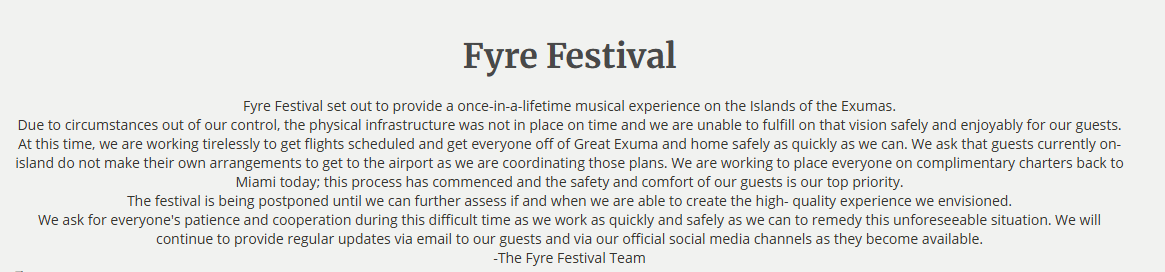
The Panel’s decision is confounding to me. Despite a lengthy and complex decision, the facts to me appear rather simple. The Complainant had a very well-known common law trademark for a music festival located in the Bahamas which preexisted the Respondent’s registration of the Domain Name. The Respondent used the Domain Name to redirect to a website offering hotel booking services and which expressly referenced the Complainant. Continue reading commentary here.

We hope you will enjoy this edition of the Digest (vol. 5.38) as we review these noteworthy recent decisions with expert commentary. (We invite guest commenters to contact us):
‣ Did the Panel Unjustly Deprive the Complainant of a Transfer? (fyrefestival .com *with commentary)
‣ Reputation is Key in Proving Targeting (ipguardian .com *with commentary)
‣ Is This Nominative Fair Use? (lamborghinidubairent .com *with commentary)
‣ Trademark Infringement or Cybersquatting? (goldrushdallas .com *with commentary)
‣ Complainant Must Prove All Material Issues; Speculation and Innuendo Are Insufficient (scutum .com)
Did the Panel Unjustly Deprive the Complainant of a Transfer?
LimeWR Fyre OÜ v. Liam Spencer, NAF Claim Number: FA2508002171353
<fyrefestival .com>
Panelist: Mr. Debrett G. Lyons
Brief Facts: The Complainant claims that in 2016 the “‘Fyre Festival’ was created and marketed as an unprecedented, opulent Bahamas getaway, with yachts and luxury cabanas, celebrity-chef catering, and the greatest live music entertainment that anyone had ever imagined.“ The Complainant asserts common law rights through continuous and widespread use of FYRE FESTIVAL since at least December 12, 2016 and states that as a result of significant media coverage, promotion, and public recognition, consumers exclusively associate “FYRE FESTIVAL” with the Complainant’s event, and that the term functions as a strong source identifier under common law. The trademark FYRE FESTIVAL has been registered with the USPTO since March 5, 2024, in the name of FYRE HOLDINGS, INC., and since January 14, 2020, in the name of XNO, LLC. On or around July 23, 2025, the Complainant purchased all right, title, and interest in the name FYRE FESTIVAL.
The Complaint states that during negotiations to purchase the trademark and other assets of the Complainant’s predecessor-in-business, it was disclosed that “the disputed Domain Name had been taken and improperly registered and used in bad faith by the Respondent. The Complainant further adds that “[s]ometime after May 2017, after the extreme difficulties Seller was facing, the prior owner of the Disputed Domain inadvertently allowed the domain registration to lapse. The Respondent registered the Domain Name on August 8, 2017. The Complainant alleges that the “Respondent’s current and historical use of a website that resolves from the disputed Domain Name presents infringing and misleading links for a travel site for Caribbean destinations and is a deliberate attempt to mislead consumers and profit off of Complainant’s brand.” The Respondent failed to submit a Response in this proceeding.
Held: The exhibit labeled “Screenshot of Respondent’s Current Website” shows a page titled “Hotel Choices in Greater Antilles,” from a website located at <greaterantilleshotels .com>. There is no explanation of this anomaly. The claim that the Respondent is infringing the Complainant’s trademark rights and improperly profiting from the same is made in the Complainant’s Declaration and repeated in the Complaint. Putting to one side the question of whether the Respondent has in fact used the disputed Domain Name in the manner alleged by the Complainant, these claims are underpinned by statements such as: “It is indisputable that the Complainant enjoys trademark rights in the FYRE FESTIVAL Marks, which long predate the creation of the Infringing Domain Name.” The Panel is not so convinced of that claim. The Complaint acknowledges that the name FYRE FESTIVAL was almost immediately notorious by reason of the spectacular failure of the event and refers to its ongoing “infamy”.
Whether the words FYRE FESTIVAL enjoyed common law trademark rights in August 2017 is, in the Panel’s assessment, contestable. The Complaint states that the Complainant ”is embarking on a new project and development for the intellectual property and FYRE FESTIVAL and FYRE brand.” Part of that project is evidently the recovery of the disputed Domain Name, which was allowed to lapse more than eight years ago. The Complaint does not show with any certainty use of the domain name (nor made submissions with respect to non-use of the name). To the extent that the Complainant asserts use in connection with travel services, there is nothing to indicate that this had an impact upon any rights held by the Complainant, nor caused any financial or other loss to the Complainant. The Panel finds that the Complainant has failed to make even a prima facie case that the Respondent has no rights or legitimate interests in the Domain Name.
The Panel’s permitted research (WIPO Overview 3.0, §4.8) found the domain <greaterantilleshotels.com> was created on November 3, 2016, and did not resolve to an active site at the time of writing. From January 16, 2018, to August 21, 2020, it resolved to a site titled “Hotel Choices in Greater Antilles.” It’s unclear if this was the same site shown in the Domain Tools screenshots, as their resolution is too poor to confirm. Paragraph 4(a)(iii) of the Policy requires that the Complainant must prove that the disputed Domain Name was registered in bad faith and is being used in bad faith. The standard of proof is the balance of probabilities, that is, more likely than not (see WIPO Overview, section 4.2). The failure to submit a Response allows the Panel to accept reasonable allegations, but equally the Panel may deny the Complaint where it relies on unsubstantiated claims or on submissions inconsistent with the facts. Applying these standards, the Panel does not find registration in bad faith.
The Panel finds the Complainant lacked clear trademark rights when the Respondent registered the domain and did not show bad-faith use or passive holding (see WIPO D2000-0003). Paragraph 4(b) of the Policy lists four scenarios that, if proven, indicate a domain was registered and used in bad faith. Here, only paragraph 4(b)(i) may apply. There is no argument of this kind to be found in the Complaint, but the Panel notes the relatively quick uptake of the domain name when its initial registration lapsed; the apparent lack of its use now; its redirection for a period to another domain name sharing the same IP address; and the somewhat static character of the information resolving from that other domain name over many years. That said, there is no evidence of the Respondent having offered to sell the domain name to the Complainant or anyone else, and nothing else of a sinister nature. On balance, the Panel finds no compelling evidence that paragraph 4(b)(i) applies.
Complaint Denied
Complainant’s Counsel: Jason Schaeffer of ESQwire.com, P.C., USA
Respondent’s Counsel: No Response
Case Comment by ICA General Counsel, Zak Muscovitch:
The Panel’s decision is confounding to me. Despite a lengthy and complex decision, the facts to me appear rather simple. The Complainant had a very well-known common law trademark for a music festival located in the Bahamas which preexisted the Respondent’s registration of the Domain Name. The Respondent used the Domain Name to redirect to a website offering hotel booking services and which expressly referenced the Complainant (see Archive.org and also see here)
The Respondent was clearly aware of the Complainant and targeted the Complainant’s mark in bad faith to capitalize off of its reputation. The Respondent clearly used the Domain Name in bad faith by redirecting the Domain Name to a hotel booking service, thereby taking advantage of the Complainant’s rights and misdirecting visitors. The Respondent didn’t even respond, and if he did, I can’t imagine what defense he could raise.
In dismissing what appears to be a strong and clear case, the Panel has in my view, unfortunately likely caused a court case to have to be brought, at much greater expense. This case is a good example of the reason why a UDRP appeal level is necessary to address errant decisions. This is not the first time that this Panelist has drawn attention for his decisions. For example, AustinPain ended up in court and was overturned. CliffNoteBooks.com (see UDRP Digest comment) was another head scratcher of a denial, among several others perplexing decisions from the same Panel.
Editor’s Note: Complainant’s Counsel is an ICA Member.
Reputation is Key in Proving Targeting
IP Guardian Pty Ltd v. Mira Holdings, WIPO Case No. D2025-2201
<ipguardian .com>
Panelist: Ms. Jane Seager (Presiding), Mr. Andrew D. S. Lothian and Mr. Matthew Kennedy
Brief Facts: The Complainant is an Australian law firm headquartered in Sydney, New South Wales and has online presence at <ipguardian .com .au>. It is the owner of Australian Trademark IP GUARDIAN, registered on June 17, 2014. The Respondent acquired the disputed Domain Name at auction for USD $450 on March 11, 2021 and redirects to a parking page provided by the Registrar offering the Domain Name for sale. The Complainant submitted a screen capture showing that the disputed Domain Name was offered with a Buy-It-Now (“BIN”) price of AUD 42,556 (equivalent to USD $25,000).
The Complainant alleges that the Respondent’s listing of the disputed Domain Name for sale at an inflated price demonstrates the Respondent’s intent to profit from the sale of the disputed Domain Name to the Complainant or to a competitor in bad faith pursuant to paragraph 4(b)(i) of the Policy. The Complainant cites the decision SRL BOWTEX v. Mira Holdings, WIPO Case No. D2024-1632, in which the panel ordered transfer of another domain name held by the Respondent and argued that the Respondent had engaged in a bad faith pattern of domain name registration.
The Respondent contends that the disputed Domain Name is described as a generic combination of “IP” and “guardian”, which is widely used in commerce globally. The Respondent states that it operates as a professional domain investor with over 1,000 “generic” domains in its portfolio, including other two-word domains such as <ipserve .com>, etc. These domain names are offered for sale or for lease on domain sales platforms without targeting any specific entity or trademark owner. The Respondent asserts that listing “generic” domain names for sale is recognized as a legitimate business activity under UDRP precedent.
Held: The Panel acknowledges that the Complainant’s trademark predates the Respondent’s acquisition of the disputed Domain Name by over six years. However, the Respondent has argued that it acquired the disputed Domain Name through a public auction for its descriptive qualities and without knowledge of the Complainant or its trademark. The Panel observes that the Complainant has not provided evidence to support the inference that the Respondent was aware of the Complainant’s trademark at the time of registration of the disputed Domain Name. As noted above, the disputed Domain Name resolves to a parked page with an invitation to purchase the domain name. The Respondent’s conduct appears consistent with its stated business model as a domain investor, holding a substantial portfolio of domain names comprising dictionary terms or combinations of dictionary terms.
There is further no evidence of the Respondent having made an approach to the Complainant in an attempt to sell the disputed Domain Name, and the Complainant has not provided any other evidence to demonstrate that the Respondent specifically targeted its trademark or business. The parking page to which the disputed Domain Name redirects does not contain any content that suggests an intent to exploit the Complainant’s mark. Having weighed the evidence presented by both Parties, the Panel finds that the Complainant has failed to establish that the Respondent registered the disputed Domain Name in bad faith pursuant to paragraph 4(b)(i) of the Policy.
Complaint Denied
Complainant’s Counsel: Internally represented
Respondent’s Counsel: Internally represented
Case Comment by ICA General Counsel, Zak Muscovitch: If one reads the Complainant’s portion of the arguments as included in the decision, one may very well see what appears to be a strong case; a) The Complainant has a registered corresponding trademark that predates the Respondent’s registration; b) The Domain Name is not comprised of a generic term, but rather is distinctive.; c) The Respondent didn’t develop an associated website; d) The Respondent offered the Domain Name for sale. Done, right? No.
When one reads the Respondent’s arguments as included in the decision, a somewhat different picture emerges of what appears to be an innocuous registration made without bad faith, but the key to the Respondent’s argument is what the Panel seized upon, which was: “The Complainant has not provided evidence to support the inference that the Respondent was aware of the Complainant’s trademark at the time of registration of the disputed Domain Name, indeed the Complainant has not provided any supporting evidence of its reputation”.
As I have said many times over in this space, reputation is everything. Without direct evidence of targeting a Complainant, a Complainant must provide indirect or circumstantial evidence of likely awareness of the Complainant since awareness is the precursor to targeting. Proving actual awareness is often difficult, so the next best thing is proving reputation. The stronger the reputation, the more likely that the Respondent was aware of the Complainant. The more likely that the Respondent was aware, the more likely that there is at least a basis to find targeting. Of course, awareness alone does not equate to bad faith. One can be fully aware of a Complainant and its mark and still have an unrelated reason for having registered the Domain Name. But at least awareness can serve as a building block to prove likely targeting, whereas without any evidence of reputation, a Panel is put in a difficult position if asked to find targeting.
This was a particularly well-reasoned decision by the Panel. The Panel’s language regarding RDNH was particularly apt and can be useful to future Panels: “Although the Complaint ultimately failed, the Panel does not find sufficient grounds to conclude that the Complainant acted in bad faith or with an improper purpose in bringing the Complaint. Rather, the Complainant’s arguments appear to have been made in a genuine attempt to protect its trademark rights. The Panel, therefore, declines to enter a finding of RDNH.” This really is the most accurate yardstick by which to generally evaluate claims of RDNH.
Is This Nominative Fair Use?
Automobili Lamborghini S.p.A. v. Evgeniy Parokhod, CAC Case No. CAC-UDRP-107748
<lamborghinidubairent .com>
Panelist: Ms. Ganna Prokhorova
Brief Facts: The Complainant is an Italian manufacturer of sports cars based in Sant’Agata Bolognese, Italy. The company of the Complainant was founded in 1963 by Ferruccio Lamborghini as Automobili Ferrucio Lamborghini. The vehicles of the Complainant belong to the world’s most famous luxury sports cars and are promoted in different languages worldwide on the internet, inter alia at the Complainant’s website <lamborghini .com>. The Complainant owns several trademark registrations comprising the word element “Lamborghini”, including but not limited to EU Trademark (June 21, 2000); and International Trademark (February 28, 2008), in many countries worldwide, including in Ukraine where the Respondent resides. The disputed Domain Name was registered on October 18, 2021, and since that time has resolved to a website redirecting Internet users to a commercial car rental platform in Dubai, United Arab Emirates, prominently featuring Lamborghini-branded vehicles alongside other competing luxury marques.
The Complainant alleges that the Respondent’s use does not meet the Oki Data criteria: the site does not exclusively offer Lamborghini goods or services, but instead promotes competing brands such as Ferrari and Rolls-Royce; it does not accurately disclose the lack of relationship with the Complainant; and it misappropriates Lamborghini’s word and figurative marks. The Complainant further alleges that given the fame of the LAMBORGHINI mark, the Respondent clearly knew of the Complainant’s rights when registering the disputed Domain Name. By using the domain to attract Internet users to a commercial car rental website that creates the false impression of affiliation, the Respondent intentionally attempts to confuse consumers for commercial gain. Additional evidence of bad faith includes the Respondent’s concealment of its identity through a privacy service, the absence of any legitimate contact details, and the lack of conceivable good-faith use of the name.
Held: While renting cars can be a legitimate business, the manner of use here (since 2021) is inherently misleading that prominently features the LAMBORGHINI name (and logo) and also advertises other luxury car brands. UDRP panels have set forth specific criteria (the Oki Data test) for a reseller or distributor to claim legitimate interests in a domain name containing a trademark: the reseller must actually offer the trademarked goods, only those goods, accurately disclose its relationship (or lack thereof) with the trademark owner, and not corner the market in domain names. The Respondent’s use fails these criteria. Prior panels have held that a respondent’s use of a complainant’s mark to redirect users to another commercial website would not support a claim to rights or legitimate interests, particularly here given the risk of implied affiliation found in the composition of the disputed Domain Name, falsely conveying a sense of affiliation to the Complainant, contrary to the fact. See WIPO Overview 3.0, sections 2.5.1 and 2.5.3.
Further, under this Panel’s view, the Respondent’s choice of the disputed Domain Name cannot have been accidental and must have been influenced by the worldwide reputation of the Complainant and its earlier trademarks. Accordingly, the Panel finds that the disputed Domain Name was registered in bad faith. The evidence also shows that the Respondent has used the disputed Domain Name in an attempt to attract Internet users for commercial gain by creating confusion with the Complainant’s trademark. The website to which the disputed Domain Name redirects prominently features the LAMBORGHINI name (and logo) to draw in customers seeking Lamborghini cars, and offers rental services presumably for profit. The Panel is of the view that, by using the famous mark in the disputed Domain Name and on the site, the Respondent misleads users into believing the site is operated by, affiliated with, or endorsed by Lamborghini in Dubai. This falls squarely within the example of bad faith described in paragraph 4(b)(iv) of the Policy.
Transfer
Complainant’s Counsel: HK2 Rechtsanwälte
Respondent’s Counsel: No Response
Case Comment by ICA General Counsel, Zak Muscovitch:
On one hand, it is difficult to be sympathetic to the Respondent who not only failed to respond to the Complaint, but obviously selected the disputed Domain Name knowing full well that the Complainant, a famous car company, wouldn’t be thrilled. On the other hand, however, the Respondent appears to have actually been using the Domain Name for an apparently genuine website that offers Lamborghini rentals in Dubai.
Under the circumstances, it appears to be a bona fide offering of services, and also one would be hard pressed to find a more aptly descriptive domain name to use for such a service. In other words, is this nominative fair use?
But on the other hand, as the Panel pointed out, “by using the famous mark in the disputed Domain Name and on the site, the Respondent misleads users into believing the site is operated by, affiliated with, or endorsed by Lamborghini in Dubai”.
Trademark Infringement or Cybersquatting?
Erik Harp d/b/a Gold Rush v. PRATIK SUBEDI, NAF Claim Number: FA2508002171019
<goldrushdallas .com>
Panelist: Mr. Alan L. Limbury
Brief Facts: The Complainant claims to have used its trademark GOLD RUSH in commerce since at least January 15, 2011 in connection with its business of providing monetary exchange services. The Complainant has locations in Colorado and Texas and uses the websites <goldrushhouston .com> and <goldrushdenver .com>. The <goldrushdallas .com> domain name was registered on March 17, 2010. The Complainant points out that the Respondent is not using the Domain Name at all, but this site is redirecting to another website <mallko .store> and that the Respondent, Gold Rush Dallas a/k/a A1 Gold Rush is a brick-and-mortar business located at 14999 Preston Road, Suite D208, Dallas, Texas 75254. The websites for Gold Rush Dallas (<goldrushdallas .com> and <a1goldrush .com>) identified an owner by the name of Alex Hamdan. The Complainant alleges that the screenshot of the domain at issue <goldrushdallas .com> from March 13, 2024 shows the infringement by the Respondent of Complainant’s registered trademark.
On or about January 13, 2025, the Complainant sent a cease and desist to the Respondent. In response, the Complainant and the then-current owner entered into a confidential settlement agreement and mutual release wherein the new owner agreed to rebrand its business from Gold Rush Dallas a/k/a A1 Gold Rush to A1 Gold Run. Further, the new owner represented to the Complainant that it does not own or control the disputed Domain Name. The Complainant further alleges that the disputed Domain Name is not being used in any way and its registration can only be considered as existing in bad faith, as it redirects to a completely unrelated website. In an attempt to resolve this matter or determine more specificity into how the Registrant is using the website, the Complainant attempted to contact the Registrant on at least two occasions and never received any response. The Respondent failed to submit a Response in this proceeding.
Held: The disputed Domain Name was registered on March 17, 2010, almost 10 months prior to Complainant’s claimed first use of its GOLD RUSH mark. There is no evidence before the Panel that the registrant has changed since then. Accordingly, the Respondent could not have had Complainant’s then non-existent trademark in mind when registering the disputed Domain Name and cannot be found to have done so in bad faith, even assuming that the Domain Name has been used in bad faith after the Complainant acquired rights in its GOLD RUSH mark. See Yoomedia Dating Limited v. Cynthia Newcomer / Dateline BBS, WIPO Case No. D2004-1085:
“Previous decisions have considered the matter of good faith registration followed by bad faith use. The prevailing view is that the Policy was not designed to prevent such situations. In Substance Abuse Management, Inc. v. Screen Actors Modesl [sic] International, Inc. (SAMI), WIPO Case No. D2001-0782, the panel stated that “If a domain name was registered in good faith, it cannot, by changed circumstances, the passage of years, or intervening events, later be deemed to have been registered in bad faith”. In Teradyne Inc.Teradyne, Inc. [sic] v. 4tel Technology, WIPO Case No. D2000-0026, the Respondent registered a domain name to reflect its own business name but subsequently sought to sell the name for profit when its business dissolved. The panel found that to decide the case on the subsequent bad faith action would “extend the Policy to cover cases clearly intended to be outside its scope.” Similarly, in Telaxis Communications Corp. v. William E. Minkle, WIPO Case No. D2000-0005, the respondent registered the disputed Domain Name in good faith but subsequently began to use it in bad faith. It was held that because the registration was made in good faith the requirement of Paragraph 4(a)(iii) was not met”.
RDNH: The disputed Domain Name was registered on March 17, 2010, prior to the claimed 2011 first use in commerce of the Complainant’s GOLD RUSH mark, registered in 2019. Accordingly, the Respondent could not have had the Complainant and its then non-existent trademark in mind when registering the domain name, a fact which must have been known to the Complainant and its Counsel when filing the Complaint. The Panel, therefore, finds that the Complaint was brought in bad faith and constitutes an abuse of the administrative proceeding.
Complaint Denied (RDNH)
Complainant’s Counsel: Michael J. Douglas of Leak, Douglas & Morano, PC, USA
Respondent’s Counsel: No Response
Case Comment by ICA General Counsel, Zak Muscovitch: The Panel was able to determine this case on the basis that the Domain Name pre-existed the Complainant’s first use of its trademark. Moreover, the Complainant was apparently aware of this and brought the Complaint anyways, therefore resulting in a finding of RDNH despite no response by the Respondent.
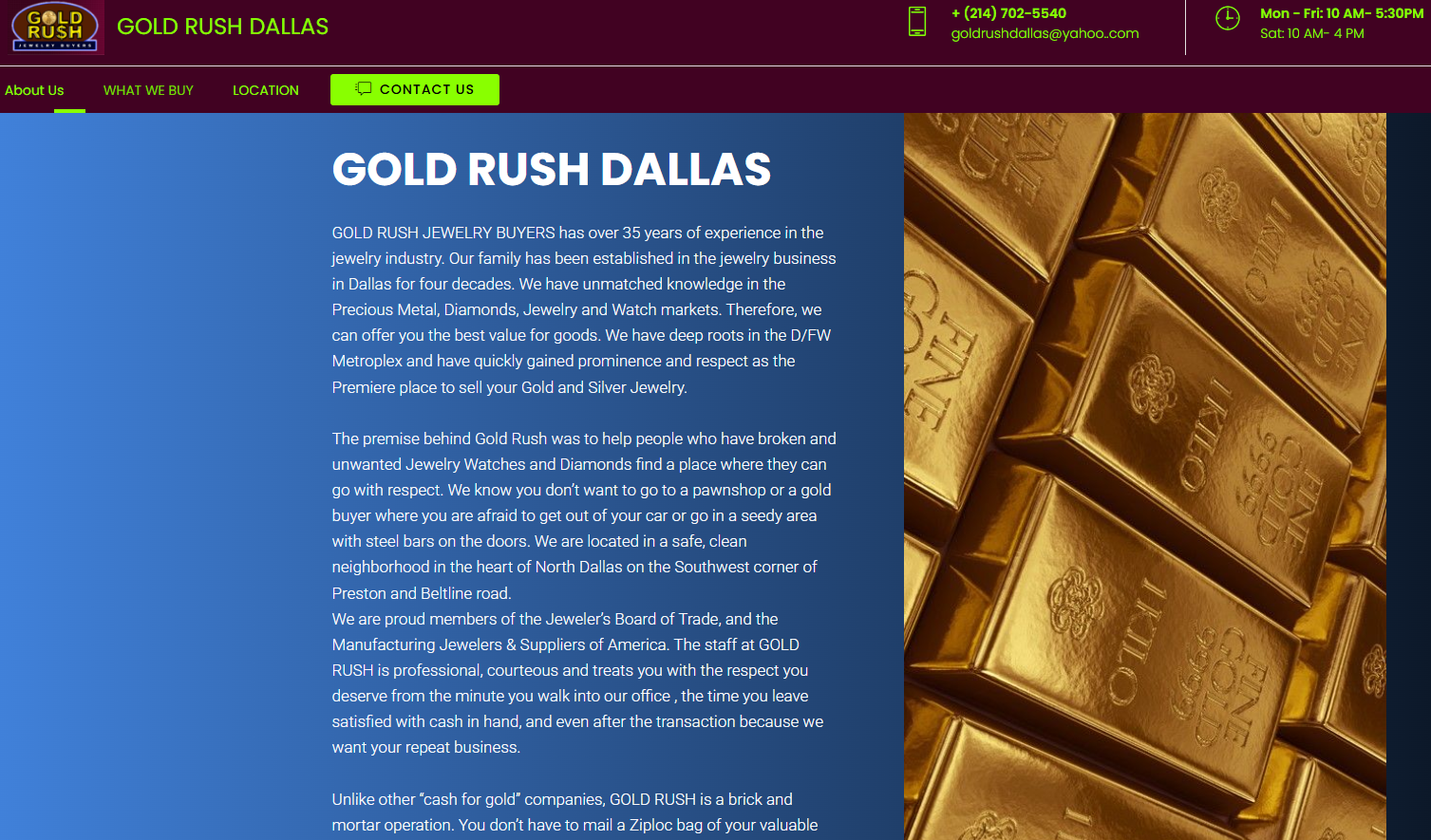
Interestingly, another basis for dismissal was also perhaps available, namely that the Respondent apparently had a genuine business including a website associated with the Domain Name, as depicted below, as well as a bricks and mortar retail location in Dallas, as noted by the Complainant.
Now, perhaps this constitutes infringement of the Complainant’s mark. But the service appears to be genuine, i.e. bona fide, rather than a ruse, and there was no apparent evidence of intentionally targeting the Complainant, so accordingly, this could be a case that could be dismissed on the basis of it constituting an apparent trademark infringement claim that could be decided in court rather than a case of cybersquatting that the UDRP is intended to resolve.
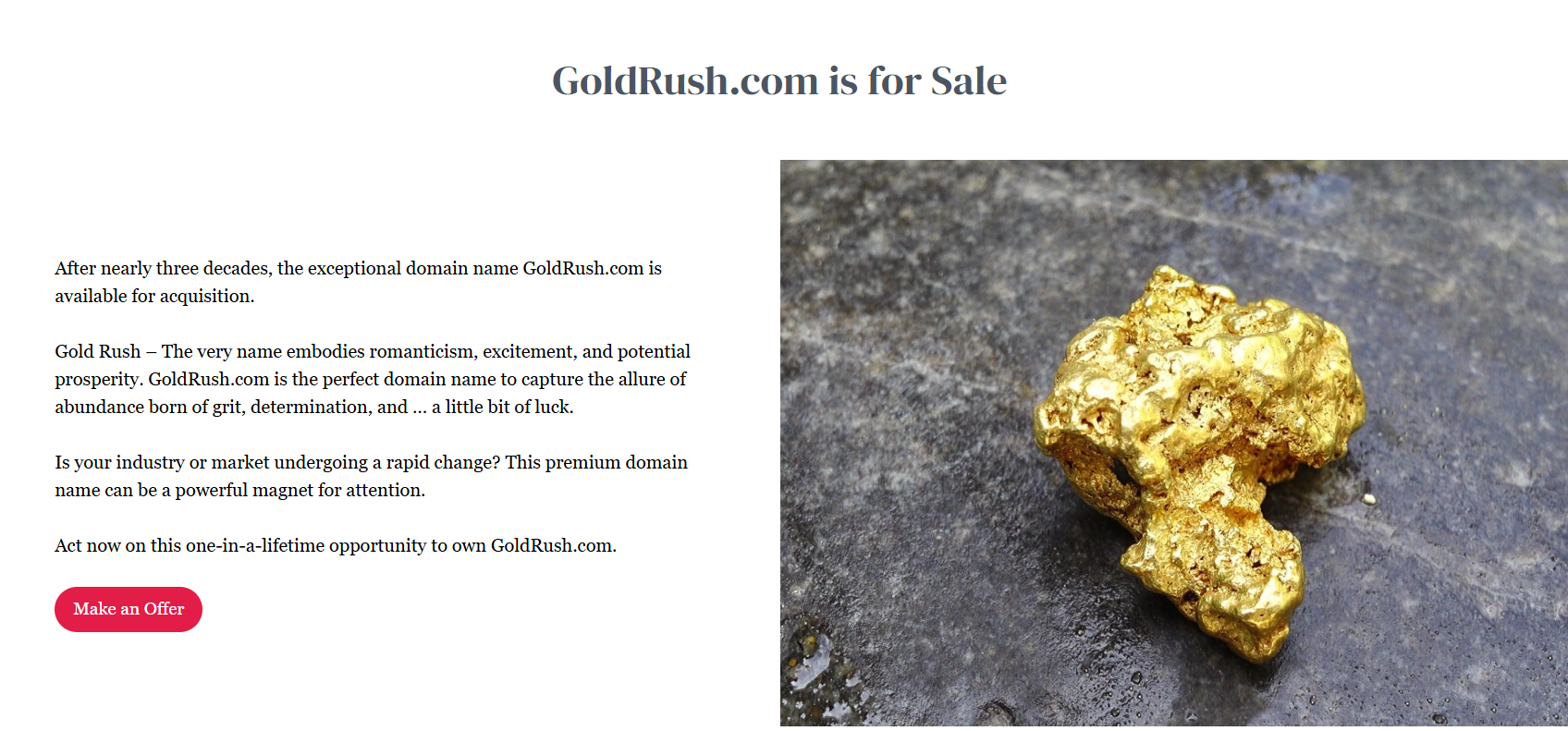
Interestingly, the domain name, GoldRush .com, appears to be for sale:
Complainant Must Prove All Material Issues; Speculation and Innuendo Are Insufficient
SCUTUM v. Wolfgang Eibl, Peter Eibl, WIPO Case No. D2025-2907
<scutum .com>
Panelist: Mr. W. Scott Blackmer
Brief Facts: The French Complainant is an international electronic security and fire safety firm, with 74 offices worldwide. The Complainant derives its name from Latin “scutum” (shield), and it has registered SCUTUM word and design trademarks including French mark dated November 8, 1995 and European Union mark dated May 3, 2010. The disputed Domain Name was created on December 7, 1998, and is currently inactive but during the period 2013-2019 it resolved to a landing page with PPC links. The Complainant states that after it became aware of the registration of the disputed Domain Name recently, it employed a domain consultant. After initial communication, the Complainant authorized the consultant to offer USD $5,000, and the Complainant claims the Respondent never replied. This proceeding followed.
The Respondent contends that “scutum” is the name of a constellation, and he furnishes evidence that on the same day, he registered other Latin-derived domain names on an astronomical theme. The Complainant’s supplemental filing attaches reverse WhoIs registration data concerning three other domain names, one of which is <azureservuces .com>, which is similar to the name of the “Azure” data services offered by Microsoft. The Complainant alleges a pattern of registering domain names exploiting the reputation of others without intent to put them to use for legitimate purposes. The Respondent states that he registered <azureservuces .com> on September 15, 2003, based on the dictionary word “azure”, while Microsoft announced Windows Azure five years later in October 2008, according to press releases reported in the media at the time.
Held: In more than 26 years since registering the disputed Domain Name, the Respondent has not used it for a website, commercial or noncommercial, relating to astronomy, nor does the Respondent offer evidence of demonstrable preparations to do so, consistent with the Policy, paragraphs 4(c)(i) or (iii). The only apparent use of the disputed Domain Name was for a page containing advertising links for a few months in 2013. Nevertheless, Panels have also recognized that aggregating or holding domain names consisting of dictionary words, as is the case here, can be bona fide if this is not a pretext for attacking a trademark. WIPO Overview 3.0, sections 2.1, and 2.10. The Panel finds under the same factual analysis that the evidence presented shows that the Respondent likely registered the disputed Domain Name for its dictionary significance and not as a pretext to exploit the Complainant’s SCUTUM mark, and thus that the Respondent can claim a legitimate interest in the disputed Domain Name for Policy purposes.
There is no evidence presented to suggest that the Respondent would necessarily have been aware of the Complainant’s French trademark, albeit dating from 1990, or “.fr” domain name registration. The record does not establish the Complainant’s fame in 1998 and indicates the Complainant was not established in Austria until 2022. The Complainant further raised an argument in its supplemental filing questioning the Respondent’s identity and suggesting that the Respondent is a serial cybersquatter. This argument lacks factual foundation. The Complainant and the Center have been able to communicate with the Respondent, who is participating in this proceeding and provides evidence concerning his other domain name registrations. The record in this proceeding does not suggest that these registrations are examples of Policy or trademark abuses. On balance, the Panel finds the Respondent’s account of the registration of the disputed Domain Name is credible and undermines the Complainant’s case. The evidence in the case file as presented does not indicate that the Respondent’s aim in registering the disputed Domain Name was to profit from or exploit the Complainant’s trademark.
RDNH: The Complainant, represented by counsel, justly can be faulted for not satisfactorily addressing the facts that the disputed Domain Name consists of a single dictionary word and has not been used in more than 26 years to attack the Complainant, submitting a record that did not establish that the mark was well known outside France in 1998. The Complainant should have been aware that, under the Policy, bad faith would have to be demonstrated at the time of registration, and that the fact that the registrant demanded a high price for the disputed Domain Name based on its current market value would be insufficient to prove the registrant’s intentions 26 years ago. The Complainants bear the ultimate burden of proof on all material issues and cannot expect to prevail on speculation and innuendo.
The Panel must also question the good faith of the Complainant in light of the Complainant’s decision to continue pursuing the Complaint following the Response showing that the Respondent was likely the original registrant in 1998 and also registered more similar domain names on the same date. The Complainant then doubled down with a supplemental filing suggesting the Respondent was a serial cybersquatter, without doing proper due diligence and also questioned the Respondent’s identity, although that has not seriously been in question in this proceeding. This course of conduct reflects a strategy that is not legally or factually well-grounded and hence may be deemed abusive.
Complaint Denied (RDNH)
Complainant’s Counsel: Cornet Vincent Segurel, France
Respondent’s Counsel: Self-represented
About the Editor:
 Ankur Raheja is the Editor-in-Chief of the ICA’s new weekly UDRP Case Summary service. Ankur has practiced law in India since 2005 and has been practicing domain name law for over ten years, representing clients from all over the world in UDRP proceedings. He is the founder of Cylaw Solutions.
He is an accredited panelist with ADNDRC (Hong Kong) and MFSD (Italy). Previously, Ankur worked as an Arbitrator/Panelist with .IN Registry for six years. In a advisory capacity, he has worked with NIXI/.IN Registry and Net4 India’s resolution professional.