
Panel: “Textbook Case of Trademark Overreach”
This looks like a sound and notably well-calibrated decision. The Panel correctly focused on what mattered most: the Respondent was not passively holding the Domain Name, nor using it as a pretext, but operating an actual project that fit the ordinary meaning of the words “open” and “space.” That is the heart of the case. As the decision recounts, the Respondent’s site was devoted to an open-source amateur radio and space communications initiative, with tangible development activity, hardware specifications, and a coherent descriptive concept. On those facts, the finding of rights or legitimate interests was straightforward. Continue reading commentary here.
We hope you will enjoy this edition of the Digest (vol. 6.15) as we review these noteworthy recent decisions with expert commentary. (We invite guest commenters to contact us):
‣ Panel: “Textbook Case of Trademark Overreach” (open .space *with commentary)
‣ Crypto Context Prevails as Panel Rejects Targeting Theory and Clarifies UDRP Limits (solcasino .io *with commentary)
‣ Blockchain Domain Lapse Exploited for Gambling Site (spacechain .com *with commentary)
‣ Panel: Dispute Lacks “Hallmarks of Cybersquatting” and Belongs in Court (upgrow .com *with commentary)
‣ Panel Flags Potentially Falsified Trademark Evidence, No Hallmarks of Cybersquatting in a Dispute Rooted in Prior Commercial Cooperation (liquidrubberworld .com *with commentary)
Panel: “Textbook Case of Trademark Overreach”
Kratos Defense & Security Solutions, Inc. v. Martin McCormick, Forum Claim Number: FA2603002210345
<open .space>
Panelist: Mr. David L. Kreider
Brief Facts: The Complainant claims to be an industry leader in the design and development of communications, technology, satellite, space, and aerospace goods and services within the military and defense industry. It owns U.S. trademark registrations for the word mark OPENSPACE (registered November 30, 2021) and KRATOS OPENSPACE (registered September 27, 2022) in Classes 9 and 42. The disputed Domain name was registered on June 27, 2025, by the Respondent, an individual amateur radio operator based in Studio City, California, who uses the Domain Name for an active open-source hardware and software initiative titled “Open Source Meets Outer Space.”
The Complainant alleges that since registration the Respondent has not used the disputed Domain name in good faith and has displayed the Complainant’s OPENSPACE mark on the associated website without authorization, in connection with space communications equipment that is related to or directly competitive with the Complainant’s goods and services. The Complainant further alleges that the Respondent’s registration of the disputed Domain name nearly five years after the Complainant adopted and secured trademark registrations for its OPENSPACE Marks demonstrates that the Respondent had knowledge of the Complainant’s rights.
The Respondent contends that while the phrase “open space” shares textual similarities with the Complainant’s registered OPENSPACE mark, the terms “open” and “space” are two generic, descriptive English dictionary words, and further claims rights and legitimate interests in the disputed Domain name based upon its current use. The Respondent further contends that the Complainant operates in the defense and government satellite sector, whereas the Respondent operates an open-source project for civilian hobbyists building DIY phased arrays, and that there is no overlap in target audience.
Held: The evidence establishes that the disputed Domain name resolves to an active website hosting a genuine open-source hardware and software initiative directed at the amateur radio community. The site provides technical specifications for three hardware products, includes photographs of prototype circuit boards, and states an expected ship date. This is not a passive or nominal use; it is an active, substantive project with tangible hardware in development. The Panel further notes that the terms “open” and “space” are common, generic English dictionary words, apt for a project that is open-source and relates to space communications. The website’s tagline, “Open Source meets Outer Space,” confirms this descriptive intent. Where a respondent registers a domain name consisting of common dictionary words for a purpose consistent with their ordinary meaning, that is strong evidence of a legitimate interest. See WIPO Overview 3.0, ¶ 2.10.1.
There is no evidence that the Respondent registered the disputed Domain name with Complainant’s OPENSPACE mark in mind, or with the intent to trade on Complainant’s goodwill. The disputed Domain name is composed of two common English dictionary words, as explained above. The evidence before the Panel shows that the Respondent selected the disputed Domain name for its descriptive value, not to target the Complainant’s trademark. The content of Respondent’s website reinforces this conclusion. The website makes no reference to the Complainant, Complainant’s products, or Complainant’s OPENSPACE mark. There are no links to Complainant’s website, no competing product offerings, and no suggestion of any affiliation with or endorsement by the Complainant. The website is devoted entirely to an amateur radio hardware project in a market segment that does not overlap with the Complainant’s business.
RDNH: The Respondent has not expressly requested a finding of Reverse Domain Name Hijacking. The Panel may, however, make such a finding on its own initiative where the record warrants it. See WIPO Overview 3.0, ¶4.16. The Complainant’s own annex screenshots directly refute its allegation that the Respondent had “made no good faith use” of the domain. A complainant represented by experienced trademark counsel should be expected to review its own exhibits before making allegations that are directly contradicted by those exhibits.
Further, the Complainant’s characterization of the Respondent’s DIY ham radio products as “directly competitive” with its multi-million-dollar defense satellite platform is a substantial overstatement of the overlap between the parties’ respective activities bordering on the absurd. Finally, the Complainant attempted to assert exclusive rights over a combination of two generic dictionary words to wrest a domain from a registrant with a demonstrably legitimate project in an entirely different market – conduct the Panel agrees is “a textbook case of trademark overreach.”
Complainant’s OPENSPACE mark is composed entirely of two common English dictionary words. While Complainant is entitled to enforce its registered trademark against confusingly similar uses within its field of goods and services, it cannot reasonably claim exclusive rights over the combination of the words “open” and “space” in connection with all space-related activities.
Complainant’s attempt to wrest a domain composed of generic dictionary words from a registrant with a demonstrably legitimate project in an unrelated market—on the basis of evidence that Complainant itself submitted and that contradicts the Complaint’s own allegations—falls below the standard of good faith expected of parties invoking the Policy. It is, as Respondent asserts, “a textbook case of trademark overreach”. The Panel finds that the Complaint was brought in bad faith and constitutes Reverse Domain Name Hijacking.
Complaint Denied (RDNH)
Complainant’s Counsel: Procopio, Cory, Hargreaves and Savitch LLP, USA
Respondent’s Counsel: Self-represented
Commentary Edited and Approved by ICA General Counsel, Zak Muscovitch:
This looks like a sound and notably well-calibrated decision. The Panel correctly focused on what mattered most: the Respondent was not passively holding the Domain Name, nor using it as a pretext, but operating an actual project that fit the ordinary meaning of the words “open” and “space.” That is the heart of the case. As the decision recounts, the Respondent’s site was devoted to an open-source amateur radio and space communications initiative, with tangible development activity, hardware specifications, and a coherent descriptive concept. On those facts, the finding of rights or legitimate interests was straightforward.
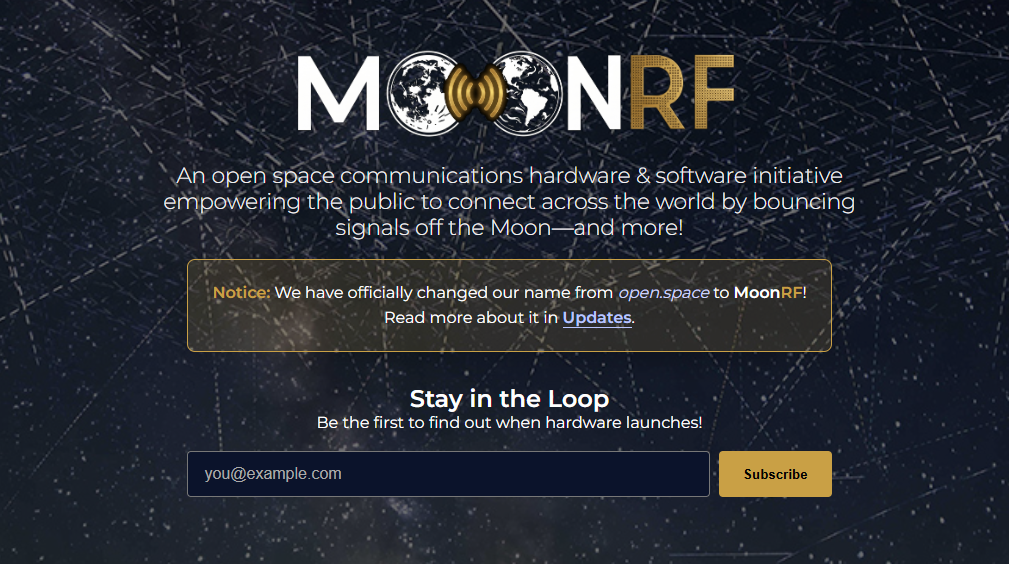
The current website, as reflected in the accompanying screenshot, adds an interesting and somewhat cautionary postscript. It indicates that the project has since rebranded to “MoonRF,” with the original Domain Name now forwarding to the new site and a notice that the name was changed. While the reasons are not expressly stated, the surrounding circumstances reasonably suggest that legal pressure, such as a trademark infringement allegation, may have prompted the change. If so, that development underscores an important distinction between the UDRP and trademark infringement regimes. The Policy is concerned with targeting, namely whether the Domain Name was registered with intent to trade on the Complainant’s mark, whereas trademark infringement does not require such intent and may be established on a showing of likelihood of confusion alone. As a result, even where a respondent appears to have a strong case under the UDRP, the practical burden, cost, and uncertainty associated with defending a trademark claim can nevertheless drive a rebrand. That does not retroactively validate the Complaint under the Policy, but it does illustrate the real-world leverage that such claims can exert beyond the UDRP framework.
The Panel was also right to reject the Complainant’s effort to collapse very different markets into supposed competition. The decision notes the gulf between the Complainant’s defense-sector satellite business and the Respondent’s civilian hobbyist-oriented open-source initiative, and properly treated the allegation of direct competition as seriously overstated. That matters not merely for bad faith, but for overall credibility. When a complainant characterizes a DIY ham-radio hardware project as directly competitive with a sophisticated defense and government communications platform, it invites exactly the kind of skepticism the Panel displayed here.
On bad faith, the Panel appropriately kept separate two questions that are too often blurred: awareness and targeting. Even if one assumed the Respondent could have discovered the Complainant that is not enough. The real question is whether the Domain Name was registered to target the Complainant’s trademark rights. Here, the descriptive composition of the Domain Name, the content of the website, the absence of any reference to the Complainant, and the non-overlapping audience all pointed the other way. The Panel’s reasoning on this point is especially persuasive because it is grounded in the actual use, not in abstract theorizing.
The RDNH finding also appears well deserved. The Panel identified two particularly troubling features: first, the Complainant’s own evidence apparently contradicted its allegation that there had been no good faith use; second, the Complaint materially exaggerated the relationship between the parties’ activities. Those are not minor pleading defects. They go to whether the Policy was invoked responsibly. The Panel’s conclusion that this was “a textbook case of trademark overreach” seems fully warranted on the record described.
Crypto Context Prevails as Panel Rejects Targeting Theory and Clarifies UDRP Limits
<solcasino .io>
Panelist: Mr. W. Scott Blackmer (Presiding), Mr. Tobias Cohen Jehoram, and Mr. Andrew D.S. Lothian
Brief Facts: The Complaint explains that Complainants share a common interest in this proceeding and also hold EU trademarks – SOL (word mark, Curaçao, July 2020) and SOL CASINO (figurative marks in Curaçao and the EU from 2020–2021). The first Complainant claims to have operated an online casino at <sol .casino> since 2020, though the Complainant has not furnished any evidence in support. The disputed Domain name was created on November 6, 2021, and is registered to the Respondent located in Costa Rica. The Respondent acquired the disputed Domain name from DAN on November 11, 2021 and it resolves to an online gambling website, which went live on about December 5, 2021. The Response includes an excerpt from a Discord discussion in December 2021 with a Solana online community leader, a co-founder of the Solana blockchain, who helped select the disputed Domain name for its appeal to users of the Solana ecosystem.
The Complainant alleges that the Respondent has acted in bad faith by attempting to divert Internet users for commercial gain by creating a likelihood of confusion with the Complainant’s marks. The Respondent notes that it registered the disputed Domain name a year before the Complainant obtained its first registration anywhere in the world for SOL CASINO as a word mark, and claims that by the time the Complainant registered SOL CASINO as a word mark in Curaçao in December 2024, the Respondent had acquired trade name rights corresponding to the disputed Domain name. The Respondent denies targeting any of them with the disputed Domain name and offers its own reasons for choosing a name for its online presence based on “sol”. The Respondent also points out that the Parties’ ongoing dispute under Curaçao national trademark law (which remains under appeal) is not dispositive of the issues under the Policy.
Held: The Respondent has established that it has been offering licensed online casino services through the website associated with the disputed Domain name since December 2021, consistent with the example of legitimate interests given in the Policy, paragraph 4(c)(i) (a use in connection with a bona fide offering of goods and services prior to any notice to the Respondent of the dispute). This could not be deemed a “bona fide” commercial use, however, if the Panel found that this facially legitimate interest is pretextual and that the Respondent registered or used the disputed Domain name in an effort to trade on the Complainant’s reputation. That possibility is examined below under the element of bad faith.
The Panel finds the Respondent’s denial of awareness and intent to exploit the Complainant mark credible, given the lack of evidence of the Complainant’s visibility online, the difference in their markets, and the Respondent’s strong reasons for using “sol” with reference to a cryptocurrency token. The Respondent’s registration of the disputed Domain name through a domain privacy service is not suspicious, as the Complainant suggests. It is a common practice which is often a default applied by registrars these days, and there is no sign that the change in the Respondent’s website contact details has actually impeded the Complainant or the Center in identifying and contacting the Respondent.
Moreover, it is hardly surprising that the Respondent would seek another licensing jurisdiction when challenged in Curaçao, and this is not in itself an indicator of bad faith under the Policy. Trademark law is national and not entirely coterminous with the UDRP or .IO Policy. The balance of probabilities, on this record, points to the Respondent selecting and using the disputed Domain name for its reference to the SOL token and the relevant suggestion of an online “crypto casino” business, not for an intended false association with the Complainant. The Panel does not find that the Respondent registered or used the disputed Domain name in bad faith within the meaning of the Policy.
Complaint Denied
Complainant’s Counsel: Represented Internally
Respondent’s Counsel: Muscovitch Law P.C., Canada
Commentary Edited and Approved by ICA General Counsel, Zak Muscovitch:
This is a careful and well-reasoned decision from a distinguished three-member Panel, which properly centers the analysis on targeting and the evidentiary burden required to establish it. The Panel’s treatment of both legitimate interests and bad faith is disciplined and appropriately tethered to the factual record.
On legitimate interests, the Panel accepted that the Respondent had been operating a licensed online casino at the Domain Name since December 2021, prior to any notice of the dispute, thereby falling squarely within paragraph 4(c)(i) of the Policy. As the Panel correctly noted, such use will ordinarily suffice unless it is merely pretextual. That framing is important. It places the burden where it belongs: on the Complainant to demonstrate that an apparently bona fide business is in fact a guise for targeting.
The Panel then turned, appropriately, to bad faith, where the case ultimately succeeded or failed. Here, the Panel found the Respondent’s explanation for selecting the Domain Name credible, namely its reference to the “SOL” cryptocurrency token and its relevance to a crypto-oriented casino offering. This was not a speculative or after-the-fact justification; it was supported by contemporaneous evidence, including a December 2021 discussion involving a Solana community figure regarding the name selection. That kind of evidence is precisely what panels often look for, but rarely see, when assessing intent at the time of registration.
Equally significant was the Panel’s treatment of the Complainant’s asserted rights. The Respondent registered the Domain Name before the Complainant obtained any word mark registration for SOL CASINO, and the evidentiary record regarding earlier use was notably thin. The Panel expressly noted the lack of evidence of the Complainant’s online visibility, which undermined any inference that the Respondent must have had the Complainant in mind. In the absence of such evidence, the Panel was right to decline to infer targeting.
The decision also offers a useful reminder about the limits of auxiliary arguments often raised by complainants. The Panel dismissed the suggestion that use of a privacy service was indicative of bad faith, recognizing it as a commonplace and often default registrar feature. Likewise, the Respondent’s shift in licensing jurisdiction in response to a Curaçao dispute was treated as commercially rational conduct rather than evidence of wrongdoing. These points reflect a commendably practical approach.
Perhaps most importantly, the Panel drew a clear boundary between the UDRP and parallel national trademark disputes. The existence of ongoing proceedings under Curaçao law did not carry the day under the Policy. As the Panel observed, trademark rights are territorial and the standards governing infringement are not coextensive with those under the UDRP. That distinction is critical. The Policy is concerned with abusive domain name registration, not with adjudicating broader trademark conflicts.
Ultimately, the Panel concluded that the balance of probabilities favored the Respondent’s explanation: that the Domain Name was selected for its association with the SOL token and the concept of a crypto casino, rather than to target the Complainant. That conclusion is well supported by the record and consistent with established UDRP principles requiring proof of intent to exploit the complainant’s mark.
This is a strong decision that reinforces the centrality of targeting, the importance of contemporaneous evidence, and the need to resist conflating trademark disputes with UDRP abuse. The Panel’s analysis is measured, fact-driven, and a useful addition to the growing body of jurisprudence in crypto-adjacent domain name disputes.
Disclosure: For transparency, readers should note that the Respondent in this proceeding was represented by Zak Muscovitch.
Blockchain Domain Lapse Exploited for Gambling Site
SpaceChain Foundation Ltd. v. Nguyen Duy Phong, WIPO Case No. D2026-0615
<spacechain .com>
Panelist: Mr. Keiji Kondo
Brief Facts: The Complainant, a Singapore entity, has several trademark registrations including: Singapore Trademark, (registered on May 23, 2018) and US trademark, (registered on December 31, 2019), for the stylized mark:  . The Complainant owned and operated the disputed Domain name continuously since 2016 in connection with its official business. Due to an unintended technical failure in receiving renewal notifications, the Complainant inadvertently allowed the disputed Domain name to expire. The Respondent re-registered the disputed Domain name on December 29, 2025. Following the re-registration, the Respondent redirected the disputed Domain name to a Vietnamese-language website branded “XOILAC86,” which promotes online football streaming and prominently displays advertising for online gambling and betting services.
The Complainant alleges that the content is entirely unrelated to the Complainant, its business, or its trademark rights. Such use does not constitute a bona fide offering of goods or services under paragraph 4(c)(i) of the Policy and demonstrates opportunistic bad-faith re-registration for commercial gain. The conduct also falls squarely within paragraph 4(b)(iv) of the Policy, which provides that evidence of bad faith exists where a respondent uses a domain name to intentionally attract, for commercial gain, Internet users to its website or another online location by creating a likelihood of confusion with the complainant’s mark as to the source, sponsorship, affiliation, or endorsement of the website. This is a clear case of misleading diversion and initial interest confusion, exploiting the Complainant’s trademark to attract traffic for commercial gain.
Held: The Panel notes that the Complainant has successfully shown that the disputed Domain name resolves by redirecting Internet users to a Vietnamese-language website branded “XOILAC86,” which promotes online football streaming and prominently displays advertising for online betting services. The circumstances of the case, in the absence of a response, clearly show that none of the circumstances in Policy clause 4(c) exist. Having reviewed the available record, the Panel finds the Complainant has established a prima facie case that the Respondent lacks rights or legitimate interests in the disputed Domain name. The Respondent has not rebutted the Complainant’s prima facie showing and has not come forward with any relevant evidence demonstrating rights or legitimate interests in the disputed Domain name such as those enumerated in the Policy or otherwise.
The Panel notes the Respondent registered the disputed Domain name long after the Complainant’s trademark. The Complainant showed the domain had been used in its business before the Respondent’s registration, for example in 2017. The Panel also notes that the disputed Domain name is now used to direct Internet users to a Vietnamese language website branded “XOILAC86”, which promotes online football streaming and prominently displays advertising for online betting services. Accordingly, the Panel finds that the Respondent, being aware of the reputation of the Complainant, acquired, and has been using, the disputed Domain name in an intentional attempt to attract, for commercial gain, Internet users to the Respondent’s website by creating a likelihood of confusion with the Complainant’s trademark as to the source, sponsorship, affiliation, or endorsement of the Respondent’s website.
Transfer
Complainant’s Counsel: Internally Represented
Respondent’s Counsel: No Response
Commentary Edited and Approved by ICA General Counsel, Zak Muscovitch:
This is a challenging case that follows a recurring pattern: the re-registration of a previously used domain name following inadvertent lapse, followed by immediate monetization through unrelated and often dubious content.
The actual use of the Domain Name, namely redirection to a Vietnamese-language website promoting football streaming alongside online betting advertisements, was neither infringing nor clearly targeting of the Complainant. Yet a plausible explanation is that the Respondent registered the Domain Name to exploit visitors to the Domain Name who were expecting to reach the Complainant as the previous user.
The Domain Name had been continuously used by the Complainant for nearly a decade before its inadvertent expiry, and there was evidence of prior use dating back to at least 2017. The Respondent’s re-registration immediately following lapse, combined with its subsequent use to redirect traffic for commercial gain, strongly supported an inference of opportunistic bad faith.
A challenge to this inference is that the Domain Name involves an unsurprising combination of two dictionary words, “Space” and “Chain”. “Chain” commonly is appended to other dictionary words given the widespread adoption of blockchain technology for various uses. Indeed, the spacechain.org domain name is registered and used by an unrelated third-party.
This is a dispute where the Panel had to weigh counterbalancing evidence. While, despite the Complainant’s inadvertent lapsed registration, the Respondent had every right to register the Domain Name for a legitimate, non-infringing purpose, the core of this dispute was whether redirecting traffic to a gambling site, even if non-infringing, was legitimate or whether it was targeting the Complainant. In circumstances such as these, where the Respondent has provided no explanation for its registration and use, and where no plausible alternative rationale is apparent on the face of the record, it is not unreasonable for a Panel to infer that that the Respondent was primarily motivated by a bad faith intent to profit from the Complainant’s customers who were visiting the Complainant’s lapsed Domain Name.
Panel: Dispute Lacks “Hallmarks of Cybersquatting” and Belongs in Court
Upgrow Inc. v. Dragos Banan, CAC Case No. CAC-UDRP-108424
<upgrow .com>
Panelist: Mr. Rodolfo Rivas Rea, Mr. Andrew D.S. Lothian and Mr. Mike Rodenbaugh
Brief Facts: The Complainant is a California-based B2B digital marketing agency offering SEO, PPC, and related services, operating since at least August 2018. The Complainant holds a USPTO registration for the word mark UPGROW (registered on September 16, 2025; first use on July 1, 2018). The disputed Domain name was originally registered in 2010, and the Complainant had an opportunity to purchase it in September 2018 for USD 12,000 but declined, choosing instead to operate at <upgrow .io>. The Respondent acquired the domain name on July 10, 2023 for USD 6,000 and built a B2C Instagram growth subscription platform under the “UpGrow” brand, claiming over 100,000 customers across more than 100 countries.
During the Respondent’s early development phase in late 2023, content appeared on the website incorrectly identifying the Complainant’s founders as the Respondent’s personnel, which the Respondent claims was the result of inadvertent “AI scraping.” The Complainant alleges that the use of specific names and identities of the Complainant’s founders cannot plausibly be attributed to accidental automated processes, but instead reflects deliberate targeting. The Respondent maintains that this content was temporary, inconsistent, and corrected before any notice from the Complainant, and therefore cannot support a finding of bad faith or intentional impersonation. The Complainant sent a cease-and-desist letter in April 2024, which went unanswered.
Held: The Panel identifies the chronological barrier as a significant obstacle: the Respondent acquired the disputed Domain name in July 2023 while Complainant’s registered trademark did not issue until September 2025. The Panel finds Complainant’s common law rights not convincingly established to a degree sufficient to support a finding that the Respondent targeted the Complainant at registration, noting “UPGROW” is a descriptive combination of common English words and that the Complainant produced no consumer surveys, advertising expenditure data, or market studies demonstrating acquired distinctiveness. The Panel further finds the AI-generated content error explanation, while not beyond question, not inherently implausible on the limited evidentiary record available, and declines to make definitive findings on such contested factual matters without the benefit of witness examination, discovery, or cross-examination.
Moreover, the evidence of alleged consumer confusion, while not irrelevant, does not in itself establish that the Respondent registered the disputed Domain name with the Complainant in mind or with intent to exploit its rights. Rather, it may equally be indicative of two entities operating under the same fairly descriptive trademark, leading to incidental misdirected communications. The case does not present the hallmarks of cybersquatting, such as opportunistic registration targeting a distinctive mark, or clear evidence of intent to capitalize on a complainant’s reputation, but instead reflects a more nuanced and contested commercial dispute. More broadly, the Panel considers that the dispute exceeds the limited scope of the Policy and would be more appropriately resolved before a court of competent jurisdiction, where the factual and legal issues may be fully ventilated.
RDNH: The Panel declines to find RDNH. Notwithstanding the Complaint’s failure on the merits, the Panel finds that the Complainant had a colorable, though ultimately unpersuasive, basis to file. This conclusion is supported by early-phase website content that incorrectly identified the Complainant’s founders as the Respondent’s personnel, which was capable of raising reasonable concerns of impersonation. Further support is found in documented misdirected customer communications suggesting marketplace confusion, as well as the Respondent’s failure to respond to the cease-and-desist letter, which may reasonably have reinforced the Complainant’s perception that UDRP recourse was warranted.
Complaint Denied
Complainant’s Counsel: Internally Represented
Respondent’s Counsel: Self-represented
Commentary Edited and Approved by ICA General Counsel, Zak Muscovitch:
This is a thoughtful and measured decision from a well-constituted three-member Panel, which properly resists the temptation to stretch the UDRP beyond its intended scope in the face of a factually contested commercial dispute.
The Panel correctly identified the chronological issue as a central obstacle for the Complainant. The Respondent’s acquisition of the Domain Name in July 2023 predated the Complainant’s registered trademark rights by more than two years. While common law rights can, in appropriate cases, fill that gap, the Panel found the evidentiary showing here insufficient. Notably absent were the kinds of materials that panels typically rely upon to establish acquired distinctiveness, such as consumer surveys, advertising expenditures, or market penetration data. In the absence of such evidence, the Panel was right to decline to infer that the Respondent registered the Domain Name with the Complainant in mind.
The Panel’s treatment of the term “upgrow” is also significant. As a combination of two ordinary English words with a descriptive connotation, it is inherently capable of independent adoption by multiple parties. This descriptive character reinforces the need for compelling evidence of targeting, which was not present on the record.
A particularly interesting aspect of the case was the allegation concerning website content that temporarily identified the Complainant’s founders as affiliated with the Respondent. The Panel approached this issue with appropriate caution. While the explanation of inadvertent “AI scraping” may invite skepticism, the Panel declined to make definitive findings on such contested factual matters in the absence of procedural tools such as discovery or cross-examination. This is a commendable restraint and a reminder of the UDRP’s institutional limitations when confronted with disputed evidence.
Similarly, the Panel’s handling of alleged consumer confusion is instructive. While evidence of misdirected communications may suggest some level of marketplace overlap, it does not, without more, establish that the Respondent registered the Domain Name with intent to target the Complainant. As the Panel recognized, such confusion may equally arise where two parties independently adopt a relatively descriptive term.
The Panel’s conclusion that the dispute falls outside the proper scope of the Policy is particularly well taken. This is not a classic cybersquatting scenario involving opportunistic registration of a distinctive mark, but rather a more nuanced conflict between two businesses operating under a similar name. In such cases, courts, with their ability to assess credibility, weigh evidence, and apply broader trademark doctrines, are the more appropriate forum.
On Reverse Domain Name Hijacking, the Panel’s refusal to make such a finding is also defensible. Although the Complaint ultimately failed, the Panel identified several factors that gave it at least a colorable basis, including the early-phase website content referencing the Complainant’s founders, evidence of misdirected communications, and the Respondent’s failure to respond to a cease-and-desist letter. These considerations, taken together, were sufficient to avoid a finding that the Complaint was brought in bad faith.
Overall, this decision is a useful reaffirmation of core UDRP principles: the importance of timing, the evidentiary burden required to establish common law rights in descriptive terms, and the limits of the Policy in resolving complex commercial disputes. The Panel’s disciplined approach and refusal to overextend the UDRP framework are particularly commendable.
Panel Flags Potentially Falsified Trademark Evidence, No Hallmarks of Cybersquatting in a Dispute Rooted in Prior Commercial Cooperation
<liquidrubberworld .com>
Panelist: Mr. Andrew D.S. Lothian
Brief Facts: The First Complainant is an Indian limited liability partnership incorporated in May 2019, offering waterproofing, fireproofing, and anticorrosion coating services. It holds Indian registration for the word mark LIQUID RUBBER, (originally filed October 5, 2013; assigned to the Complainant in November 2019). The Second Complainant claims to be the owner of a group of affiliated entities and holds a Belarussian device mark (registered February 5, 2020) and a Russian device mark (registered April 1, 2022), both featuring a black shield hexagon with “Liquid Rubber” in white, the same visual identity as the First Complainant’s branding. The Respondent is the CEO of Balt Partner Group UAB, a Lithuanian entity that manufactures and sells liquid rubber waterproofing products and holds Lithuanian registration for an “LR WORLD” shield device (registered November 12, 2021). The disputed Domain name was registered March 7, 2021.
The Complainant alleges that the Respondent copied the Complainant’s website content, layout, product descriptions, trade dress, and logo with only minor changes, showing clear knowledge of the Complainant’s mark, domain name, and business, and evidencing opportunistic bad faith. The Respondent contends that it has rights and legitimate interests in the disputed Domain name, noting that this was registered to promote and sell the Respondent’s own liquid rubber products manufactured in Lithuania. Notably, the Respondent asserts that the Complainant failed to disclose material facts to the Panel, as WhatsApp records show the Second Complainant was in active commercial cooperation with the Respondent as late as August 2022, coordinating invoices and marketing materials, including materials bearing the disputed Domain name. One of the Complainant’s own product labels contained a QR code that, when scanned, redirected to the disputed Domain name.
Held: The Panel declines to decide on the UDRP merits, denying the Complaint on the narrow ground that the dispute falls outside the cybersquatting scope of the Policy and is more appropriately resolved by a court of competent jurisdiction (WIPO Overview 3.1, §4.14.6). The Panel found the case to be a complex multi-jurisdictional business and trademark dispute arising from a prior commercial relationship between the Second Complainant and the Respondent, with shared trading styles likely originating from their period of co-operation. The disputed Domain name was found to be largely incidental to the wider commercial conflict. The Panel further notes that the Parties were not strangers to the domain name’s use: the Second Complainant’s own WhatsApp messages confirmed awareness of the disputed Domain name by at least August 2022, and Complainant’s product label pointed users to it via QR code.
The Panel suggests that a court forum, with oral testimony, cross-examination, discovery, and interim remedies, or direct commercial dialogue between the parties would be the more appropriate avenue. The Panel further expressly declines to make an RDNH finding given the out-of-scope disposal. However, the Panel delivered a pointed rebuke to Complainant’s counsel: the trademark registration images submitted by the Complainants, for both the Belarussian and Russian marks, differed materially from the marks as they actually appear on the official public registers (neither containing the word “WORLD” as depicted in the Complainant’s annexes), suggesting the documents may have been altered to strengthen the Complainant’s case. The Panel noted that Complainant’s counsel have a professional responsibility regarding the accuracy of materials put before a tribunal and “may wish to reflect” on that responsibility.
Complaint Denied
Complainant’s Counsel: Law Office of H K Acharya & Company, India
Respondent’s Counsel: AVOCAD Law Firm, Lithuania
Commentary Edited and Approved by ICA General Counsel, Zak Muscovitch:
This decision reflects a firm application of UDRP limits, with the Panel declining to extend the Policy into a dispute more properly characterized as a complex multi-jurisdictional commercial and trademark dispute.
At its core, this case did not present the hallmarks of cybersquatting. Rather, it arose from a prior commercial relationship between the Parties, with evidence of cooperation extending well beyond the registration of the Domain Name. The record showed that the Second Complainant was aware of, and indeed actively engaged with, the Respondent in connection with the Domain Name’s use, including coordination of marketing materials and even the incorporation of a QR code on the Complainant’s own product labels directing users to the disputed Domain Name. These are not the facts of an unsuspecting trademark owner targeted by a bad faith registrant. They instead point to a shared commercial context in which rights and expectations are inherently contested.
Against that backdrop, the Domain Name itself was, as the Panel recognized, largely incidental to the broader dispute. The Parties appear to have operated with overlapping branding, potentially originating during their period of cooperation, and the subsequent breakdown in relations gave rise to competing claims over intellectual property and business identity. Such disputes, particularly when spanning multiple jurisdictions and involving contested factual narratives, fall well outside the streamlined and document-limited framework of the UDRP.
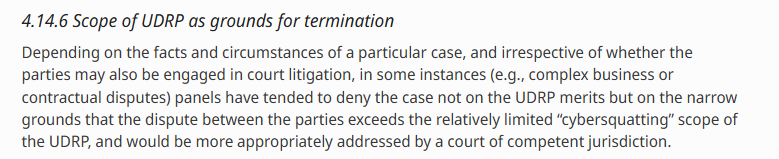
The Panel’s reliance on WIPO Overview 3.1, section 4.14.6, is well placed. Where a case turns on complex questions of contractual dealings, shared business history, and disputed trademark rights, the Policy is not designed to serve as a substitute for a full adjudicative process. The Panel appropriately pointed to the availability of court proceedings, with their capacity for discovery, cross-examination, and interim relief, as the more suitable forum.
However, the Panel’s decision to decline a finding of Reverse Domain Name Hijacking is more difficult to reconcile with the record. The apparent submission of altered trademark images, coupled with the Complainants’ failure to disclose material prior dealings with the Respondent, are serious concerns that go directly to the good faith of the Complaint. Indeed, bringing a UDRP complaint in circumstances where the dispute is fundamentally outside the scope of the Policy may itself support a finding of RDNH, particularly where key contextual facts are omitted or mischaracterized. The Panel’s pointed remarks regarding counsel’s professional responsibilities underscore the gravity of these issues, even if they stopped short of a formal RDNH finding.
Overall, the decision underscores an important boundary: the UDRP is not a vehicle for resolving fractured business relationships or competing claims to shared branding developed through prior cooperation. Where the hallmarks of cybersquatting are absent, and the dispute instead turns on contested commercial history and credibility, the Policy properly yields to more appropriate forums.
 Ankur Raheja is the Editor-in-Chief of the ICA’s new weekly UDRP Case Summary service. Ankur has practiced law in India since 2005 and has been practicing domain name law for over ten years, representing clients from all over the world in UDRP proceedings. He is the founder of Cylaw Solutions.
He is an accredited panelist with ADNDRC (Hong Kong) and MFSD (Italy). Previously, Ankur worked as an Arbitrator/Panelist with .IN Registry for six years. In a advisory capacity, he has worked with NIXI/.IN Registry and Net4 India’s resolution professional.