
Panel Reformulates Oki Data Test and Proposes “Lost Mary Criteria”
It is rare for a decision to expressly adopt a new interpretative framework. Yet that is what the Panel boldly did here; the Panel found “that it is time to adjust the Oki Data criteria according to current needs in the e-commerce world” and even renamed it as the “Lost Mary Criteria”.
The Panel noted that “it should be borne in mind that the Oki Data criteria are not solid law that a Panel should follow….[rather] they are part of self regulation rules as developed by ICANN and panelists and agreed to by holders of domain names”. The Panel further noted that “the Oki Data doctrine has evolved as the majority view of panelists in domain name disputes, but it is not the only view”. continue reading commentary.

We hope you will enjoy this edition of the Digest (vol. 5.30) as we review these noteworthy recent decisions with expert commentary. (We invite guest commenters to contact us):
‣ Panel Reformulates Oki Data Test and Proposes “Lost Mary Criteria” (lostmarydirect .com *with commentary)
‣ Once Whois Revealed, Any Doubt Removed (tyrone .com *with commentary)
‣ Respondent’s Surname Email Business is Legitimate Interest (peet .com *with commentary)
‣ Conclusory Allegations of Common Law Trademark Rights are Insufficient (magenta-line .com *with commentary)
‣ Panelist’s Independent Research Revealed Respondent’s Registration Predated Complainant Trademark Rights (ranchbot .com *with commentary)
Panel Reformulates Oki Data Test and Proposes “Lost Mary Criteria”
<lostmarydirect .com>
Panelist: Ms. Marieke Westgeest
Brief Facts: The Complainants are two legal entities belonging to the same group, domiciled in Hong Kong and in Shenzhen, China respectively. The Complainants state that LOST MARY was founded in 2022 and is the sister brand of the famous disposable e-cigarette brand ELF BAR. The Complainants hold, among other trademarks, the International Registration for LOST MARY, registered on 4 August 2021 and Australian Trademark for LOST MARY, registered on 11 November 2022 in the name of Dashing Joys Limited. The Complainants shows that LOST MARY products are currently available for sale on a number of online e-cigarette retail platforms in the UK. The disputed Domain Name was registered on 30 November 2023. The Respondent is a reseller and operates the disputed Domain Name to resell genuine LOST MARY vape products lawfully, according to the Respondent, purchased from the Complainants’ authorized distributors.
According to the Respondent, his use of LOST MARY constitutes a bona fide offering of goods under Policy, Paragraph 4(c)(i). The Respondent’s website emphasizes the authenticity of the products, stating they are “100% Authentic LOST MARY Disposables Vapes” and “sourced directly from authorized resellers of the manufacturer,” reflecting purchases through legitimate supply chains. The Respondent continues by referring to Oki Data Americas, Inc. v. ASD, Inc. (WIPO D2001-0903), in which the Panel recognized a reseller’s legitimate interest when selling genuine trademarked goods, provided certain criteria are met. The Respondent maintains that his activities fully comply with recognized reseller standards. He states that he offers only genuine LOST MARY products through the disputed domain and does not sell competing or counterfeit goods.
The Respondent has added a clear disclaimer to address any potential confusion after receiving the Complaint which clarifies the absence of any official connection with the Complainant, and there is no attempt to monopolize domain names involving the LOST MARY mark. The Respondent points out that there is no evidence of actual consumer confusion or deceptive intent, emphasizing that the similarity between his website and Complainants’ site is incidental to reselling branded products. The Respondent further contends that his use of the LOST MARY mark in the domain name is nominative fair use necessary to identify the products being sold and not to suggest any endorsement or affiliation. The mark is used only to the extent needed to describe the genuine goods offered for sale. Additionally, the Respondent rejects any suggestion of bad faith.
Held: The Oki Data requirements were established in 2001 to protect consumers from confusion when authorized dealers used trademark owners’ marketing visuals online, particularly at a time when the public was less familiar with the Internet. The decision emphasized the need for clear disclaimers on reseller websites to distinguish them from official trademark sites. Over the years, most Panels have applied these criteria to resellers as an added safeguard. However, with nearly 25 years of e-commerce development, the public is now more adept at recognizing the difference between official and reseller sites.
Reseller websites typically display goods and pricing prominently, making their nature clear without an explicit disclaimer The Panel finds that the Oki Data criteria should be updated to reflect current internet usage. A disclaimer is no longer strictly necessary; instead, any effective method that clearly distinguishes the reseller’s site from the trademark owner’s is sufficient to demonstrate fair use. This could include a unique website design or prominently displaying the reseller’s legal entity. The key requirement is that there must be no risk of consumer confusion about the website’s origin. The Policy remains focused on preventing cybersquatting, not regulating all domain name disputes, and trademark owners should address unauthorized reseller activity through contracts or traditional litigation if needed.
Revised Oki Data criteria (Lost Mary criteria): There is actual offering of goods and services via Respondent’s website at issue; The use of the website is to sell only the specific trademarked goods which have been brought into the market by the trademark owner and; The Respondent’s website can be easily distinguished from that of the trademark owner; The Respondent must also not try to corner the market in domain names that reflect the trademark. The Panel will apply the above-mentioned revised Oki Data criteria (from now on: the Lost Mary criteria) to assess whether the Respondent in the current Complaint has a legitimate interest or not.
The Respondent is not affiliated with the Complainants but sells genuine LOST MARY goods, a fact not disputed by the Complainants. The Panel compared both parties’ websites and found them clearly distinct: the Complainants’ site has a calm purple aesthetic and focuses on brand experience, while the Respondent’s site features a hand-drawn logo, bold orange colors, and prominent pricing offers typical of a reseller. The Panel found that these differences ensure the public can readily distinguish between the official and reseller sites, and that the Respondent’s use of the trademark in the domain is bona fide.
While the Complainants allege deliberate imitation and bad faith, the Panel accepts the Respondent’s explanation that any similarities stem from the nature of reselling branded products. The Panel does note that using “LOST MARY” in the reseller’s logo could potentially raise trademark issues under other legal frameworks, but such matters fall outside this proceeding. Evidence of the Respondent holding other domain names involving third-party vaping brands was found irrelevant, as none involve LOST MARY. The Panel ultimately concludes that the Respondent has a legitimate interest in the disputed Domain Name, and the Complainants have not met their burden to show otherwise.
Complaint Denied
Complainant’s Counsel: Internally Represented
Respondent’s Counsel: Self-represented
Case Comment by ICA General Counsel, Zak Muscovitch: It is rare for a decision to expressly adopt a new interpretative framework. Yet that is what the Panel boldly did here; the Panel found “that it is time to adjust the Oki Data criteria according to current needs in the e-commerce world” and even renamed it as the “Lost Mary Criteria”.
The Panel noted that this “it should be borne in mind that the Oki Data criteria are not solid law that a Panel should follow….[rather] they are part of self regulation rules as developed by ICANN and panelists and agreed to by holders of domain names”. The Panel further noted that “the Oki Data doctrine has evolved as the majority view of panelists in domain name disputes, but it is not the only view”.
Indeed, the Oki Data test has evolved over time. As noted in UDRP Perspectives at 2.3, although the Oki Data test has consistently been applied since 2001, it is best used as a guide and adapted as necessary by Panels. In other words, it is not enshrined in stone but rather can be a helpful yardstick by which to measure the good or bad faith of a particular reseller.
More recently, a modified version of the Oki Data test has been adopted by some panelists that adopt a more holistic approach to the Oki Data criteria (see for example: Textron Aviation Inc. v. William Ahern / Atlantic Beechcraft Services, NAF Claim Number: FA2505002157839 (See my in-depth UDRP Digest comment); Textron Innovations Inc. v. Joerg Dogondke, Forum FA2504002151258 <cessna150150. com>, Denied; and also see for example, Fluke Corporation v. Erwin Bryson / fixmyfluke / Nelson Bryson, Forum FA2203001988399, <flukerepair.com> and <fixmyfluke.com>, Denied with dissenting opinion) (see UDRP Digest comment), and in particular have reconsidered whether the absence of a prominent disclaimer necessarily makes the Respondent’s use illegitimate.
Under this more holistic and less rigid approach, Panels look at multiple factors including domain name composition, website content that may either confirm or deny affiliation with the Complainant as well as any other circumstances relating to the use of the domain name and Respondent’s business.
From that perspective, the decision in the present case represents a continuation of the evolution of the Oki Data test towards a less rigid and more “holistic approach”, where for example, the absence of a specific disclaimer isn’t fatal to a reseller’s legitimate interest.
In the present case, the Panel acknowledges Oki Data’s continued applicability but proposes an “adjustment”; “the third criterium can be rephrased through broadening it and in which the disclaimer is an example, not a conditio sine qua non”.
The Panel proposes a reformulation of the Oki Data test to the “Lost Mary Criteria”, as follows:
- There is actual offering of goods and services via Respondent’s website at issue;
- The use of the website is to sell only the specific trademarked goods which have been brought into the market by the trademark owner;
- The Respondent’s website can be easily distinguished from that of the trademark owner. Aspects that can be decisive to distinguish Respondent’s website from that of the trademark owner are inter alia (but not limited):
- the placing of a disclaimer disclosing Respondent’s relationship with the trademark owner on the home page of the website;
- the creation of a different look and feel of the website of Respondent as compared to the website of the trademark owner;
- the dominant use of resellers’ websites specific elements like pricing and depiction of the goods;
- the use of a logo on the top of the home page, not including the trademark as mentioned in the disputed domain name, that addresses the entity of Respondent on the website.
- Respondent must also not try to corner the market in domain names that reflect the trademark.
Accordingly, it appears that in a manner comparable to the “holistic” approach that focuses on the totality of factors, the Panel is suggesting that Panels should take into account a multitude of factors that serve to adequately distinguish a website from the trademark owners, without necessarily and specifically requiring a disclaimer.
Applying the “Lost Mary Criteria” to the present case, the Panel found inter alia, “that the public will be able to distinguish the two websites immediately” which together with the other factors considered, led the Panelist to determine that the Respondent had a legitimate interest as a reseller of the Complainant’s genuine products.
But what about the Domain Name itself, LOSTMARYDIRECT .COM? The Complainant claimed that “the term “direct” in the disputed domain name suggests a reseller or direct sales channel, not the official brand”. Use of the term “direct” could however be interpreted as referring to the manufacturer directly selling to the public rather than through a distributor, rather than connoting a reseller as suggested by the Respondent – thereby deceiving the consumer. Ostensibly however, this is immaterial under the “Lost Mary Criteria” since the Respondent’s website is “easily distinguished” from the Complainants and thereby avoids confusion by consumers who after “almost 25 years after the Oki Data decision, [are] accustomed to the Internet and is sufficiently wise to distinguish an official trademarked website from that of a reseller”.
It is refreshing to see a Panelist take a renewed look at principles that we have adopted after so many years and that is how the common law develops. On the other hand, whether evolutions of or departures from the existing case law, the test of any new or modified approach boils down to whether subsequent Panelists will adopt it as consensus. To the extent that this decision carries on the natural evolution from a strict Oki Data test to a more holistic approach where having a specific disclaimer is not necessarily a requirement provided other factors adequately serve to avoid consumer confusion, I think that it serves an important and useful purpose.
Once Whois Revealed, Any Doubt Removed
Corcreevy Pty Ltd v. domain administration, Anything .com, Ltd., WIPO Case No. D2025-1881
<tyrone .com>
Panelist: Ms. Jane Seager (Presiding), Mr. Luca Barbero and Mr. Jeremy Speres
Brief Facts: The Australian Complainant, incorporated on June 14, 2011, has been trading under the names “Tyrone Masonry” since 2011 and “Tyrone Group” since 2014. The Complainant operates a construction business, specializing in commercial masonry and operates its business from two primary locations in Western Australia. The Complainant is the owner of Australian Trademark, TYRONE (figurative), registered on March 27, 2024. The disputed Domain Name was registered on May 13, 2002. In February 2025, the disputed Domain Name resolved to a landing page displaying sponsored links and including a banner at the top of the page stating, “tyrone .com may be for sale!”. The Complainant asserts that the Respondent acquired the disputed Domain Name between May 6, 2022, and February 21, 2024.
The Complainant further alleges that the disputed Domain Name is passively held by the Respondent and use of the disputed Domain Name carries a risk of implied affiliation with the Complainant. The Respondent claims to have registered the disputed Domain Name in 1998 and provides evidence of ownership since 2004. The Respondent operates a business registering domain names made up of common names and dictionary words for investment or resale. It claims “tyrone” is a common first name and registered the disputed domain for its inherent value as such. The Respondent states that it does not select the PPC links itself, explaining that they are automatically generated based on parking provider software.
Held: A key aspect of the Complainant’s case is the assertion that the Respondent acquired the disputed Domain Name at a date between May 6, 2022, and February 21, 2024. Based upon the evidence, the Panel finds it more likely than not that the Respondent’s ownership of the disputed Domain Name extended back to at least May 13, 2002, if not before as claimed by the Respondent. What is clear from the evidence on record is that the Respondent’s registration of the disputed Domain Name predated the incorporation of the Complainant and the Complainant’s adoption of the trademark TYRONE by many years. Indeed, the Complainant did not acquire a trademark registration for TYRONE until 2024, two decades after the registration of the disputed Domain Name.
There is nothing in the record to suggest that the Respondent could have had the Complainant’s trademark in mind when the Respondent registered the disputed Domain Name, as at that time the Complainant did not yet exist. The Panel finds that the Complainant has failed to establish that the disputed Domain Name was registered in bad faith, therefore the Complaint must fail. For completeness, the Panel notes that prior UDRP panels have accepted that aggregating and holding domain names (usually for resale) consisting of acronyms, dictionary words, or common phrases can be bona fide and is not per se illegitimate under the Policy.
RDNH: The Complaint was advanced on the notion that the disputed Domain Name was acquired between 2022 and 2024. However, the Complainant’s assertions in this regard are not supported in evidence. The Panel notes that there may have been doubt as to the identity of the registrant due to redaction of registration information in the publicly-accessible WhoIs record; however, any such doubt should have been removed upon disclosure of the registration information further to the Complainant’s submission of the Complaint to the Center. Despite this, the Panel notes that the Complainant chose to proceed with the Complaint containing factual statements that the Complainant should have recognized as being incorrect. The Panel finds that the Complainant knew or should have known that it could not succeed. In light of the above, the Panel finds that the Complaint was brought in bad faith and constitutes an attempt at Reverse Domain Name Hijacking.
Complaint Denied (RDNH)
Complainant’s Counsel: Bennett Litigation and Commercial Law, Australia
Respondent’s Counsel: ESQwire .com PC, United States of America
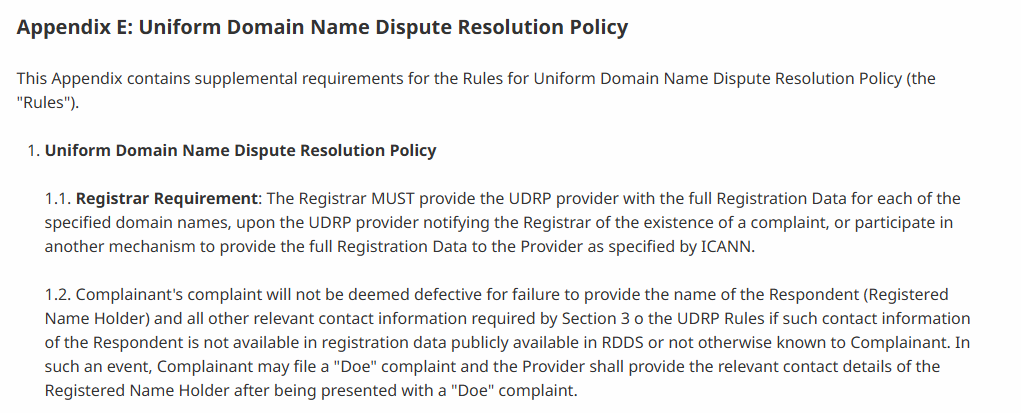
Case Comment by ICA General Counsel, Zak Muscovitch: Some Panels need to update their approach as a result of the Whois Verification process. Since May 25, 2018, Appendix E of ICANN’s Temp Spec has set out the procedure for revealing Whois details in UDRP proceedings:
The procedure works like this;
- Complainant files Complaint with Provider;
- Provider reviews for compliance with UDRP Rules;
- Provider requests Registrar provide underlying Whois details;
- Provider furnishes Complainant with the underlying Whois details and invites Complainant to amend Complaint;
- Complainant either amends Complaint based upon the revealed Whois or proceeds with the original Complaint;
- Provider commences proceeding and notifies Respondent of the proceeding.
As you can see, the UDRP Provider commences the proceeding after the Complainant is furnished with Whois Details. That means that the Complainant will have had the opportunity to amend its Complaint or to reconsider its Complaint before the proceeding is officially commenced by the Provider. As such, Complainants cannot rely upon ‘pre-Whois verification uncertainty as to the identify of the Respondent and Panels, as the Panel did here, can and should take into consideration that;
“there may have been doubt as to the identity of the registrant due to redaction of registration information in the publicly-accessible WhoIs record; however, any such doubt should have been removed upon disclosure of the registration information further to the Complainant’s submission of the Complaint to the Center.”
Well done, Panel.
Respondent’s Surname Email Business is Legitimate Interest
Peet Limited v. Domain Admin, Tucows .com Co, WIPO Case No. D2025-1847
<peet .com>
Panelist: Ms. Stephanie G. Hartung (Presiding), Ms. Deanna Wong Wai Man and Ms. Sally M. Abel
Brief Facts: The Complainant is active in the residential land developers’ business in Australia, creating master-planned communities, townhouses, and apartments. The Complainant is the registered owner of various national Australian trademarks, that includes word/design trademark PEET P (February 3, 1995), and word trademark PEET (July 7, 2005). The Respondent is an ICANN-accredited registrar which, inter alia, is active in the business of offering personalized email addresses. On or before June 15, 2006, the Respondent publicly announced that it acquired a portfolio of around 17,000 common surname domain names for a price of USD $18 million.
The Complainant alleges that the Respondent is seeking to profit from the trademark value of the word “peet” by using the disputed Domain Name in connection with a personalized email service, as the Respondent’s customers may create email addresses under “[…]@peet,com” with the intention of imitating an employee of the Complainant. The Respondent contends that it has legitimate interests in respect of the disputed Domain Name since the term “peet” primarily is a common surname, as the Complainant’s corporate name, which derived from its founder James Thomas Peet, suggests, and that the use of surname domain names for a bona fide email service is well-trod territory in UDRP jurisprudence.
Held: The Panel finds that it is more likely than not that the Respondent’s use of the disputed Domain Name over a number of years has been wholly independent of the Complainant’s PEET trademark and business. The Panel accepts that the Respondent’s use of the disputed Domain Name aligns with a consistent business practice of registering domain names corresponding to surnames for the provision of personalized email address services. Clearly, before any notice to the Respondent of the dispute, the Respondent used, or made demonstrable preparations to use, the disputed Domain Name in a bona fide offering of services as set forth by paragraph 4(c)(i) of the Policy.
The Panel does not see sufficient evidence, provided by the Complainant, indicating that the Respondent did register the disputed Domain Name in bad faith targeting the Complainant and its PEET trademark or that the Respondent’s aim in registering the disputed Domain Name was to impersonate the Complainant or obtain undue profit from it or exploit the latter. The mere risk that the Respondent’s customers may create email addresses under “[…]@peet .com” with the intention of imitating an employee of the Complainant for e.g., some unlawful activities, does not turn the Respondent’s email service as such into a bad faith undertaking, unless there had been any evidence of such intentional use orchestrated by, or actively involving the Respondent, which the Complainant has not provided.
Complaint Denied
Complainant’s Counsel: Bennett Litigation and Commercial Law, Australia
Respondent’s Counsel: John Berryhill, Ph.d., Esq., United States of America
Case Comment by ICA General Counsel, Zak Muscovitch: These surname email service cases have been going on, usually unsuccessfully, since Tucows acquired Mailbank Inc. trading as NetIdentity in 2006. The first such case was apparently brought by Walls Industries, Inc. to try to get Walls .com at the Forum on December 21, 2006. Since then there have been around 20 such cases according to UDRP Tools. While there have been a handful of notable exceptions such as the case of Marker .com (2012), the case of Brickman .com (2012), the case of Aubert .com (2009, with Dissent), the case of Ricard .com (2008), and the case of Weidner .com (2007), for the least 13 years since 2012, the Respondent, Tucows, has consistently prevailed. It was these early losses for the Respondent which led to it launching court cases when it received a UDRP and requesting dismissal in favour of the court proceeding, as it did for what appears to have been the first time in the Dunlop .com case in 2009. Tucows’ pre-emptive court strategy even led to what is arguably the leading domain name dispute case in Canada, namely Tucows v. Renner, concerning the domain name Renner .com. This court cases followed a WIPO Panel’s termination of the earlier WIPO proceeding in favour of the court proceeding which Tucows had commenced in response.
Tucows’ recourse to the courts was recently in the news again on July 22, 2025, when DNW.com reported that “thirteen years after a UDRP panelist ordered Tucows to transfer the domain name marker.com to Marker Völkl (International) GmbH, a Canadian court has ruled that Tucows (NASDAQ: TCX) can keep the domain”.
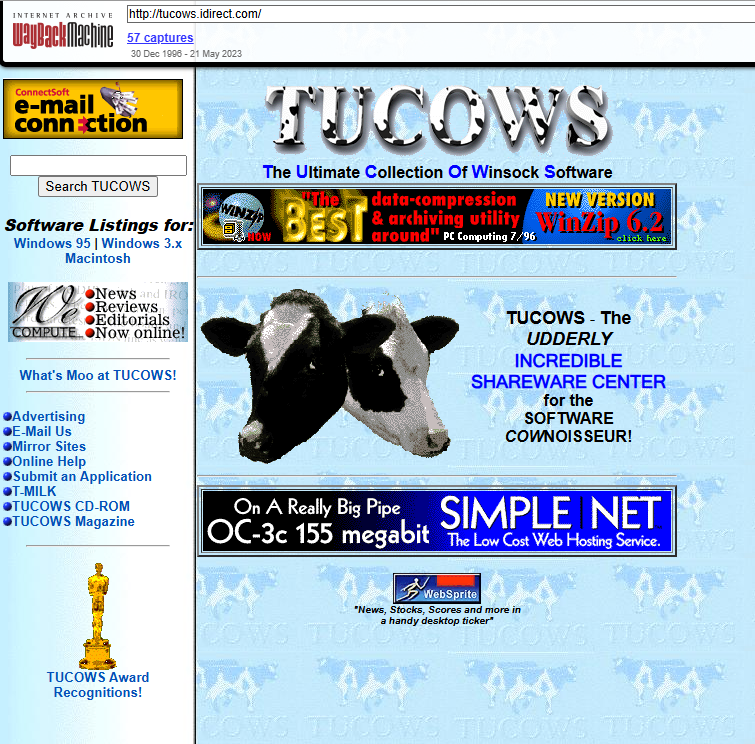
For those who are interested in a bit of Internet trivia, it is a little-known fact that Tucows did not start off as a domain name registrar. In fact, I remember downloading software from Tucows long before it was a domain name registrar. Tucows was originally founded in 1993 as a shareware and freeware software download site. It was tremendously popular back in the day. Tucows was an acronym for The Ultimate Collection Of Winsock Software – T.U.C.O.W.S., and had nothing to do with cows except for the branding. This is what it looked like back in the day:
Today, Tucows is one of the largest domain name registrars, with a reported 29 million domain names under management and is very active in all aspects of ICANN multistakeholder governance.
Conclusory Allegations of Common Law Trademark Rights are Insufficient
Magenta Line, LLC v. Sipan Babertsyan / DEXATEL OU, NAF Claim Number: FA2506002160574
<magenta-line .com>
Panelist: Ms. Karen J. Bernstein
Brief Facts: The Complainant is the owner of the unregistered trademark for MAGENTA LINE for Carrier services, including SMS, voice, and software development services. The Complainant claims it has been using the MAGENTA LINE common law trademark since 2010. The Complainant alleges that the Respondent is a former employee of Dexatel OÜ, a company affiliated through common ownership with the Complainant. During his employment at Dexatel, the Respondent served as Chief Technology Officer and was granted administrative access to a shared account that managed the domain names <dexatel .com> and <magenta-line .com>. His access to the shared account was strictly role-based, and at no time was he authorized to alter administrative control or transfer account ownership.
Shortly before the termination of his contract on December 4, 2023, the Respondent changed the administrative contact email associated with the account from a Dexatel corporate address to his personal Gmail address, without disclosure or authorization. After his departure, he rejected formal access recovery requests and refused to cooperate. His continued control of the disputed Domain Name blocks the Complainant from using the domain for essential business operations. The Respondent did not formally respond to the Complaint or address any of the allegations contained in the Complaint, but instead requested that these proceedings be deferred or dismissed in light of the Dexatel matter.
Held: The threshold challenge for the Complainant is that it lacks a registered trademark and does not offer persuasive evidence that its claimed unregistered MAGENTA LINE mark has “become a distinctive identifier which consumers associate with the complainant’s goods and/or services.” In Policy terms, a complainant must offer detailed and specific evidence to demonstrate that an unregistered mark has acquired distinctiveness or secondary meaning. Conclusory allegations of unregistered or common law rights, even if undisputed in the particular UDRP case, does not normally suffice to show secondary meaning.
The Complainant owns no federal trademark registrations and adduces no evidence other than a 2018 Certificate of Formation and an unsigned LLC Agreement, to show that the unregistered MAGENTA LINE mark for Carrier services, including SMS, voice, and software development services has achieved secondary meaning. These two documents do not evidence that the MAGENTA LINE name has acquired distinctiveness. See Navigo Energy Inc. v. Andreas Meier and toptarget .com BV, NAF FA0310000206312 (the “Policy was intended solely to protect registered and unregistered trademarks and not trade names because trade names are not universally protected as are trademarks”).
Claim Denied
Complainant’s Counsel: Lilit Yeghiazaryan, Estonia
Respondent’s Counsel: No Formal Response
Case Comment by ICA General Counsel, Zak Muscovitch: Complainants without registered trademarks must prove common law trademark rights. In the present case, the Panel noted the absence of “detailed and specific evidence to demonstrate that an unregistered mark has acquired distinctiveness or secondary meaning” and dismissed the Complaint. We sometimes see this unfortunate technical failure by Complainants.
As noted in UDRP Perspectives at 1.1, for a Panel to award common law rights to any expression, thereby granting it the same status as a registered trademark, without proper evidence would be improper and unjust. To support a claim of common law trademark rights, the Complainant should present strong and serious evidence of constant use by the Complainant and recognition of the trademark from the customers of the associated goods or services. Proof of common law trademark rights cannot be based on conclusory allegations. A Complainant will have failed to establish common law rights in its mark where it makes mere assertions of such rights, which are insufficient without accompanying evidence to demonstrate that the public identifies a Complainant’s mark with a Complainant’s products.
Panelist’s Independent Research Revealed Respondent’s Registration Predated Complainant Trademark Rights
Farmbot Holdings Pty Ltd v. Christian Sampson, WIPO Case No. D2025-2145
<ranchbot .com>
Panelist: Mr. Jeremy Speres
Brief Facts: The Complainant, founded in 2000, offers water technology solutions and services to farmers. It has operated in the United States under its RANCHBOT mark, with its website hosted at the domain name <ranch-bot .com>. The Complainant’s RANCHBOT mark is registered in various jurisdictions, that includes International registration dated July 21, 2021, designating the United States. The disputed Domain Name was registered on May 2, 2014, and currently redirects to <brandabledomains .com>, which in turn resolves to a “403 Forbidden” error page. The Complainant’s evidence establishes that on June 1, 2023, the disputed Domain Name redirected to a website which stated: “Min offer 10 BTC”.
The Complainant alleges in response to the Procedural Order No. 1 that it has been using the trademark since at least 2021 and that the evidence suggests that the Respondent acquired the disputed domain after the trademark right accrued in 2023. The Complainant further alleges that the disputed Domain Name was registered and used in bad faith to profit from its well-known mark, noting the Respondent’s extortionate offer to sell the domain for USD $500,000, which exceeded the good faith valuation, and described this as an extortionate tactic. The Respondent did not reply to the Complainant’s contentions.
Held: The disputed domain was registered in 2014, while the Complainant registered <ranch-bot .com> in 2020 and began using the RANCHBOT mark and filed for trademark in 2021. In Procedural Order No. 1, the Panel invited the Complainant to provide more evidence which would demonstrate the Complainant’s earliest unregistered trademark rights. The Complainant’s response was to claim that, because the only evidence of active use of the disputed Domain Name was its redirection to a website in 2023 offering it for sale, it is reasonable to infer that the Respondent only acquired the disputed Domain Name shortly before this use in 2023. No further evidence supporting the contention that the Respondent acquired the disputed Domain Name after the Complainant obtained trademark rights was provided.
In accordance with its powers of independent research articulated under Rules, the Panel has considered publicly available WhoIs history records for the disputed Domain Name. These indicate that the current Respondent, with the same name and email address, has owned the disputed Domain Name since at least as early as 2015, long before the Complainant began using its mark or acquired registered trademark rights. Further, there is no evidence in the record indicating how the Respondent could have been aware, at the time it registered or acquired the disputed Domain Name either in 2014 or 2015, of the Complainant’s intentions to adopt its RANCHBOT mark in 2021. Given the conjunctive nature of the bad faith element, requiring both bad faith registration and bad faith use, the Complaint cannot succeed.
RDNH: The Complainant’s trademark rights, and first usage of its mark, long postdate registration or acquisition of the disputed Domain Name by the Respondent, and the Complainant is represented by counsel, which are both relevant factors supporting a finding of RDNH. WIPO Overview 3.0, section 4.16. However, the Complainant’s argument that the disputed Domain Name was only acquired by the Respondent shortly before the disputed Domain Name was used in 2023 is not entirely without supporting evidence. Ultimately the evidence did not support a firm conclusion in the Complainant’s favor on this point, which impacts the outcome of the case.
The Complainant alleges the Respondent once offered the domain for USD $500,000. Although no evidence was provided, the Panel finds this claim plausible since the domain previously redirected to a sales page. If the Respondent did indeed offer the disputed Domain Name to the Complainant, then this may at least provide some support for the Complainant’s apparent belief that the disputed Domain Name was registered with a view to selling it to the Complainant, although the Panel has no evidence before it and makes no findings in this regard. This all suggests that it is possible that the Complainant genuinely believed this to be a case of cybersquatting.
Complaint Denied
Complainant’s Counsel: McCoy Russell LLP, United States
Respondent’s Counsel: No Response
Case Comment by ICA General Counsel, Zak Muscovitch: In this case the Panelist noted the absence of evidence supporting the Complainant’s reliance on common law trademark rights and issued a Procedural Order “to provide information regarding its claimed unregistered trademark rights”. This approach is an option for Panelists, as is dismissal and dismissal without prejudice. Deciding which approach to take may depend on the particular circumstances of a case. Where there is no Response filed, it may militate in favour of a Procedural Order, provided that the Respondent is given an opportunity to respond to the Procedural Order. Where however, a Response is filed, allowing a Complainant to correct its faulty case would likely be unfair to the Respondent who has already responded to the original allegations and therefore a dismissal may be more appropriate. A dismissal without prejudice is an option that stands midway between a Procedural Order and a dismissal. It may be appropriate to dismiss without prejudice and thereby enable a Complainant to refile where no Response has been filed and where it appears to the Panelist that but for inadvertence or oversight, evidence of common law trademark rights appears to have been available but was not filed.
There was another very interesting aspect of this case. The Complainant had claimed that it “was reasonable to infer that the Respondent only acquired the disputed domain name shortly before [the Respondent’s first use of the Domain Name] in 2023, but provided “no further evidence supporting the contention that the Respondent acquired the disputed domain name after the Complainant obtained trademark rights was provided”. The Panel could have therefore dismissed the Complaint on the basis that the Complainant did not prove that its trademark rights pre-existed the Respondent’s Domain Name registration. Instead, the Panel “in accordance with its powers of independent research articulated inter alia in paragraphs 10 and 12 of the Rules…considered publicly available WhoIs history records for the disputed domain name” and found that “these [records] indicate that the current Respondent, with the same name and email address, has owned the disputed domain name since at least as early as 2015, long before the Complainant began using its mark or acquired registered trademark rights”. As such, the Panel was able to conclusively determine that contrary to the inference urged by the Complainant, the Respondent could not have registered the Domain Name in bad faith”. There is something to be said for this investigatory approach as it resulted in a conclusive determination that was based upon facts, though those facts had to be uncovered by the Panelist. The Respondent should have responded and disclosed those facts himself, but having not done so, the Panelist wanted to ensure that justice was done and investigated himself. The alternative would have been dismissal or dismissal without prejudice to refile. Would these alternatives better serve justice rather than getting to the bottom of the matter as the Panelist did in this case?
There are different approaches to this. Some like myself, are sticklers for the adversarial method and are generally loath for Panelists to assume any investigatory role beyond verifying trademark rights, relying solely upon the submissions of the respective parties. Under this approach, a Panel will dismiss a Complaint if the evidence is not there rather than look for it to assist a Complainant who has the onus even in a no-Response case. On the other hand, even in common law jurisdiction court proceedings under the adversarial system, a judge will sometimes find the plaintiff’s unopposed evidence wanting and adjourn a hearing to enable the Plaintiff to come back with more, rather than dismiss the motion for judgment outright. In the UDRP context, this would be akin to a Procedural Order.
This is a very interesting area where there are compelling arguments on both sides of the issue and is therefore worthy of further consideration and debate. In any event, credit to the Panel for not accepting an unsupported inference urged by the Complainant and for trying to avoid a miscarriage of justice in this case.
About the Editor:
 Ankur Raheja is the Editor-in-Chief of the ICA’s new weekly UDRP Case Summary service. Ankur has practiced law in India since 2005 and has been practicing domain name law for over ten years, representing clients from all over the world in UDRP proceedings. He is the founder of Cylaw Solutions.
He is an accredited panelist with ADNDRC (Hong Kong) and MFSD (Italy). Previously, Ankur worked as an Arbitrator/Panelist with .IN Registry for six years. In a advisory capacity, he has worked with NIXI/.IN Registry and Net4 India’s resolution professional.